
 100% FREE ACCESS
6th Standard CBSE Syllabus & Materials
6th Standard CBSE
CBSE 6th Social Science The Value of Work - New Sample Question Papers Study Material - QB365 Set A
NEW6th Standard CBSE
CBSE 6th Social Science Family and Community - New Sample Question Papers Study Material - QB365 Set A
NEW6th Standard CBSE
CBSE 6th Social Science India's Cultural Roots - New Sample Question Papers Study Material - QB365 Set A
NEW6th Standard CBSE
CBSE 6th Social Science India,That is Bharat - New Sample Question Papers Study Material - QB365 Set A
NEW6th Standard CBSE
CBSE 6th Social Science Timeline and sources of history - New Sample Question Papers Study Material - QB365 Set A
NEW6th Standard CBSE
CBSE 6th Social Science Oceans and Continents - New Sample Question Papers Study Material - QB365 Set A

Published on: 24/10/2025
Download CBSE Class 6th Standard CBSE Science question papers, sample papers, important questions, and previous year solved papers in PDF format. Get free study materials, NCERT solutions, and exam preparation resources for Class 6th Standard CBSE Science
Questions + Answers key
Take MCQ Science Test
1.
Show an experiment which proves that light always travels in a straight line.
2.
Differentiate between a luminous and non-luminous objects.
3.
Suggest any two means for the conversion of a transparent glass sheet into a translucent sheet.
4.
Differentiate between a shadow and an image.
5.
Can you think of creating a shape that would give a circular shadow, if held in one way and a rectangular shadow, if held in another way?
6.
Distinguish between transparent and translucent object
7.
What do you understand by incandescent body?
8.
Compare pinhole image with the shadow of some objects.
9.
Shadow of flying aeroplane cannot be seen on the earth. Explain why.
10.
Mention the name of an object which partially allows the light to pass through it.
11.
A shadow is formed when light falls on alan ________ object.
12.
Light travels in a _________ line.
13.
Light helps us to__________________objects.
14.
When we look into____________ mirror, our left hand looks like right hand. This process is called__________
15.
Never try to look_________________at the sun.
16.
__________________material passes light partially.
17.
Shadows are formed by _________________object.
18.
________________is natural source of light.
19.
You will see the shortest shadow of yourself in sunlight__________.
in the morning
at noon
in the evening
in the night
20.
Image of sun through a pinhole camera can be seen as:
Long
Cylindrical
Circular
Any of these
21.
Image formed by a pinhole camera is :
Inverted
Erect
Laterally inverted
Black and white
22.
Shadows give us the information regarding the
size of the object
surface
shape of the object
shape of the source
23.
Bouncing back of ray of light from shining surface on which it was incident is known as
refraction
bending
reflection
dispersion
24.
Which of the following is not always necessary to observe a shadow?
Sun
Screen
Source of light
Opaque object
25.
A student observes a tree given in figure through a pinhole camera. Which of the diagrams given in figure. (a) to (d) depicts the image seen by her correctly?


26.
What is a shadow? Explain a simple process for shadow formation.
27.
A football match is being played at night in a stadium with flood lights ON. You can see the shadow of a football kept at the ground but cannot see its shadow when it is kicked high in the air. Explain.
28.
What is reflection?
29.
How does light travel?
30.
What are transparent materials?
31.
Is shadow two dimensional or three dimensional?
32.
Name a living luminous source of light
1.
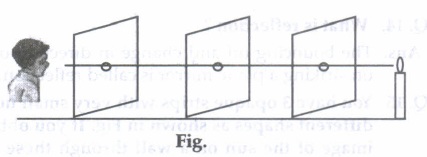
The light always travels in a straight line. This can be shown by performing a simple activity. For this, first of all let us take three cardboards of equal size. Now, a hole is made'at the centre of each cardboard at the same level. The three cardboard are placed on a flat table and aligned linearly as shown in the figure.
A candle is lighted at one end of the table with its flame at the level of the holes and is seen at the other end. It is observed that the light of the candle is seen effortlessly. Now, the middle one of the three cardboards is displaced from its position. Now, we are unable to see the light. The reason behind this is that the light travelling in the straight line is obstructed due the misalignment of the cardboards. This proves that light always travels in a straight line
2.
Luminous objects are those objects which emit the light of their own e.g. the stars, the sun, burning candle, etc. While non-luminous objects are those objects which do not emit light of their own, e.g. Blackboard, moon, earth, etc.
3.
The two ways through which a transparent glass sheet can be converted into a translucent sheet are
(i) If one side of butter paper gets covered, then a transparent glass sheet turns into a translucent one.
(ii) By smearing a thin layer of oil.
4.
The dark patch of light is known as a shadow which is formed when there is an opaque object in the path of light.
When an image is the reflection of light. By seeing image, we can identify the object but shadow can mislead you from actual object.
5.
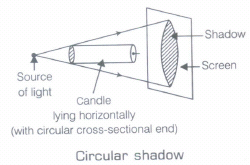
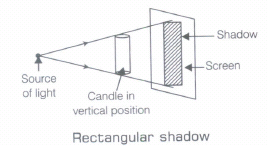
Yes, there are many things that could give a circular shadow if held in one way and a rectangular shadow, if held in another way, e.g. a cylindrical object, a pencil, a candle, etc.
(i) Getting a circular shadow of a candle (which is cylindrical in shape), when it is laid down horizontally
(ii) Getting a rectangular shadow of a candle while in standing or in vertical position.
6.
| S.No | Translucent object | Transparent object |
|---|---|---|
| (a) | They allow the light to pass partially through them. | Allow light to pass through them completely. |
| (b) | Objects can be seen, but not dearly | Objects can be seen clearly. |
| (c) | Butter paper and wax paper are examples of objects. | Glass and Air are examples of objects. |
7.
If we make a metal red hot, it emits light. This is called incandescent body
8.
The pinhole images are inverted while the shadow is different from it.
9.
Shadow of flying aeroplane cannot be seen on the earth because umbra region cannot able to reach the earth.
10.
The object which partially allows the light to pass through it is a translucent Object, e.g. wax paper.
11.
()
opaque
12.
()
straight
13.
()
see
14.
()
plane, lateral inversion
15.
()
directly
16.
()
Translucent
17.
()
opaque
18.
()
Sun
19.
(b)
at noon
20.
(c)
Circular
21.
(a)
Inverted
22.
(c)
shape of the object
23.
(c)
reflection
24.
(a)
Sun
25.
(d)
26.
Opaque objects do not allow light to pass through them. When an opaque object is placed in the path of light, then the light is obstructed by the object leading to the formation of a dark patch known as the shadow of that object, which can be taken on a screen placed behind it.
Shadow formation: To form a shadow, there must be (i) a light source (ii) a screen (iii) an opaque object placed between the light source and the screen. For shadow formation, we can follow the given steps
Step 1: Take an opaque object.
Step 2: Throw light on it from a light source.
Step 3: Put a screen behind the object. In this way, a shadow of an object can be obtained on the screen.
In this way, a shadow of an object can be obtained on the screen.
27.
The shadow of the object cannot be caught if the screen and the object are very far from each other. This is the same case, the shadow of the football cannot be seen on the ground when it is kicked high in the air. This happens because if we take the object away and away from the screen, the image becomes smaller and smaller and a time comes when it disappears from the screen.
28.
()
The bouncing off and change in direction of light on striking a plane mirror is called reflection
29.
()
Light travels in a straight line
30.
()
Materials that allow light to pass through them are called transparent materials. We can see clearly through them. For example. Glass.
31.
()
Two dimensional.
32.
()
Jugnu, firefly

6th Standard CBSE Syllabus & Materials
6th Standard CBSE
CBSE 6th Social Science Locating Places on the Earth - New Sample Question Papers Study Material - QB365 Set A
NEW6th Standard CBSE
CBSE 6th Science A Journey Through States of Water - New Sample Question Papers Study Material - QB365 Set A
NEW6th Standard CBSE
CBSE 6th Science Temperature and its Measurement - New Sample Question Papers Study Material - QB365 Set A
NEW6th Standard CBSE
CBSE 6th Science Materials Around Us - New Sample Question Papers Study Material - QB365 Set A



NCERT Books

Syllabus

Exam Pattern

Sample Question Papers

Previous year Question Papers

Important Notes

MCQ Practice test

NCERT Exemplers

Case study Questions

Image Based Questions

Passage based Questions

HOT Questions

Value Based Questions

Model Questions Papers
NCERT ( Book Back ) Questions

Assertion and Reason
Important Questions And Answers

CBSE 6th Standard CBSE Subjects
CBSE Standards


