
 100% FREE ACCESS
6th Standard CBSE Syllabus & Materials
6th Standard CBSE
CBSE 6th Social Science The Value of Work - New Sample Question Papers Study Material - QB365 Set A
NEW6th Standard CBSE
CBSE 6th Social Science Family and Community - New Sample Question Papers Study Material - QB365 Set A
NEW6th Standard CBSE
CBSE 6th Social Science India's Cultural Roots - New Sample Question Papers Study Material - QB365 Set A
NEW6th Standard CBSE
CBSE 6th Social Science India,That is Bharat - New Sample Question Papers Study Material - QB365 Set A
NEW6th Standard CBSE
CBSE 6th Social Science Timeline and sources of history - New Sample Question Papers Study Material - QB365 Set A
NEW6th Standard CBSE
CBSE 6th Social Science Oceans and Continents - New Sample Question Papers Study Material - QB365 Set A

Published on: 24/10/2025
Download CBSE Class 6th Standard CBSE Science question papers, sample papers, important questions, and previous year solved papers in PDF format. Get free study materials, NCERT solutions, and exam preparation resources for Class 6th Standard CBSE Science
Questions + Answers key
Take MCQ Science Test
1.
A carpenter is fixing a curtain rod on the wall by tightening a screw. How many different kinds of motions is the screw undergoing?
2.
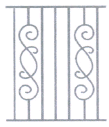
The photograph given in figure shows a section of a grille made up of straight and curved iron bars. How would you measure the length of the bars of this section so that the payment could be made to the contractor?
3.
Four children measure the length of a table which was about 2 m. Each of them used different ways to measure it.
(a) Shyam measured it with a half metre long thread.
(b) Gurmeet measured it with a 15 cm scale from her geometry box.
(c) Reena measured it using her handspan.
(d) Salim measured it using a 5 m long measuring tape.
Which one of them would get the most accurate length? Give reasons for your answer.
4.
The height of a person is 1.65 m. Express it into cm and mm.
5.
Arrange the following lengths in their increasing magnitude.
1 metre, 1 centimetre, 1 kilometre, 1 millimetre
6.
How would you decide whether an object is in motion or at rest?
7.
How can we use a string to measure distances less then the length of the string?
8.
Name the type of motion possessed by planet around the sun.
9.
Give the name of the device used to measure girth of a tree.
10.
State whether the hour hand of a wall clock is at rest or in motion.
11.
What is measurement?
12.
How many mm3 are there in 1 cm3 ?
13.
What is the current system of measurement of length ?
14.
What is straight line motion?
15.
What is motion?
16.
The length of a curved line can be measured by using a___________________
17.
A plucked string of a sitar executes ________________motion.
18.
2000 cm is equal to ________________metre.
19.
Motion of the needle of a sewing machine is ____________________
20.
Five kilometre is ___________m
21.
The object which does not change its position time is said to be at rest.
22.
A cloth merchant uses a meter rod to measure the length of the cloth.
23.
A flying bird in the sky is at rest.
24.
An elastic tape cannot give a true measurement.
25.
One metre is equal to 1000 cm.
26.
A flying kite's motion in the sky is :
Linear motion
Circular motion
Random motion
Vibrational motion
27.
An example of rectilinear motion is
Afree falling apple from tree
A stone thrown downward with force
Astone throw horizontally with great force
None of these
28.
1 metre is equal to :
10 cm
10 decimetre
10 decametre
None of these
29.
One decametre is equal to
10cm
10mm
10m
10km
30.
Find the odd one out:
Rotation of earth about its axis
Tabla surface
Blades of rotating fan
Moving vehicle on straight road
31.
A ball rolling on the ground represents
rectilinear motion
rotational motion
Both (a) and (b)
None of the above
32.
You are provided three scales A, B and C as shown in figure to measure a length of 10 cm.
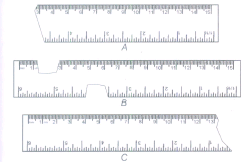
For the correct measurement of the length, you will use the scale
only A
only B
only C
Any of the three scales
33.
Bholu and Golu are playing in a ground. They start running from the same point A in the ground and reach point B at the same time by following the paths marked 1 and 2, respectively as shown in the figure. Which of the following is true for the given situation?
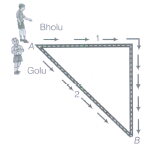
As compared to Golu, Bholu covers a
longer distance but with a lower speed
longer distance with a higher speed
shorter distance with a lower speed
shorter distance with a higher speed
34.
Which of the following does not express a time interval?
A day
A second
A school period
Time of the first bell in the school
35.
The distance between Delhi and Mumbai is usually expressed in the unit of
decametre
metre
centimetre
kilometre
36.
How can we find the length of a curved line? Explain.
37.
It is not accurate to measure a length with elastic tapes. Explain why.
38.
How are the motions of a wheel of a moving bicycle and a mark on the blade of a moving electric fan different? Explain.
39.
While travelling in a train, it appears that the trees near the track are moving whereas co-passengers appear to be stationary. Explain the reason.
1.
The screw undergoes two kinds of motions, i,e., circular and periodic motions
2.
To measure the length of bars of grille, straight part of iron bar is measured directly with measuring tape and curved part. It first measured with thread, then after measuring tape is used to measure the length of thread.
3.
(d) Shyam will measure it most accurately because of the following reasons
(i) Length 2 m which he want to measure can be measured using this scale only in a single attempt.
(ii) This scale is standard scale and will measure the correct measurements. Other scales given are either non-standard or having the length less than the length we want to measure.
4.
Given, height of a person = 1.65 m
We know that
1 metre (m)= 100 centimetre (cm)
1 metre (m) = 1000 millimetre (mm)
(a) The height of a person in cm = 1.65x 100 cm = 165 cm
(b) The height of a person in mm = 1.65x 1000 mm = 1650 mm
5.
We know that
1 kilometre (km) = 1000 metre (m)
1 metre (m) = 100 centimetre (cm)
1 centimetre (cm) = 10 millimetre (mm)
Hence, increasing order of given units is as follows:
1 millimetre <1 centimetre <1 metre <1 kilometre
6.
An object is said to be at rest when it does not change its position with time. While an object is said to be in motion when it changes its position with time.
7.
By marking 1/2, 1/4and 1/8 of string length
8.
The motion possessed by the planets around the sun is circular motion.
9.
The device which is used to measure girth of a tree is a measuring tape.
10.
Due to the changing position of hour hand of a wall clock, it always be in motion.
11.
()
The comparison of an unknown quantity with a standard known quantity is known as measurement.
12.
()
1 cm = 10mm
1 cm3 = 10mm x 10mm x 10mm = 1000mm3.
13.
()
SI system
14.
()
When a body moves in a straight line, it is called rectilinear motion
15.
()
If a body moves from its position, then it is said to be in motion.
16.
()
thread or measuring tape
17.
()
periodic oscillatory
18.
()
20
19.
()
periodic motion
20.
()
5000
21.
(a)
22.
(a)
23.
(b)
24.
(a)
25.
(b)
26.
(c)
Random motion
27.
28.
(b)
10 decimetre
29.
(c)
10m
30.
(d)
Moving vehicle on straight road
31.
(c)
Both (a) and (b)
32.
(d)
Any of the three scales
33.
(b)
longer distance with a higher speed
34.
(d)
Time of the first bell in the school
35.
(d)
kilometre
36.
Draw a curved line CD. Take a thread and make a knot at one of its ends. Keep the knot made in the thread on point C of the line. Place a small portion of the thread along the line, keeping it tight using your fingers and thumb. Keep on stretching the thread on the curved line till you take the thread to the point D of the line. Make a mark on the thread where it touches the other end of the line at point D. Now, stretch the thread along a metre scale and the length between the knot in the beginning and mark on the thread is measured through scale. This measured length on scale will give you the length of the curved line CD.
37.
Elastic tapes are stretchable due to which their length can be increased during the measurement if it is not handle with care. Therefore, the measurement done by elastic tapes may be greater than the actual length of the object. So, we can say that elastic tapes are not accurate to measure a length.
38.
The motions of a wheel of a moving bicycle and a mark on the blade of a moving electric fan are different in the following ways.
| S.No. | Wheel of moving bicycle | Work on the blade of electric fan |
| 1 | The motion is rotational and circular both. | The motion is circular |
| 2 | It changes position while doing circular motion. | It cannot change its position. |
| 3 | It can execute rectilinear motion. | It cannot execute rectilinear motion |
| 4 | It can cover some distances in any time interval. | It cannot cover any distance. |
39.
While travelling, trees near the track same to be moving back (i.e. opposite to the direction of motion of a train) because there is a relative motion between outside trees and moving train. While in case of co-passengers, the relative motion between we and co-passengers, is zero, so it appears to be stationary.

6th Standard CBSE Syllabus & Materials
6th Standard CBSE
CBSE 6th Social Science Locating Places on the Earth - New Sample Question Papers Study Material - QB365 Set A
NEW6th Standard CBSE
CBSE 6th Science A Journey Through States of Water - New Sample Question Papers Study Material - QB365 Set A
NEW6th Standard CBSE
CBSE 6th Science Temperature and its Measurement - New Sample Question Papers Study Material - QB365 Set A
NEW6th Standard CBSE
CBSE 6th Science Materials Around Us - New Sample Question Papers Study Material - QB365 Set A



NCERT Books

Syllabus

Exam Pattern

Sample Question Papers

Previous year Question Papers

Important Notes

MCQ Practice test

NCERT Exemplers

Case study Questions

Image Based Questions

Passage based Questions

HOT Questions

Value Based Questions

Model Questions Papers
NCERT ( Book Back ) Questions

Assertion and Reason
Important Questions And Answers

CBSE 6th Standard CBSE Subjects
CBSE Standards


