
 100% FREE ACCESS
6th Standard CBSE Syllabus & Materials
6th Standard CBSE
CBSE 6th Social Science The Value of Work - New Sample Question Papers Study Material - QB365 Set A
NEW6th Standard CBSE
CBSE 6th Social Science Family and Community - New Sample Question Papers Study Material - QB365 Set A
NEW6th Standard CBSE
CBSE 6th Social Science India's Cultural Roots - New Sample Question Papers Study Material - QB365 Set A
NEW6th Standard CBSE
CBSE 6th Social Science India,That is Bharat - New Sample Question Papers Study Material - QB365 Set A
NEW6th Standard CBSE
CBSE 6th Social Science Timeline and sources of history - New Sample Question Papers Study Material - QB365 Set A
NEW6th Standard CBSE
CBSE 6th Social Science Oceans and Continents - New Sample Question Papers Study Material - QB365 Set A

Published on: 24/10/2025
Download CBSE Class 6th Standard CBSE Science question papers, sample papers, important questions, and previous year solved papers in PDF format. Get free study materials, NCERT solutions, and exam preparation resources for Class 6th Standard CBSE Science
Questions + Answers key
Take MCQ Science Test
1.
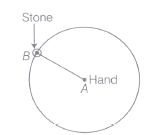
Boojho is not sure why we say that the distance of the stone from your hand is same when we whirl it around. Can you help him understand this? Remember that stone is held with string.
2.
Describe in detail that how do the thickness of a thin wire can be determined.
3.
Briefly explain the type of motion performed by the earth.
4.
Give two examples of periodic motion.
5.
The height of a person is 1.65 m. Express it into cm and mm.
6.
Explain how did people know how far they have travelled.
7.
During rolling of a ball, which type of motion is performed?
8.
Give the name of the motion that simple pendulum exhibits.
9.
Give the name of the device used to measure girth of a tree.
10.
Mention the two contributions in 20th century towards transportation.
11.
Different modes of___________________ are used to go from one place to another.
12.
The metric system for measurement was created by the_________________
13.
A plucked string of a sitar executes ________________motion.
14.
A body repeating its motion after certain interval of time is in______________ motion.
15.
Motion of a wheel of a bicycle is ________________
16.
Motion of a child on a swing is_________________
17.
A cloth merchant uses a meter rod to measure the length of the cloth.
18.
The SI unit of distance is cm.
19.
From a broken meter scale, measurement can be done from zero mark.
20.
Motion of earth about its own axis is rotatory.
21.
One metre is equal to 1000 cm.
22.
A ball rolling on the ground represents
rectilinear motion
rotational motion
Both (a) and (b)
None of the above
23.
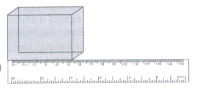
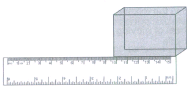
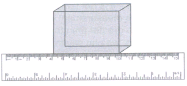
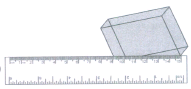
Which of the following figure shows the correct placement of a block along a scale for measuring its length?
24.
Which of the following does not express a time interval?
A day
A second
A school period
Time of the first bell in the school
25.
The distance between Delhi and Mumbai is usually expressed in the unit of
decametre
metre
centimetre
kilometre
26.
Boojho was riding in his bicycle along a straight road. He classified the motion of various parts of the bicycle as (a) rectilinear motion (b) circular motion and (c) both rectilinear as well as circular motion. Can you list one part of the bicycle for each type of motion? Support your answer with reason.
27.
How are the motions of a wheel of a moving bicycle and a mark on the blade of a moving electric fan different? Explain.
1.
Distance is actually defined as length or space between two places. It is clear from the diagram that when we whirl the stone, the space or length between points A and B, i.e. between hand and stone does not change.
Hence, distance is same.
2.
First of all, take a round pencil and try to wrap the given wire round the pencil making.
25 turns forming a coil. Now, measure the length of the wire that turns formed coil. Divide the total length of the coil by number of turns. This is the thickness of the Wire.
3.
The earth performs two types of motion. One of the motions is when it moves around the sun, then it is said to possess circular motion and on the other hand, it also rotates about its own axis called rotational motion.
4.
Two examples of periodic motions are
(i) Motion of the earth around the sun
(ii) To and fro movement of bob of a pendulum
5.
Given, height of a person = 1.65 m
We know that
1 metre (m)= 100 centimetre (cm)
1 metre (m) = 1000 millimetre (mm)
(a) The height of a person in cm = 1.65x 100 cm = 165 cm
(b) The height of a person in mm = 1.65x 1000 mm = 1650 mm
6.
By measuring distance by a particular standard unit of measurement, we can measure how far they have travelled.
7.
Rotational and rectilinear motion are performed during the rolling of a ball.
8.
Periodic motion is exhibited by the simple pendulum.
9.
The device which is used to measure girth of a tree is a measuring tape.
10.
The two contributions in 20th century towards transportation is electric trains and supersonic aeroplanes.
11.
()
transport
12.
()
French
13.
()
periodic oscillatory
14.
()
periodic
15.
()
circular motion
16.
()
periodic motion
17.
(a)
18.
(b)
19.
(b)
20.
(a)
21.
(b)
22.
(c)
Both (a) and (b)
23.
(c)
24.
(d)
Time of the first bell in the school
25.
(d)
kilometre
26.
(a) Rectilinear motion The handle of bicycle will always move in rectilinear path because it cannot do circular or rotatory motion.
(b) Circular motion The Paddles of bicycle will always move circularly around its chain fixing system because it cannot move in forward direction without the whole chain system.
(c) Both rectilinear and circular The wheels of bicycle will move in rectilinear as well as in circular motion because the wheel as a whole will move forward and its point or particles around the rim will execute circular motion.
27.
The motions of a wheel of a moving bicycle and a mark on the blade of a moving electric fan are different in the following ways.
| S.No. | Wheel of moving bicycle | Work on the blade of electric fan |
| 1 | The motion is rotational and circular both. | The motion is circular |
| 2 | It changes position while doing circular motion. | It cannot change its position. |
| 3 | It can execute rectilinear motion. | It cannot execute rectilinear motion |
| 4 | It can cover some distances in any time interval. | It cannot cover any distance. |

6th Standard CBSE Syllabus & Materials
6th Standard CBSE
CBSE 6th Social Science Locating Places on the Earth - New Sample Question Papers Study Material - QB365 Set A
NEW6th Standard CBSE
CBSE 6th Science A Journey Through States of Water - New Sample Question Papers Study Material - QB365 Set A
NEW6th Standard CBSE
CBSE 6th Science Temperature and its Measurement - New Sample Question Papers Study Material - QB365 Set A
NEW6th Standard CBSE
CBSE 6th Science Materials Around Us - New Sample Question Papers Study Material - QB365 Set A



NCERT Books

Syllabus

Exam Pattern

Sample Question Papers

Previous year Question Papers

Important Notes

MCQ Practice test

NCERT Exemplers

Case study Questions

Image Based Questions

Passage based Questions

HOT Questions

Value Based Questions

Model Questions Papers
NCERT ( Book Back ) Questions

Assertion and Reason
Important Questions And Answers

CBSE 6th Standard CBSE Subjects
CBSE Standards


