
 100% FREE ACCESS
6th Standard CBSE Syllabus & Materials
6th Standard CBSE
CBSE 6th Social Science The Value of Work - New Sample Question Papers Study Material - QB365 Set A
NEW6th Standard CBSE
CBSE 6th Social Science Family and Community - New Sample Question Papers Study Material - QB365 Set A
NEW6th Standard CBSE
CBSE 6th Social Science India's Cultural Roots - New Sample Question Papers Study Material - QB365 Set A
NEW6th Standard CBSE
CBSE 6th Social Science India,That is Bharat - New Sample Question Papers Study Material - QB365 Set A
NEW6th Standard CBSE
CBSE 6th Social Science Timeline and sources of history - New Sample Question Papers Study Material - QB365 Set A
NEW6th Standard CBSE
CBSE 6th Social Science Oceans and Continents - New Sample Question Papers Study Material - QB365 Set A

Published on: 24/10/2025
Download CBSE Class 6th Standard CBSE Science question papers, sample papers, important questions, and previous year solved papers in PDF format. Get free study materials, NCERT solutions, and exam preparation resources for Class 6th Standard CBSE Science
Questions + Answers key
Take MCQ Science Test
1.
A carpenter is fixing a curtain rod on the wall by tightening a screw. How many different kinds of motions is the screw undergoing?
2.
Describe three rules to measure length.
3.
Give two examples of each of the following mode of transport used by humans- (a) Land, (b) Water, (c) Air
4.
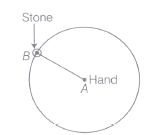
Boojho is not sure why we say that the distance of the stone from your hand is same when we whirl it around. Can you help him understand this? Remember that stone is held with string.
5.
Mamta is measuring a piece of wood with broken meter scale. Her friend Kanchan correct her by measuring it from any full mark of meter
(a) State the values that Kanchan reflect here.
(b) Give one correct way for measurement.
6.
We need standard unit of measurements for a quantity. Explain why.
7.
Can an object be in motion and rest simultaneously for different observers? Give an example and consequence.
8.
Write the similarities and differences between the motion of a bicycle and a ceiling fan that has been switched on.
9.
The distance between Radha's home and her school is 3250 m. Express this distance into km.
10.
Give two examples each of modes of transport used on land, water and air.
11.
What are the inexact methods of measurement?
12.
The height of a person is 1.965 m. Express it in cm and mm.
13.
Name two devices that are used to measure length.
14.
When you are travelling in plane, are you in motion or rest?
15.
How do people know how far they have travelled?
16.
Correct the following.
(a) The motion of a swing is an example of rectilinear motion.
(b) 1 m = 1000 cm
17.
Mention some modes of transportation of ancient times.
18.
Give the name of the device used to measure girth of a tree.
19.
Name one process of ancient times which is used to measure the length.
20.
Give the name of the motion possessed by the vehicles on a straight road.
21.
A piece of ribbon folded five times is placed along 30 cm long measuring scale as shown in Fig.

The length of the ribbon is between
1.15 cm - 1.25 cm
1.25 cm - 1.35 cm
1.50 cm -1.60 cm
1.60 cm - 1.70 cm
22.
Motion of Potter's wheel is:
Circular
Rotational
Oscillatory
Periodic
23.
Which of the following is not a combination of two motions?
Movement of bicycle
Movement of a player on ground
Motion of a ball on ground
Rotation of earth.
24.
An example of rectilinear motion is
Afree falling apple from tree
A stone thrown downward with force
Astone throw horizontally with great force
None of these
25.
Find the odd one out:
Rotation of earth about its axis
Tabla surface
Blades of rotating fan
Moving vehicle on straight road
26.
Curved length can be measured by :
Metre scale
Cubit
Measuring tape
All of these
27.
A ball rolling on the ground represents
rectilinear motion
rotational motion
Both (a) and (b)
None of the above
28.
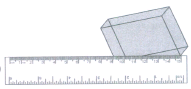
Which of the following figure shows the correct placement of a block along a scale for measuring its length?
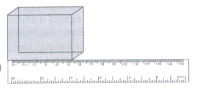
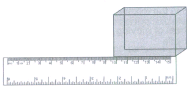
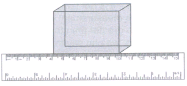
29.
Which of the following does not express a time interval?
A day
A second
A school period
Time of the first bell in the school
30.
The distance between Delhi and Mumbai is usually expressed in the unit of
decametre
metre
centimetre
kilometre
31.
How can we find the length of a curved line? Explain.
32.
Three students measured the length of a corridor and reported their measurements. The values of their measurements were different. What could be the reason for difference in their measurements? (Mention any three)
33.
How are the motions of a wheel of a moving bicycle and a mark on the blade of a moving electric fan different? Explain.
34.
While travelling in a train, it appears that the trees near the track are moving whereas co-passengers appear to be stationary. Explain the reason.
1.
The screw undergoes two kinds of motions, i,e., circular and periodic motions
2.
(i) Length of the scale, that you are using to measure, must be greater than the length of the object.
(ii) The eye must be placed just above the point, that you are reading, otherwise there will be an error due to parallax.
(iii) If the zero mark of the scale is damaged or the edge of the scale is not smooth, then start the measurement from another mark
3.
(a) Land-motorcycle, car.
(b) Water-Boat, steamer.
(c) Air-Aeroplane, helicopter.
4.
Distance is actually defined as length or space between two places. It is clear from the diagram that when we whirl the stone, the space or length between points A and B, i.e. between hand and stone does not change.
Hence, distance is same.
5.
(a) Kanchan is intelligent, helping and has good knowledge of subject.
(b) One correct way for measuring from broken scale is to start from full marks.
6.
We need standard unit of measurements because the unit like handspan, foot, cubit differ from person to person or even indifferent countries. So, for a uniform measurement, standard unit of measurement is really required.
7.
Yes, a person driving a car is in rest with respect to other person in car but in motion with respect to a person standing roadside. State of motion and rest depends upon observer or reference point.
8.
Similarities are given below
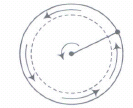
(i) The wheels of a bicycle and a ceiling fan execute a rotational motion on a fixed axis.
(ii) The particles of both exhibit circular motion except the particles at the centre.
Differences are given below
(i) Bicycle changes its position while exhibiting circular motion but a ceiling fan does not change its position.
(ii) Bicycle can execute rectilinear motion with translational motion but ceiling fan does not execute rectilinear motion.
9.
Given, distance between Radha's home
and her school = 3250 m
We know that
1 km = 1000m
\(\therefore 1m ={1\over 1000}km\)
Now, the distance between Radha's home and her school in km
\( = 3250 \times {1\over 1000}={3250\over 1000}\)
= 3.25 km
10.
There are mainly three modes of transport which are given below:
(i) Land transports Those transports that run on land are called land transports, e.g. bus and truck.
(ii) Water transports Those transports that run on water are called water transports, e.g. boat and ship.
(iii) Air transports Those transports that run in air are called air transports, e.g. aeroplane and helicopter.
11.
Foot, handspan and arm length are used to measure the length. These are inexact methods of measurement.
12.
1m = 100em = 1000 mm
\(\therefore\)The height of the given person in cm is
= 1.965 x 100 = 196.5 cm
\(\therefore\)The height of the given person in mm is
= 1.965 x 1000 = 1.965 mm.
13.
The two devices that are used to measure length are:
(i) Metre-scale (ii) Screw gauge.
14.
Relative two earth, we are in motion and relative to plane or any other thing in plane, we are at rest
15.
By measuring distance by a particular standard unit of measurement.
16.
(a) The motion of a swing is an example of periodic motion.
(b) 1 m = 100 cm
17.
In ancient times, there were some modes of transportation like bullock cart, horse cart, camel cart, etc.
18.
The device which is used to measure girth of a tree is a measuring tape.
19.
Handspan is a process which is used to measure the length in ancient times.
20.
Rectilinear motion is the motion possessed by the vehicles on a straight road.
21.
(c)
1.50 cm -1.60 cm
22.
(b)
Rotational
23.
(b)
Movement of a player on ground
24.
25.
(d)
Moving vehicle on straight road
26.
(c)
Measuring tape
27.
(c)
Both (a) and (b)
28.
(c)
29.
(d)
Time of the first bell in the school
30.
(d)
kilometre
31.
Draw a curved line CD. Take a thread and make a knot at one of its ends. Keep the knot made in the thread on point C of the line. Place a small portion of the thread along the line, keeping it tight using your fingers and thumb. Keep on stretching the thread on the curved line till you take the thread to the point D of the line. Make a mark on the thread where it touches the other end of the line at point D. Now, stretch the thread along a metre scale and the length between the knot in the beginning and mark on the thread is measured through scale. This measured length on scale will give you the length of the curved line CD.
32.
The reasons may be as follows
(i) Their scales of measurement may not be standard or they may be using different scales of measurement.
(ii) The length of the scale may not be proper, i.e. the length of scale may be shorter ·than the length they want to measure.
(iii) There may be some errors in the scale which they are using or they may not be using the correct method of observing the scale.
33.
The motions of a wheel of a moving bicycle and a mark on the blade of a moving electric fan are different in the following ways.
| S.No. | Wheel of moving bicycle | Work on the blade of electric fan |
| 1 | The motion is rotational and circular both. | The motion is circular |
| 2 | It changes position while doing circular motion. | It cannot change its position. |
| 3 | It can execute rectilinear motion. | It cannot execute rectilinear motion |
| 4 | It can cover some distances in any time interval. | It cannot cover any distance. |
34.
While travelling, trees near the track same to be moving back (i.e. opposite to the direction of motion of a train) because there is a relative motion between outside trees and moving train. While in case of co-passengers, the relative motion between we and co-passengers, is zero, so it appears to be stationary.

6th Standard CBSE Syllabus & Materials
6th Standard CBSE
CBSE 6th Social Science Locating Places on the Earth - New Sample Question Papers Study Material - QB365 Set A
NEW6th Standard CBSE
CBSE 6th Science A Journey Through States of Water - New Sample Question Papers Study Material - QB365 Set A
NEW6th Standard CBSE
CBSE 6th Science Temperature and its Measurement - New Sample Question Papers Study Material - QB365 Set A
NEW6th Standard CBSE
CBSE 6th Science Materials Around Us - New Sample Question Papers Study Material - QB365 Set A



NCERT Books

Syllabus

Exam Pattern

Sample Question Papers

Previous year Question Papers

Important Notes

MCQ Practice test

NCERT Exemplers

Case study Questions

Image Based Questions

Passage based Questions

HOT Questions

Value Based Questions

Model Questions Papers
NCERT ( Book Back ) Questions

Assertion and Reason
Important Questions And Answers

CBSE 6th Standard CBSE Subjects
CBSE Standards


