
 100% FREE ACCESS
6th Standard CBSE Syllabus & Materials
6th Standard CBSE
CBSE 6th Social Science The Value of Work - New Sample Question Papers Study Material - QB365 Set A
NEW6th Standard CBSE
CBSE 6th Social Science Family and Community - New Sample Question Papers Study Material - QB365 Set A
NEW6th Standard CBSE
CBSE 6th Social Science India's Cultural Roots - New Sample Question Papers Study Material - QB365 Set A
NEW6th Standard CBSE
CBSE 6th Social Science India,That is Bharat - New Sample Question Papers Study Material - QB365 Set A
NEW6th Standard CBSE
CBSE 6th Social Science Timeline and sources of history - New Sample Question Papers Study Material - QB365 Set A
NEW6th Standard CBSE
CBSE 6th Social Science Oceans and Continents - New Sample Question Papers Study Material - QB365 Set A

Published on: 07/12/2018
The Central Board of Secondary Education (CBSE) is a prestigious educational board which comes under the Union Government of India. Here, you will get the clue that from where and how the questions are being framed from the chapter Electricity and Circuits for CBSE Class 6 Science. These questions can provide students with a chapter wise preparation strategy so that they can prepare for their exam more efficiently.
The National Council of Education and Training sets the curriculum for all schools that follow the Central Board of Secondary Education (CBSE) across the nation. The important questions provided below will also make students familiar with the marking scheme and the difficulty level of the exam. The important questions for CBSE class 6 Science are prepared by subject experts according to the latest syllabus of CBSE. Students are advised to solve these important questions which can make them more focused on their exam and also bring a sense of discipline and seriousness in their exam preparation.
Creative questions were added in this question paper in order to enhance the student's knowledge and get the idea that how to answer strategic questions asked in the board exams. This question paper is designed based on the academic syllabus. Sample papers should be practised in examination condition at home or school and also show it to your teachers for checking or compare with the answers provided.
Download CBSE Class 6th Standard CBSE Science question papers, sample papers, important questions, and previous year solved papers in PDF format. Get free study materials, NCERT solutions, and exam preparation resources for Class 6th Standard CBSE Science
Questions + Answers key
Take MCQ Science Test
1.
How does an electric cell produce electricity?
2.
Sita is operating an base electric wire so that its electric iron can be used safely. Her friend Vimlesh advised her not to do so without plastic gloves.
(a) Mention the values that Vimlesh shows here.
(b) A plastic glove is an insulator or conductor.
3.
Why do bulbs have two terminals?
4.
As we know that silver is the best conductor of electricity instead of this we use copper and aluminium. Why?
5.
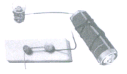
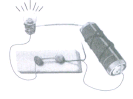
Complete the drawing shown in the figure to indicate where the free ends of the two wires should be joined to make the bulb glow.
6.
Due to Sudden power failure in Ravi's house, he lighted three candles. He placed one of them in the drawing room, second in the kitchen for his mother and third one in his grandmother's room as she was ailing and bed-ridden.
(i) What is the importance of light in one's life?
(ii) What is the chemical transformation in a candle?
(iii) What values are exhibited by Ravi?
7.
Why is it compulsory to keep a fire extinguisher near the meter room of housing societies?
8.
How can you explain that the human body is a good conductor of electricity?
9.
Name two insulators and two conductors.
10.
Paheli wanted to glow a torch bulb using a cell. She could not get connecting wires instead she got two strips of aluminium foil. Will she succeed? Explain how.
11.
Think of six activities which use electric current Also name the devices used to perform the activity.
| Activity you perform | Device | |
|---|---|---|
| Example: | Get light | Torch |
| ___________ | ....................... | |
| ___________ | ....................... | |
| ___________ | ....................... | |
| ___________ | ....................... | |
| ___________ | ....................... |
12.
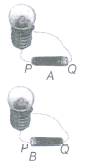
In figures A and B, show a bulb connected to a cell in two different ways.
(a) Mention the direction of the current through the bulb in both the cases (Q to P or P to Q)?
(b) Will the bulb glow in both the cases?
(c) Does the brightness of the glowing bulb depend on the direction of current through it?
13.
What is used in making or breaking a circuit?
Plug
Battery
Wire
Switch
14.
Non-metals like________ and ____________ are good conductors of electricity.
Wood and paper
Graphite and gas carbon
Glass and rubber
None of these
15.
Which of these uses a chemical reaction to produce an electric current?
An electric generator
A dry cell
Wind mill
Al lof these
16.
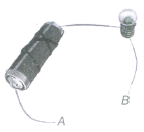
In the following arrangement shown in figure, the bulb will not glow if the ends A and B are connected with
a steel spoon
a metal clip
a plastic clip
a copper wire
17.
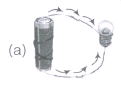
Choose the figure from the options (a), (b), (c) and (d) given below which shows the correct direction of current.
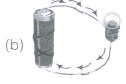
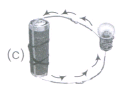
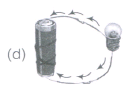
18.
In the circuit shown in figure, when the switch is moved to ON position.
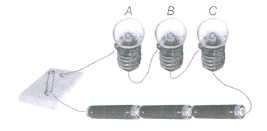
the bulb A will glow first
the bulb B will glow first
the bulb C will glow first
all bulbs will glow together
19.
In an electric bulb, light is produced due to the glowing of
the glass case of the bulb
the thin filament
the thick wires supporting the filament
gases inside glass case of the bulb
20.
Dry cell converts electrical energy into chemical energy.
21.

The above symbol is of switch.
22.
The device used to break an electric circuit is called________.
23.
A magnet always has _________poles.
24.
A power station provides us __________________
25.
A complete circuit contains bulb_____________ and_________________
26.
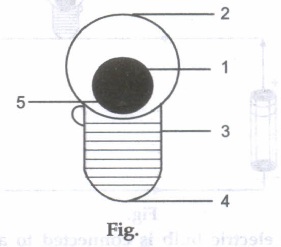
Fig. shows a bulb with its different parts marked as 1, 2, 3, 4 and 5. Which of them label the terminals of the bulb?
27.
How does an electric bulb glow?
1.
The chemical energy stored in the chemicals stored inside a cell converts into electrical energy. When the chemicals of the cell are used up, it stops producing electricity.
2.
(a) Vimlesh is intelligent and has good knowledge of current and its hazard.
(b) A plastic glove is an insulator. It does not conduct electricity.
3.
Bulb has two terminals because it is connected to the terminals of a cell or a battery so that current passes through the filament.
4.
Among copper, silver and aluminium, we use copper and aluminium not silver for household wires because copper and aluminium are much cheaper than silver and silver is used as an ornaments and is also heavier than copper and aluminium.
5.
To complete the circuit, we must join the one end of the wire with the free end of cell. The other end of wire must be connected with the bulb. Now, the bulb will glow.
6.
(i) Light helps us to see an object.
(ii) It converts chemical energy into light energy.
(iii) The values exhibited by Ravi are caring, love and presence of mind.
7.
It is compulsory to keep a fire extinguisher near the meter room of housing societies so that it can be used easily to douse electric fires caused by electric sparks.
8.
Human body is a good conductor of electricity because if we stand barefoot on the ground and touch an electric wire, we will get an electric shock.
9.
The two insulators are:
(i) Plastic (ii) Rubber
The two conductors are:
(i) Aluminium (ii) Copper
10.
Yes, she will succeed because aluminium is a conductor of electricity, it will complete the electrical circuit and bulb will glow.
11.
| Activity you perform | Device |
|---|---|
| (1) Get light | Torch |
| (2) Get the hot water | Geyser |
| (3) Get the cold water | Refrigerator |
| (4) Get the moving air | Fan |
| (5) Do the mechanical work | Motor |
| (6) Watch movies | Television |
12.
(a) The direction of current will be from Q to P in A and direction of current will be from P to Q in B. Because direction of current is always from positive terminal to negative terminal of the cell or battery.
(b) Yes, the bulb will glow in both the cases because to glow the bulb, we just need to complete the circuit.
(c) No, the brightness of the bulb never depend upon the direction of current passing through it.
13.
(d)
Switch
14.
(b)
Graphite and gas carbon
15.
(b)
A dry cell
16.
(c)
a plastic clip
17.
(b)
18.
(d)
all bulbs will glow together
19.
(b)
the thin filament
20.
(b)
21.
(b)
22.
()
switch
23.
()
two
24.
()
electricity
25.
()
switch, cell
26.
()
Label 3 and 4 show the terminals of the bulb.
27.
()
When current passes through filament, it gets red hot and emits light.

6th Standard CBSE Syllabus & Materials
6th Standard CBSE
CBSE 6th Social Science Locating Places on the Earth - New Sample Question Papers Study Material - QB365 Set A
NEW6th Standard CBSE
CBSE 6th Science A Journey Through States of Water - New Sample Question Papers Study Material - QB365 Set A
NEW6th Standard CBSE
CBSE 6th Science Temperature and its Measurement - New Sample Question Papers Study Material - QB365 Set A
NEW6th Standard CBSE
CBSE 6th Science Materials Around Us - New Sample Question Papers Study Material - QB365 Set A



CBSE 6th Standard CBSE Subjects
CBSE Standards




