
 100% FREE ACCESS
6th Standard Syllabus & Materials
6th Standard
TN 6th Tamil பருவம் 1 - இயல் 1 - மொழி -தமிழ்த்தேன் - இன்பத்தமிழ் Sample Question Papers Study Material - QB365 Set A
NEW6th Standard
TN 6th English T1 - Supplementary - The Apple Tree and The Farmer Sample Question Papers Study Material - QB365 Set A
NEW6th Standard
TN 6th English T1 - Prose - When The Trees Walked Sample Question Papers Study Material - QB365 Set A
NEW6th Standard
TN 6th Social Science T3 - CIV - Road Safety Sample Question Papers Study Material - QB365 Set A
NEW6th Standard
TN 6th Social Science T3 - CIV - Local Bodies - Rural and Urban Sample Question Papers Study Material - QB365 Set A
NEW6th Standard
TN 6th Social Science T3 - CIV - Democracy Sample Question Papers Study Material - QB365 Set A

Published on: 28/12/2018
SECOND SUMMATIVE IMPORTANT 5 MARKS
Download Tamil Nadu 6th Standard Science question papers, model tests, one-mark questions, important questions, and public exam papers in PDF format. Free study materials and answer keys for TN State Board students.
Questions + Answers key
Take MCQ Science Test1.
Label the diagram given below to show the four main parts of the urinary system and answer the following questions.
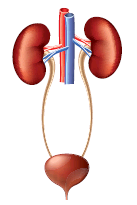
A. Which organ removes extra salts and water from the blood?
B. Where is the urine stored?
C. What is the tube through which urine is excreted out of the body?
D. What are the tubes that transfer urine from the kidneys to the urinary bladder called?
2.
Tabulate any five cell organelles and their function.
3.
Why is atmosphere essential for life on earth?
4.
Write short notes on conductors and insulators.
5.
What is the source of electricity? Explain the various power stations in India?
6.
Explain thermal expansion with suitable examples.
7.
Why do we hiccup and cough sometimes when we swallow food?
8.
When a candle is lit the following changes are observed.
a. Wax melts.
b. Candle keeps burning.
c. The size of the candle decreases.
d. The molten wax solidifies
e. Which of the changes can be reversed? Justify your answer.
9.
If you heat a circular disk with a hole, what change do you expect in the diameter of the hole? Remember that the effect of heating increases the separation between any pair of particles.
10.
When a window is accidentally left open on a winter night, will you feel uncomfortable because the cold is getting in, or because the heat is escaping from the room?
1.
A. Kidneys removes extra salts and water from the blood
B. The urine is stored in Urinary bladder
C. Through urethra urine is excreted out of the body.
D. Ureter transfer urine from the kidneys to the urinary bladder.
2.
| Cell Organelles | Main Functions |
|---|---|
| Cell wall | Surrounds and protects the cell. Make the cell stiff and strong. |
| Cell membrane | Holds and protects the cell. Controls the movement of materials in and out of the cell. |
| Cytoplasm | A watery gel - like material in which cell parts move. |
| Mitochondria | Produce and supply most of the energy for the cell. |
| Chloroplasts | Capture the energy from sunlight and use it to produce food for the cell by photosynthesis. |
3.
A huge envelope of air surrounded the earth is called Atmosphere.
(i) This envelope is thicker near the earth's surface.
(ii) As we go higher up, the density and the availabillty of air gradually decreases.
(iii) Movement of wind, Presence of water vapours for cloud formation are the vital roles of atmosphere.
(iv) Troposphere is the responsible layer for the weather we experience on earth.
(v) Stratosphere has the Ozone layer which protects all life on earth from the harmful UV rays of the sun.
4.
Conductors:
(i) The rate of flow of electric charges in a circuit is called electric current.
(ii) The materials which allow electric charges to pass through them are called conductors.
(iii) Examples: Copper, iron, aluminium, impure water, eafth etc.
Insulators (Non -Conductors) :
(i) The material which do not allow electric charges to pass through them are called insulators or non- conductors.
(ii) Examples: plastic, glass, wood, rubber, chinna clav, ebonite etc.
5.
We get electricity from thermal power, hydel power, tidal power wind power, solar power etc as sources of electricity
Thermal Power stations:
In thermal power stations, the thermal energy generated by burning coal, diesel or gas is used to produce steam. The steam is used to rotate the turbine. While the turbine rotates, the coil of wire kept between the electromagnet rotates. Due to electro magnetic induction electricity is produced. Here heat energy is converted into electrical energy.
Hydel power stations:
In hydel power stations, the turbine is made to rotate by the flow of water from dams to produce electricity. Here kinetic energy is converted into electrical energy. Hydel stations have long economic lives and low operating cost.
Atomic power stations:
In atomic power stations, nuclear energy is used to boil water. Here the steam is used to rotate the turbine. As a result, electricity is produced. Atomic power stations are also called as nuclear power stations. Here nuclear energy is converted into mechanical energy and then electrical energy.
Wind Mills:
In wind mills, wind energy is used to rotate the turbine to produce electricity. Here kinetic energy is converted into electrical energy.
6.
The expansion of substance on heating is called, the thermal expansion of that substance
(i) Gaps are left in between rails while laying railway track :
So that there is enough margin for the tracks to expand and contract due to the temperature changes. If that gap is not left then the tracks might have enormous stress in them while expanding due to heat, which can damage them.
(ii) Gaps are left in between two joints of a concrete bridge:
Thermal expansion takes place due to the increase in the kinetic energy of the constituent molecules as they are heated. Thermal expansion is the reason we leave some gaps between section of h concrete bridge.
7.
While swallowing food if the food particles enter into respiratory tract leads to hiccup and cough to eject out the food particles from respiratory tract.
8.
a) melting of wax and
d) Solidification of the molten wax can be reversed.
Burning of candle is a physical / reversible change. That is,
\(\text { Solid wax } \underset{\text { Cooling }}{\stackrel{\text { Heating }}{\rightleftarrows}} \text { molten wax }\)
9.
Many of us expect that diameter of hole will decrease, but actually as the diameter of ring increases diameter of hole will also increase.
10.
The heat is escaping from the room because the room temperature is higherthan atmosphere. Heat energy flows from higher temperature to lower temperature.

6th Standard Syllabus & Materials
6th Standard
TN 6th Social Science T3 - GEO - Understanding Disaster Sample Question Papers Study Material - QB365 Set A
NEW6th Standard
TN 6th Social Science T3 - GEO - Globe Sample Question Papers Study Material - QB365 Set A
NEW6th Standard
TN 6th Social Science T3 - GEO - Asia and Europe Sample Question Papers Study Material - QB365 Set A
NEW6th Standard
TN 6th Social Science T3 - HIS - South Indian Kingdoms Sample Question Papers Study Material - QB365 Set A



Tamilnadu Stateboard 6th Standard Subjects
Tamilnadu Stateboard Standards




