
 100% FREE ACCESS
6th Standard CBSE Syllabus & Materials
6th Standard CBSE
CBSE 6th Social Science The Value of Work - New Sample Question Papers Study Material - QB365 Set A
NEW6th Standard CBSE
CBSE 6th Social Science Family and Community - New Sample Question Papers Study Material - QB365 Set A
NEW6th Standard CBSE
CBSE 6th Social Science India's Cultural Roots - New Sample Question Papers Study Material - QB365 Set A
NEW6th Standard CBSE
CBSE 6th Social Science India,That is Bharat - New Sample Question Papers Study Material - QB365 Set A
NEW6th Standard CBSE
CBSE 6th Social Science Timeline and sources of history - New Sample Question Papers Study Material - QB365 Set A
NEW6th Standard CBSE
CBSE 6th Social Science Oceans and Continents - New Sample Question Papers Study Material - QB365 Set A

Published on: 27/07/2018
Based on the chapter Food: Where does it Come from?. some of the important questions are prepared in this question paper.
For parents, Please subscribe and get the plenty of question with answer for your children practice. For Subscription please Click here.
Download CBSE Class 6th Standard CBSE Science question papers, sample papers, important questions, and previous year solved papers in PDF format. Get free study materials, NCERT solutions, and exam preparation resources for Class 6th Standard CBSE Science
Questions + Answers key
Take MCQ Science Test
1.
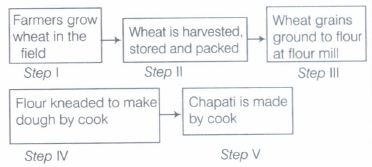
Wheat is staple food in Northern India. We make chapati from flour obtained from wheat grains (atta). Show various contributions involved till the chapati is made (through a flow chart).
2.
Give a reason as to why the food culture in different regions of our country is different.
3.
Food habits of people living in South India are different from others. What are they?
4.
Why do organisms need food? Write two reasons.
5.
If you are given moong dal grains. How will you make the sprouts from them?
6.
Name five plants and their parts that we eat.
7.
Things that are used to make food item are known as ________________ .
8.
The major sources of food are___________ and ___________ .
9.
We get sugar from ___________ .
10.
Pulses are rich sources of proteins, usually cooked. Is there a way to consume pulses raw?
11.
Out of all identified parts, name the part of the plants that we eat generally.
12.
Name three edible parts of the plant.
13.
An animal shows inclination towards eating a particular type of food item. What does this indicate?
14.
Cooking of food is necessary. Why?
15.
Flowers of which plants are used as vegetables?
16.
Rajni went to Chennai to visit her friend. She noticed that the climate was very hot and the food available was so different than at home. Coconut is used extensively and rice is included in all meals. Her friend's mother explained these differences to Rajni.
(a) What changes were observed by Rajni in regard with food habits?
(b) Food habits of all places are different. What do you understand by food habits?
(c) List one dish commonly made in South India. Identify its ingredients, and separate plant and animal derived ingredients.
(d) Do you observe any values in Rajni? Name them.
17.
Given figure shows some insects and a place where it collects its food.
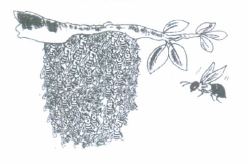
(a) Name the insect and the place where it lives as shown in the figure.
(b) What is the food of this insect?
(c) How does it help farmers while collecting its food?
(d) Name the product we collect from this insect.
(e) Name the nutritive constituents of the insect.
18.
One of the following food is not obtained from animals. The food is
honey
milk
maize
mutton
19.
Select one of the following that is a cereal.
Rice
Tea
Onion
Beans
20.
The part of a banana plant not used as food is
flower
fruit
stem
root
21.
We get eggs from
goose
buffalo
bee
goat
22.
Honeybee makes honey from
pollen
petals
nectar
bud
23.
All nutrients can be obtained from one kind of food only.
24.
We get sugar from sugarbeet.
1.
A flow chart shows various contributions involved till the chapati is made.
2.
People living in different regions of our country use different methods of cooking food depending upon the availability of food products, e.g. in Northern India, wheat is grown, so people eat chapati as a staple food, where as in South India, people are rice eaters because rice is produced there in large quantity.
3.
South India being close to sea, provides plenty of sea animal products like fish, etc. Chiefly grown cereal there is rice.
So, the people there mainly eat rice, fish, meat, etc. Vegetarians make idli, sambhar, uttapam, banana chips, coconut chutney. They use coconut oil as a cooking medium.
4.
Food is needed by organisms for the following reasons
(i) Food provides us energy to perform various functions of body to sustain life.
(ii) Food helps us to protect the body against various diseases and infections.
5.
We will soak a handful of moong dal in water overnight. In the morning, we will drain out water and wrap seeds in wet cotton cloth for one more day. Third day, the seeds will show sprouts which are edible and good source of proteins and minerals.
6.
Five plants and their parts that we eat, are
| Plant | Eating part |
| Carrot | Roof |
| Spinach | Leaf |
| Wheat | Seed |
| Brinjal | Fruit |
| Potato | Stern |
7.
()
ingredients
8.
()
plants, animals
9.
()
sugarcane
10.
Yes, sprouting of pulses can be done. In this form, pulses are highly nutritious.
11.
We generally eat fruit of many plants.
12.
Roots, fruits and leaves are edible parts in different plants.
13.
Inclination to eat particular type of food is called food habit.
14.
We cook food so that it can be used by our body easily.
15.
Pumpkin flowers are used as vegetables.
16.
(a) Food habits of people in Chennai were different as they used coconut oil for cooking and coconut is extensively used in preparing other dishes. Rice was part of every meal, they consume less or no chapatis.
(b) Food habits refer to particular interest towards certain types of food. It is commonly influenced by location, climate and availability.
(c) Sambhar dal is very common. Its main ingredients are dal, condiments, vegetables and oil. All of these ingredients are plant products.
(d) Rajni is friendly, observant and knowledge seeking girl. She is aware of her surroundings which is very important.
17.
(a) The insect is 'honeybee'. Its place is 'beehive'.
(b) This insect feeds on pollens and nectar of flowers.
(c) Honeybee visits the flowers and it brings about pollination while collecting its food, thus helps the farmers, setting is facilitated.
(d) We collect honey from beehive.
(e) Honey is rich in sugars, enzymes and minerals. We use it as a food.
18.
(c)
maize
19.
(a)
Rice
20.
(d)
root
21.
(a)
goose
22.
(c)
nectar
23.
(b)
24.
(a)

6th Standard CBSE Syllabus & Materials
6th Standard CBSE
CBSE 6th Social Science Locating Places on the Earth - New Sample Question Papers Study Material - QB365 Set A
NEW6th Standard CBSE
CBSE 6th Science A Journey Through States of Water - New Sample Question Papers Study Material - QB365 Set A
NEW6th Standard CBSE
CBSE 6th Science Temperature and its Measurement - New Sample Question Papers Study Material - QB365 Set A
NEW6th Standard CBSE
CBSE 6th Science Materials Around Us - New Sample Question Papers Study Material - QB365 Set A



CBSE 6th Standard CBSE Subjects
CBSE Standards




