
 100% FREE ACCESS
6th Standard CBSE Syllabus & Materials
6th Standard CBSE
CBSE 6th Social Science The Value of Work - New Sample Question Papers Study Material - QB365 Set A
NEW6th Standard CBSE
CBSE 6th Social Science Family and Community - New Sample Question Papers Study Material - QB365 Set A
NEW6th Standard CBSE
CBSE 6th Social Science India's Cultural Roots - New Sample Question Papers Study Material - QB365 Set A
NEW6th Standard CBSE
CBSE 6th Social Science India,That is Bharat - New Sample Question Papers Study Material - QB365 Set A
NEW6th Standard CBSE
CBSE 6th Social Science Timeline and sources of history - New Sample Question Papers Study Material - QB365 Set A
NEW6th Standard CBSE
CBSE 6th Social Science Oceans and Continents - New Sample Question Papers Study Material - QB365 Set A

Published on: 30/07/2018
Based on the current academic syllabus, some of the important questions are prepared from the chapter Changes Around Us.
Students, subscribe and get plenty of question paper with answer key. For subscription please click here.
Download CBSE Class 6th Standard CBSE Science question papers, sample papers, important questions, and previous year solved papers in PDF format. Get free study materials, NCERT solutions, and exam preparation resources for Class 6th Standard CBSE Science
Questions + Answers key
Take MCQ Science Test
1.
Change of a bud into a flower is a change which cannot be reversed. Give four more such examples.
2.
Name the cause of change which takes place during the
(a) conversion of ice into water.
(b) conversion of water into hydrogen and oxygen.
(c) formation of image of a person on a photographic film.
(d) bending of iron rods to make an iron grille.
3.
What is charring of sugar? State whether it is a physical change or chemical change.
4.
A potter working on his wheel-shaped a lump of clay into a pot. He then baked the pot in an oven. Do these two acts lead to the same kind of changes or different? Give your opinion and justify your
5.
Melting of wax can be reversed whereas burning of wax cannot be reversed. Explain.
6.
Give examples to explain the difference between changes that can or cannot be reversed.
7.
Rusting of iron is an example of
slow change
fast change
physical change
reversible change
8.
Which is a way to make a change happen?
Heating of substance
Mixing of substance with another substance
Cooling of substance
All of the above
9.
Iran rim is made slightly smaller than the wooden wheel. The rim is usually heated before fixing into the wooden wheel because on heating the iron rim
expands and fits onto the wooden wheel
contracts and fits onto the wooden wheel
no change in the size takes place
expands first, then on cooling contracts and fits onto the wooden wheel
10.
Salt can be separated from its solution (salt dissolved in water) because
mixing of salt in water is a change that can be reversed by heating and melting of salt
mixing of salt in water is a change that cannot be reversed
mixing of salt-in water is a permanent change
mixing of salt in water is a change that can be reversed by evaporation
11.
Pick the change that can be reversed from the following.
Cutting of trees
Melting of ghee
Burning of candle
Blooming of flower
12.
The boiling of rice is a physical change.
13.
Bursting of crackers are reversible change.
14.
When ice melts to form water, then a change occurs in its state.
15.
Rubber ball can change the shape if squeezed.
16.
A balloon increases in size when filled with air.
17.
Change in weather takes place due to____________ of the sun.
18.
Burning of paper is a ________change.
19.
Formation of rust on iron nail is a____________ change.
20.
Day and night occur due to ______________of the earth.
21.
Growth of a plant is ___________change.
22.
When the ice melts? Is it reversible?
23.
Write the changes that can be noticed in our body easily.
24.
Write the changes which cannot be reversed.
25.
Look at the figures given below, which show three situations (a) burning candle (b) an extinguished candle (c) melting wax.
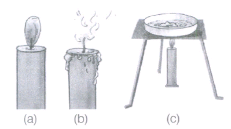
Which of these shows a reversible change and why?
26.
When a candle burns, both physical and chemical changes occur. Explain.
27.
Give one example in each case.
(a) Change which occurs on heating but can be reversed.
(b) Change which occurs on heating but cannot be reversed.
(c) Change which occurs on cooling but can be reversed.
(d) Change which occurs on mixing two substances but can be reversed.
(e) Change which occurs on mixing two substances but cannot be reversed.
1.
Changes that cannot be reversed are called irreversible changes.
Some examples are as follows:
(i) Milk into curd
(ii) Burning of wood
(iii) Ripening of fruits
(iv) Digestion of food
2.
(a) Heat
(b) Electricity
(c) Light
(d) Force
3.
When sugar is continuously heated in the porcelain dish, it becomes foggy due to water vapour. A black powdery substance is left behind which is charcoal. This process is called charring of sugar.
This is a chemical change.
4.
These two acts are of different kinds. Making a lump of clay into a pot is a reversible change, while baking the pot in an oven is an irreversible change.
5.
Melting of wax is a reversible change because solid wax melts on heating and melted wax becomes solid on cooling. Melting of wax is a change which can be reversed, whereas burning of wax is an irreversible change we cannot combine all the products of burning of wax to get back the original candle. Therefore, burning of wax is a Change which cannot be reversed.
6.
(a) Changes that can be reversed In such changes, we can go back to original state. These changes are also known as reversible changes.
Some examples are as follows:
(i) Melting of ice
(ii) Drying of clothes
(iii) Knitting of sweater
(iv) Heating of milk
(v) Stretching the rubber band
(b) Changes that cannot be reversed In such changes, we cannot go back to original state. These changes are also known as irreversible changes.
Some examples are as follows:
(i) Making curd from milk
(ii) Making flour from grain
(iii) Boiling of eggs
(iv) Growth of plants
(v) Burning of paper or wood
7.
(a)
slow change
8.
(d)
All of the above
9.
(d)
expands first, then on cooling contracts and fits onto the wooden wheel
10.
(d)
mixing of salt in water is a change that can be reversed by evaporation
11.
(b)
Melting of ghee
12.
(b)
13.
(b)
14.
(a)
15.
(a)
16.
(a)
17.
()
heat
18.
()
chemical
19.
()
chemical
20.
()
rotation
21.
()
irreversible
22.
Ice melts when it is heated. Yes, it is reversible
23.
The changes that can be noticed in our body easily are
(i) our nails grow and
(ii) our body growth.
24.
The two changes which cannot be reverse are
(i) Change of milk into curd.
(ii) Rusting of iron
25.
Melting of wax in (c), which on cooling, changes back to solid wax but burning candle and an extinguished candle show chemical irreversible change.
26.
Physical changes A candle is made up of wax. We take a small candle and measure its length with scale. Now fix this candle on a tile kept on table and light it with burning matchstick. Allow the candle to burn for some time. Now we absorb melting wax comes to side of candle or table. This wax is reversible and we can used this wax.
Chemical changes The wax near the flame burns and gives new substance like carbon dioxide, carbon soot, water vapours, heat and light.
27.
The example of each case is as follows:
(a) Heating of an iron rod
(b) Baking of chapati
(c) Formation of ice from water
(d) Formation of salt solution
(e) Mixing of cement and water

6th Standard CBSE Syllabus & Materials
6th Standard CBSE
CBSE 6th Social Science Locating Places on the Earth - New Sample Question Papers Study Material - QB365 Set A
NEW6th Standard CBSE
CBSE 6th Science A Journey Through States of Water - New Sample Question Papers Study Material - QB365 Set A
NEW6th Standard CBSE
CBSE 6th Science Temperature and its Measurement - New Sample Question Papers Study Material - QB365 Set A
NEW6th Standard CBSE
CBSE 6th Science Materials Around Us - New Sample Question Papers Study Material - QB365 Set A



CBSE 6th Standard CBSE Subjects
CBSE Standards




