
 100% FREE ACCESS
6th Standard CBSE Syllabus & Materials
6th Standard CBSE
CBSE 6th Social Science The Value of Work - New Sample Question Papers Study Material - QB365 Set A
NEW6th Standard CBSE
CBSE 6th Social Science Family and Community - New Sample Question Papers Study Material - QB365 Set A
NEW6th Standard CBSE
CBSE 6th Social Science India's Cultural Roots - New Sample Question Papers Study Material - QB365 Set A
NEW6th Standard CBSE
CBSE 6th Social Science India,That is Bharat - New Sample Question Papers Study Material - QB365 Set A
NEW6th Standard CBSE
CBSE 6th Social Science Timeline and sources of history - New Sample Question Papers Study Material - QB365 Set A
NEW6th Standard CBSE
CBSE 6th Social Science Oceans and Continents - New Sample Question Papers Study Material - QB365 Set A

Published on: 22/09/2018
Monthly Test
Download CBSE Class 6th Standard CBSE Science question papers, sample papers, important questions, and previous year solved papers in PDF format. Get free study materials, NCERT solutions, and exam preparation resources for Class 6th Standard CBSE Science
Questions + Answers key
Take MCQ Science Test
1.
Can you name some states of our country where cotton is grown?
2.
Why do living organisms need food?
3.
Do the people of all ages need the same type of diet?
4.
Where do bees store their food and in which from?
5.
List the following substances as soluble and insoluble in water.
Sand, sugar, vinegar, common salt, chilli, ghee.
6.
Write the basic material that is used for making fabrics (or cloth).
7.
Temperature affects the solubility of solids in liquids. Explain.
8.
Fat rich foods are harmful for us if we eat them too much. What do you think?
9.
Does preparing different food items involve addition of same ingredients? Give an example.
10.
Cooking of food is necessary. Why?
11.
Which of the following will float on water?
Mud piece
Cotton
Wood piece
Metal
12.
Which of the following vitamins gets destroyed by heat during cooking?
Vitamin A
Vitamin B
Vitamin C
Vitamin D
13.
Which of the following organisms is not an omnivore?
Goat
Cat
Cockroach
Human
14.
Which of the following materials is not lustrous?
Gold
Silver
Wood
Diamond
15.
Which statement out of the following is incorrect?
Use of charkha was popularised by Mahatma Gandhi as a part of the Independence movement
In India, jute is mainly grown in Kerala and Punjab
To make fabric, the fibres are first converted into yarns
To make fabric, the fibres are first converted into yarns
16.
In an activity, a teacher dissolved a small amount of solid copper sulphate in a tumbler half-filled with water. Which method would you use to get back solid copper sulphate from the solution?
Decantation
Evaporation
Sedimentation
Condensation
17.
Paheli bought some vegetables such as french beans, lady's finger, green chillies, brinjals and potatoes all mixed in a bag. Which of the following methods of separation would be most appropriate for her to separate them?
Winnowing
Sieving
Threshing
Handpicking
18.
Which of the following nutrients is not present in milk?
Protein
Vitamin-C
Calcium
Vitamin-D
19.
Below are the names of some animals.
(i) Cow
(ii) Sheep
(iii) Horse
(iv) Ox
Which of the above are the sources of milk for human beings?
(i) and (iii)
(i) and (ii)
(ii) and (iii)
(iii) and (iv)
20.
From the given options, choose a food obtained from animals.
Sugar
Honey
Jaggery
Jam
21.
Ice is _______ than water
22.
The property which is identified with nose is _________
23.
The component of food that does not provide any nutrient to our body and yet is essential in our food is ___________.
24.
Eating too much of fat-rich foods may lead to a condition called ________.
25.
________ is required for healthy eyes.
26.
__________ is a disease caused by a severe protein and carbohydrate deficiency in the diet.
27.
For separation of two miscible liquids we use ______
28.
Wheat and maize are the sources of _________.
29.
Man, crow and pig are _________.
30.
Animals that eat other animals are called _________.
31.
SNAKES AND LADDERS
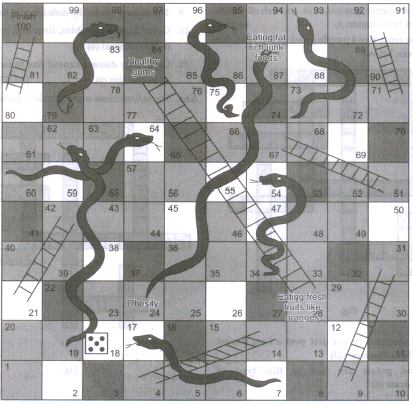
Make a board-game just like' snakes and ladders' with 10 - 10 grid boxes.
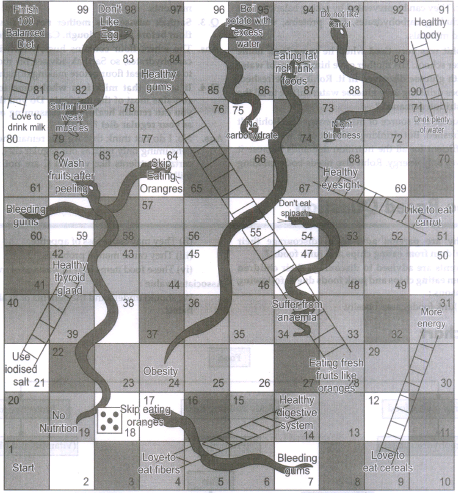
The mouth of the snake will represent the faulty food habit or faulty method of cooking. Its tail will represent the deficiency disease caused or loss of any nutrient in food.
Similarly, the box at the base of a ladder will represent healthy food habit or healthy method of cooking. Its upper end will represent the beneficial effect of that habit. An example is given as Fig. Complete the board and play with your friends.
32.
Observe the items given in fig. carefully and answer the questions that follow.
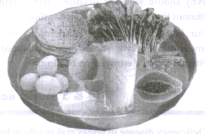
(a) Food item rich in carbohydrates is _______
(b) Egg is a rich source of protein, the mineral, ________ and vitamin _________
(c) _______ is a rich source of fat.
(d) Milk provides ________, vitamin D and ________ (mineral)
(e) _______ (fruit) is a rich source of vitamin A.
(f) Spinach is a good source of the mineral _________
(g) Both eggs and ________ are rich in ________.
1.
Cotton is grown in Punjab, Gujarat, Maharashtra, Tamil Nadu, Madhya Pradesh and Rajasthan. Warm climate and black soil are essential for growth of cotton plants.
2.
Living organisms need food for their survival, growth and to keep themselves healthy.
3.
No, the people of all ages do not need the same type of diet. It depends on the physical work done and age of a person. A growing age person needs more protein diet as compared to an old age person.
4.
Bees collect nectar from flowers and convert it into honey. The honey is stored in the beehives so as to be used throughout the year.
5.
(i) Soluble Sugar, vinegar, common salt.
(ii) Insoluble Sand, chilli, ghee.
6.
The basic material used for making fabrics (or cloth) are fibres.
7.
The solubility of solids in liquids increases with increase in temperature.
8.
Yes, it can be very harmful to eat too much fat rich foods. Unused fats get deposited in our body.
9.
Yes, some ingredients are used in preparation of various dishes, e.g. water, salt and oil.
10.
We cook food so that it can be used by our body easily.
11.
(c)
Wood piece
12.
(c)
Vitamin C
13.
(a)
Goat
14.
(c)
Wood
15.
(c)
To make fabric, the fibres are first converted into yarns
16.
(b)
Evaporation
17.
(d)
Handpicking
18.
(b)
Vitamin-C
19.
(b)
(i) and (ii)
20.
(b)
Honey
21.
()
lighter
22.
()
odour
23.
()
roughage
24.
()
obesity
25.
()
Vitamin A
26.
()
Marasmus
27.
()
distillation
28.
()
Carbohydrates
29.
()
omnivores
30.
()
carnivores
31.
The solved 'snakes and ladders' board-game is given below:
32.
(a) chapati
(b) calcium, D
(c) Butter
(d) protein, calcium
(e) Papaya
(f) iron
(g) peas, proteins.

6th Standard CBSE Syllabus & Materials
6th Standard CBSE
CBSE 6th Social Science Locating Places on the Earth - New Sample Question Papers Study Material - QB365 Set A
NEW6th Standard CBSE
CBSE 6th Science A Journey Through States of Water - New Sample Question Papers Study Material - QB365 Set A
NEW6th Standard CBSE
CBSE 6th Science Temperature and its Measurement - New Sample Question Papers Study Material - QB365 Set A
NEW6th Standard CBSE
CBSE 6th Science Materials Around Us - New Sample Question Papers Study Material - QB365 Set A



CBSE 6th Standard CBSE Subjects
CBSE Standards




