
 100% FREE ACCESS
6th Standard Syllabus & Materials
6th Standard
TN 6th Tamil பருவம் 1 - இயல் 1 - மொழி -தமிழ்த்தேன் - இன்பத்தமிழ் Sample Question Papers Study Material - QB365 Set A
NEW6th Standard
TN 6th English T1 - Supplementary - The Apple Tree and The Farmer Sample Question Papers Study Material - QB365 Set A
NEW6th Standard
TN 6th English T1 - Prose - When The Trees Walked Sample Question Papers Study Material - QB365 Set A
NEW6th Standard
TN 6th Social Science T3 - CIV - Road Safety Sample Question Papers Study Material - QB365 Set A
NEW6th Standard
TN 6th Social Science T3 - CIV - Local Bodies - Rural and Urban Sample Question Papers Study Material - QB365 Set A
NEW6th Standard
TN 6th Social Science T3 - CIV - Democracy Sample Question Papers Study Material - QB365 Set A

Published on: 20/09/2019
Download Tamil Nadu 6th Standard Science question papers, model tests, one-mark questions, important questions, and public exam papers in PDF format. Free study materials and answer keys for TN State Board students.
Questions + Answers key
Take MCQ Science Test1.
Bacteria are very small _________ microorganism.
Prokaryotic
Eukaryotic
Protozoa
Acellular
2.
The study of living beings or organisms is called
Psychology
Biology
Zoology
Botany
3.
The important function of stomata is __________.
Conduction
Transpiration
Photosynthesis
Absorption
4.
Seeds from water-melon can be removed by ________
hand-picking
filtration
magnetic separation
decantation
5.
Which among the following is an oscillatory motion?
Rotation of the earth about its axis
Revolution of the moon about the earth
To and fro movement of a vibrating string
All of these.
6.
The height of a tree can be measured by
Metre scale
plastic ruler
Metre rod
measuring tape
7.
Virus can grow and multiply outside host.
8.
Paramecium is a multicelluar organism.
9.
Liquids have no fixed volume but have fixed shape.
10.
Vehicles moving with varying speeds are said to be in uniform motion
11.
Sir Isaac Newton invented Computer.
12.
Ten millimetre makes one centimetre
13.
______ is the device that uses Index number.
14.
Influenza is a ___________ disease.
15.
Tail of a bird acts as a rudder which helps to ____________.
16.
Primary organs of photosynthesis are _____________.
17.
Matter is made up of _________
18.
Gravitational force is a _________ force.
19.
500 gm = ________ kilogram.
20.
Where can we see camels in India?
21.
Define - Sedimentation
22.
Name any four input devices.
23.
Define balanced diet.
24.
Define force.
25.
What is the SI Unit of mass?
26.
Differentiate between Unicellular and Multicellular organisms.
27.
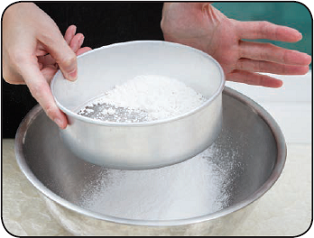
Look at the picture given below and explain the method of separation illustrated.
28.
Define mass.
29.
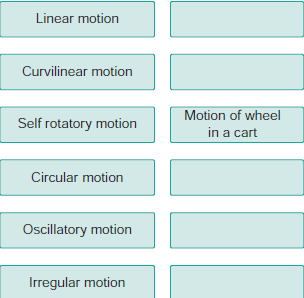
Fill with examples:
30.
Distinguish the properties of solid, liquid and gas. Draw a suitable diagram.
31.
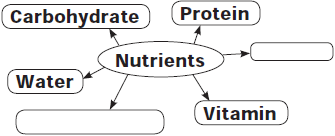
Complete the Diagram
32.
Pick out the odd one.
a. Calculator
b. Abacus
c. Flash card
d. Laptop
Calculator
Abacus
Flash card
Laptop
33.
Fourth generation Computer
34.
Vitamin E
35.
Gets compressed easily
36.

37.
Nano
38.
1 Metre, 1 centimetre, 1 kilometre, and 1 millimetre.
39.
The force which acts on an object without physical contact._______
1.
(c)
Protozoa
2.
(b)
Biology
3.
(c)
Photosynthesis
4.
(a)
hand-picking
5.
(c)
To and fro movement of a vibrating string
6.
(d)
measuring tape
7.
False Correct statement: Virus replicates only inside the cells of other living organisms
8.
False - Correct statement: Paramoecium is a multicelluar organism.
9.
False - Correct statement: Liquids have fixed volume but have no fixed shape.
10.
False.
Correct Ans: Vehicles moving with varying speeds are said to be in non-uniform motion
11.
False Correct statement: Charles Babbage invented Computer.
12.
True
13.
()
Computer
14.
()
viral (virus)
15.
()
control the direction of the movements
16.
()
leaves
17.
()
atoms
18.
()
Non Contact
19.
()
0.500
20.
We can see camels in Thar Desert,in Rajasthan State.
21.
The settling down of heavier component of a mixture when allowed to remain undisturbed for some time is called sedimentation.
22.
(i) The Keyboard
(ii) Mouse
(iii) Scanners
(iv) joysticks
23.
A balanced diet is one which contains adequate amount of al the necessary nutrienrs required for healthy growth and activity.
24.
Force is push or pull by an animate or inanimate agency.
25.
Kilogram.
26.
| S.No. | Unicellular Organisms | Multicellular Organisms |
| 1 | They are made up of single cell. | They are organisms are made up of many cells. |
| 2 | The single cell of the organism can perform all the functions of life. |
Division of labour exists among cells. Different cells are specialized to peform different functions. |
| 3 | These organisms are generally very small (microscopic) in size. |
They are mostly large in size |
| 4 | They lack tissues, organs and organ systems. |
They are composed of tissues, organs and organ system |
| 5. | Growth occurs by an increase in the size of the cell. eg. Amoeba, Paramecium and Euglena. |
Growth occurs by an increase in the number of cells by cell division. eg. Earthworms, Fish, Frogs, Lizard and human beings. |
27.
The method of separation is sieving.
(i) sieving is used when we have to separate solid particles of different sizes.
(ii) In this picture, the flour is separated from the targer sized particles.
28.
Mass is the measure of the amount of matter in an object.
29.
Linear motion - A coconut falling from a tree
Curvilinear motion - A car driving around a curve
Self rotatory motion - Motion of the wheel in a cart
Circular motion - Athlete running around a track
Oscillatory motion - Swinging of a pendulum
Irregular motion - Movement of people in a bazaar
30.
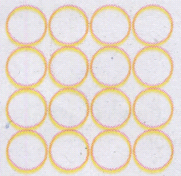
| PARTTCLES IN A SOLID |
PARTICLES IN A LIQUID | PARTICLES IN GASEOUS |
 |
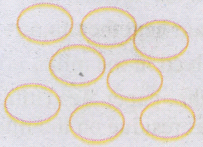 |
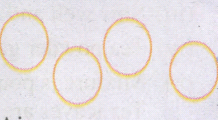 |
| S.No. | SOLID STATE | LIQUID STATE | GASEOUS STATE |
| 1. | Definite shape and volume | No definite shape, liquids attain the shape of the vessel in which they are kept. | Gases have neither a definite shape nor a definite volume. |
| 2. | Incompressible | Compressible to a small extent. | Highly compressible |
| 3. | There is little space between the particles of solid. | These particles have a greater space between them. | The space between gas particles is the greatest. |
| 4. | These particles attract each other very strongly. | The force of attraction between liquid particles is lesser than solid particles. | Thd force of attraction is least between gaseous particles. |
| 5. | Particles of solid cannot move freely. | These particles move freely. | Gaseous particles are in a continuous, random motion. |
31.
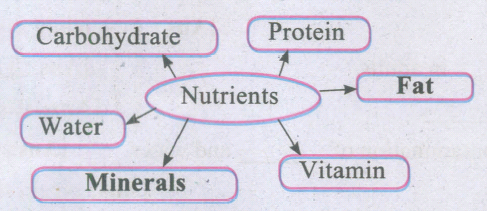
32.
c. Flash card
33.
Micro processor
34.
Sterility
35.
Cotton wool
36.
Oscillatory motion
37.
10-9
38.
1 millimetre < 1 centimetre < 1 Metre < 1 kilometre.
39.
Non contact force

6th Standard Syllabus & Materials
6th Standard
TN 6th Social Science T3 - GEO - Understanding Disaster Sample Question Papers Study Material - QB365 Set A
NEW6th Standard
TN 6th Social Science T3 - GEO - Globe Sample Question Papers Study Material - QB365 Set A
NEW6th Standard
TN 6th Social Science T3 - GEO - Asia and Europe Sample Question Papers Study Material - QB365 Set A
NEW6th Standard
TN 6th Social Science T3 - HIS - South Indian Kingdoms Sample Question Papers Study Material - QB365 Set A



Tamilnadu Stateboard 6th Standard Subjects
Tamilnadu Stateboard Standards




