
 100% FREE ACCESS
6th Standard Syllabus & Materials
6th Standard
TN 6th Tamil பருவம் 1 - இயல் 1 - மொழி -தமிழ்த்தேன் - இன்பத்தமிழ் Sample Question Papers Study Material - QB365 Set A
NEW6th Standard
TN 6th English T1 - Supplementary - The Apple Tree and The Farmer Sample Question Papers Study Material - QB365 Set A
NEW6th Standard
TN 6th English T1 - Prose - When The Trees Walked Sample Question Papers Study Material - QB365 Set A
NEW6th Standard
TN 6th Social Science T3 - CIV - Road Safety Sample Question Papers Study Material - QB365 Set A
NEW6th Standard
TN 6th Social Science T3 - CIV - Local Bodies - Rural and Urban Sample Question Papers Study Material - QB365 Set A
NEW6th Standard
TN 6th Social Science T3 - CIV - Democracy Sample Question Papers Study Material - QB365 Set A

Published on: 06/09/2019
Electricity
Download Tamil Nadu 6th Standard Science question papers, model tests, one-mark questions, important questions, and public exam papers in PDF format. Free study materials and answer keys for TN State Board students.
Questions + Answers key
Take MCQ Science Test1.
The combination of two or more cells is called a ____________.
2.
The long perpendicular line in the electrical symbol represents its ________________ terminal.
3.
____________ is the device used to close or open an electric circuit.
4.
Secondary cell can be used only once.
5.
Pure water is a good conductor of electricity.
6.
The switch is used to close or open an electric circuit.
7.
Circle the odd one out. Give reason for your choice.
Switch, Bulb, Battery, Generator.
8.
What type of circuit is there in a torch light?
9.
Can you produce electricity from lemon?
10.
Silver is a good conductor but it is not preferred for making electric wires. Why?
11.
Draw the circuit diagram for series connection.
12.
Tabulate the different components of an electric circuit and their respective symbols.
13.
What is the source of electricity? Explain the various power stations in India?
14.
In which among the following circuits does the bulb glow?
.JPG)
.JPG)
.JPG)
.JPG)
15.
Electricity is produced in
transformer
power station
electric wire
television
1.
()
Bartery.
2.
()
Positive
3.
()
Key
4.
False - Correct statement: Secondary cells can be used again and again.
5.
False - Correct statement: Pure water is a non conductor of electricity.
6.
True
7.
Switch, Bulb and Battery are the parts of the electric circuit. Generator is the source of electricity.
8.
Simple circuit is there in a torch light.
9.
yes, I can produce electricity from lemon. Because lemon juice (Acetic acid) acts like a electrolyte.
10.
Silver is not used to make electric wires because it is expensive.
11.
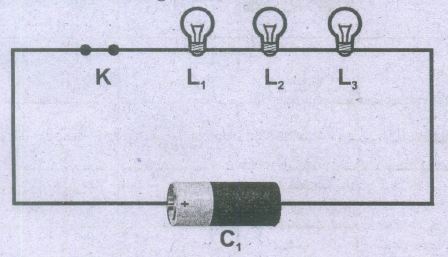
12.
| SI. No. | Electric component | Figure | Symbol | Remarks |
| 1. | Electric cell | .JPG) |
.JPG) |
Longer terminal refers positive and shorter terminal refers negative. |
| 2. | Battery | .JPG) |
.JPG) |
Two or more cells connected in series |
| 3. | Switch-open | .JPG) |
.JPG) |
Switch is in off position |
| 4. | Switch-closed | .JPG) |
.JPG) |
Switch is in on position |
| 5. | Electric bulb | .JPG) |
.JPG) |
The bulb does not glow |
.JPG) |
.JPG) |
The bulb glows | ||
| 6. | Connecting wires | .JPG) |
____________ | Used to connect devices. |
13.
We get electricity from thermal power, hydel power, tidal power wind power, solar power etc as sources of electricity
Thermal Power stations:
In thermal power stations, the thermal energy generated by burning coal, diesel or gas is used to produce steam. The steam is used to rotate the turbine. While the turbine rotates, the coil of wire kept between the electromagnet rotates. Due to electro magnetic induction electricity is produced. Here heat energy is converted into electrical energy.
Hydel power stations:
In hydel power stations, the turbine is made to rotate by the flow of water from dams to produce electricity. Here kinetic energy is converted into electrical energy. Hydel stations have long economic lives and low operating cost.
Atomic power stations:
In atomic power stations, nuclear energy is used to boil water. Here the steam is used to rotate the turbine. As a result, electricity is produced. Atomic power stations are also called as nuclear power stations. Here nuclear energy is converted into mechanical energy and then electrical energy.
Wind Mills:
In wind mills, wind energy is used to rotate the turbine to produce electricity. Here kinetic energy is converted into electrical energy.
14.
(d)
15.
(b)
power station

6th Standard Syllabus & Materials
6th Standard
TN 6th Social Science T3 - GEO - Understanding Disaster Sample Question Papers Study Material - QB365 Set A
NEW6th Standard
TN 6th Social Science T3 - GEO - Globe Sample Question Papers Study Material - QB365 Set A
NEW6th Standard
TN 6th Social Science T3 - GEO - Asia and Europe Sample Question Papers Study Material - QB365 Set A
NEW6th Standard
TN 6th Social Science T3 - HIS - South Indian Kingdoms Sample Question Papers Study Material - QB365 Set A



Tamilnadu Stateboard 6th Standard Subjects
Tamilnadu Stateboard Standards




