
 100% FREE ACCESS
6th Standard Syllabus & Materials
6th Standard
TN 6th Tamil பருவம் 1 - இயல் 1 - மொழி -தமிழ்த்தேன் - இன்பத்தமிழ் Sample Question Papers Study Material - QB365 Set A
NEW6th Standard
TN 6th English T1 - Supplementary - The Apple Tree and The Farmer Sample Question Papers Study Material - QB365 Set A
NEW6th Standard
TN 6th English T1 - Prose - When The Trees Walked Sample Question Papers Study Material - QB365 Set A
NEW6th Standard
TN 6th Social Science T3 - CIV - Road Safety Sample Question Papers Study Material - QB365 Set A
NEW6th Standard
TN 6th Social Science T3 - CIV - Local Bodies - Rural and Urban Sample Question Papers Study Material - QB365 Set A
NEW6th Standard
TN 6th Social Science T3 - CIV - Democracy Sample Question Papers Study Material - QB365 Set A

Published on: 10/09/2019
Water
Download Tamil Nadu 6th Standard Science question papers, model tests, one-mark questions, important questions, and public exam papers in PDF format. Free study materials and answer keys for TN State Board students.
Questions + Answers key
Take MCQ Science Test1.
Using R.O. (Reverse Osmosis) plant at home eliminates lot of non-potable water. The best way to effectively use the expelled water of R.O. plant is________.
make the expelled water go and seep near the bore well
use it for watering plants
to drink the expelled water after boiling and cooling
to use for cooking as the water is full of many nutrients
2.
About 30% of the fresh water is found in?
glaciers
ground water
other sources of water
0.3%
3.
Which of the following processes add water vapour to the atmosphere?
i. Transpiration
ii. Precipitation
iii. Condensation
iv. Evaporation
ii and iii
ii and iv
i and iv
i and ii
4.
Which of the following is not a part of water cycle?
evaporation
condensation
rain
distillation
5.
Around 97% of water available on earth is________ water
fresh
pure
salty
polluted
6.
What are the types of rain water harvesting?
7.
Name the places where water is found as ice.
8.
The fresh water available on earth is only 3%. We cannot increase the amount of water. In that case, how can sustain the water level?
9.
Give reason for the following statement – Sewage should not be disposed of in rivers or oceans before treatment.
10.
What is potable water? List down its characteristics.
11.
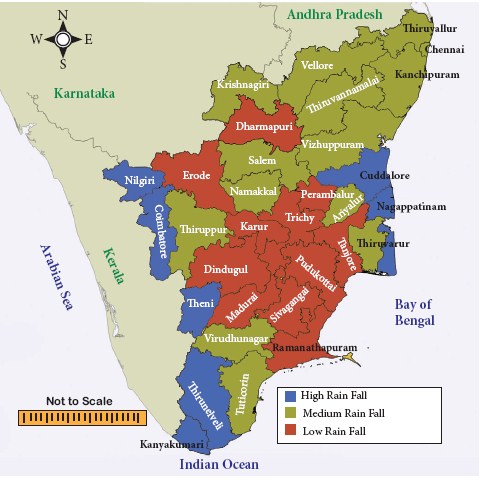
a. Identify the districts that get only low annual rainfall in Tamilnadu.
b. Identify the districts that get a medium annual rainfall in Tamilnadu.
c. State the districts that enjoy high annual rainfall in Tamilnadu
1.
(b)
use it for watering plants
2.
(b)
ground water
3.
(c)
i and iv
4.
(d)
distillation
5.
(c)
salty
6.
There are two types of rain water harvesting
1. Collecting water from where it falls.
2. Collecting rainwater by constructing bunds.
7.
polar ice - gaps, glaciers and ice sheets in Arctic region and Antarctica.
8.
(i) Create awareness among the people.
(ii) Rain water harvesting.
(iii) Recycling of water by separating pollutants.
(iv) Save water for the future generations by using water carefully and in a limited way, This is conservation of water.
(v) Controlling deforestation.
(vi) Adopting drip irrigation and sprinkler irrigation in agriculture. By this way lesser amount of water can be used for irrigation.
9.
(i) Sewage should not be disposed off in rivers or oceans before treatment.
(ii) If we dispose sewage water before treatment the river and oceans will be polluted.
(iii) We can not use the river water for our day to day life.
(iv) Aquatic animals and species will die due to pollution.
10.
(i) Potable water is the water which is safe to drink. On an average the human body requires 2-3 liters of water per day for proper functioning.
(ii) It is transparent.
(iii) It is odourless and colourless.
(iv) Cleaned of harmful contaminants.
(v) It is harmless or free from disease causing bacteria.
11.
a) Madurai, Dindugul, Karur, Trichy, Pudukottai, Tanjore, Perambalur, Erode, Dharmapuri.
b) Tuticorin, Virudhunagar, Thiruppur, Thiruvarur, Ariyalur, Namakkal, Salem, Vizhuppuram, Thiruvannamalai, Vellore, Krishnagiri, Kanchipuram, Chennai, Thiruvallur.
c) Tirunelveli, Theni, Coimbatore, Nilagiri, Cuddalore, Nagappatinam.

6th Standard Syllabus & Materials
6th Standard
TN 6th Social Science T3 - GEO - Understanding Disaster Sample Question Papers Study Material - QB365 Set A
NEW6th Standard
TN 6th Social Science T3 - GEO - Globe Sample Question Papers Study Material - QB365 Set A
NEW6th Standard
TN 6th Social Science T3 - GEO - Asia and Europe Sample Question Papers Study Material - QB365 Set A
NEW6th Standard
TN 6th Social Science T3 - HIS - South Indian Kingdoms Sample Question Papers Study Material - QB365 Set A



Tamilnadu Stateboard 6th Standard Subjects
Tamilnadu Stateboard Standards




