
 100% FREE ACCESS
6th Standard CBSE Syllabus & Materials
6th Standard CBSE
CBSE 6th Social Science The Value of Work - New Sample Question Papers Study Material - QB365 Set A
NEW6th Standard CBSE
CBSE 6th Social Science Family and Community - New Sample Question Papers Study Material - QB365 Set A
NEW6th Standard CBSE
CBSE 6th Social Science India's Cultural Roots - New Sample Question Papers Study Material - QB365 Set A
NEW6th Standard CBSE
CBSE 6th Social Science India,That is Bharat - New Sample Question Papers Study Material - QB365 Set A
NEW6th Standard CBSE
CBSE 6th Social Science Timeline and sources of history - New Sample Question Papers Study Material - QB365 Set A
NEW6th Standard CBSE
CBSE 6th Social Science Oceans and Continents - New Sample Question Papers Study Material - QB365 Set A

Published on: 05/12/2018
CBSE Class 6 is a crucial grade in your secondary school education. So learning with effective preparation is a must. Our study materials for CBSE Class 6 follow the latest CBSE syllabus and are prepared by subject experts who have much experience in the academic industry. In this question paper, the questions are cover from the 6th Science chapter Urban Administration. Questions are prepared as per NCERT guidelines by the help of expert teachers.
By referring to our solutions, students get a clear understanding of each concept in detail. Students who have referred to our solutions have seen a significant increase in overall marks and ease in understanding the subjects. Our study materials are not only used by students but also by educational institutes in India.
In this post, we are providing you with the most important questions of Science exam from the chapter Water. You should know answers to these questions in all likelihood to score good marks in Class 6 Science exam.
The latest sample papers have been designed as per the latest blueprints, syllabus and examination trends. Sample papers should be practiced in examination condition at home or school and also show it to your teachers for checking or compare with the answers provided.
Download CBSE Class 6th Standard CBSE Science question papers, sample papers, important questions, and previous year solved papers in PDF format. Get free study materials, NCERT solutions, and exam preparation resources for Class 6th Standard CBSE Science
Questions + Answers key
Take MCQ Science Test
1.
In our country, most of the rainfall occurs during the ________ season.
2.
The rainwater can be used to ________ groundwater.
3.
Water, as ___________goes into atmosphere by the processes of___________ and___________ and forms___________ which on condensation fall in the form of___________ and___________.
4.
State for each of the following whether it is due to evaporation or condensation. Steam rising from wet clothes while they are ironed.
5.
The process of changing water into its vapour is called__________
6.
Water changes to ice at 0°C.
7.
Water is non-renewable natural resource
8.
Water vapour is present in the environment during monsoon season only.
9.
Water vapour enters into air through evaporation.
10.
The evaporation of water takes place only in the sunlight.
11.
Why do some water pipes burst in winter?
12.
Why do wet clothes placed on a clothesline get dry after some time? Explain.
13.
Is oxygen soluble in water? How is this important?
14.
Name two main processes which transfer water present on the earth into water vapour continuously.
15.
Write any two activities which require more than one bucket of water.
16.
Water is one of our most precious commodities and no life can survive without it It has been predicted that water scarcity will become the subject of "Wars"in the near future. Write any two ways in which water is getting polluted. Write any two measures to stop water pollution at your level
17.
Sachin was very hungry one day. He went to kitchen where his mom was cooking food. He suddenly opened the lid of freshly cooked rice and found tiny drops of water on the under side of the lid. He became curious to know the cause of the presence of water drops on the under side of lid.
(a) Why was droplets present on the lid of container?
(b) What will happen if lid is opened during cooking?
(c) Do you observe any values in Sachin? Name them.
18.
How do the areas covered with concrete affect the availability of groundwater?
19.
Why is there a need for conserving water? Give two reasons.
20.
Why do wet clothes placed on a clothes line dry after sometime? Explain.
21.
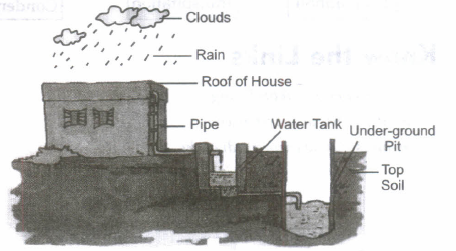
Explain the process of rooftop rain water harvesting with the help of a suitable diagram.
22.
State different uses of water
23.
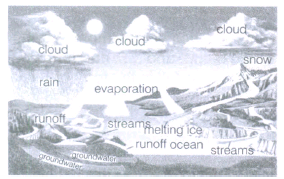
Draw a diagram to show how sea water reaches a lake or pond?
24.
About 97% of the water on the earth is
salt water
pure water
polluted water
drinking water
25.
Observe the given figure and tell which process is taking place
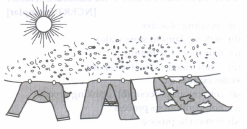
Condensation
Evaporation
Transpiration
None of the above
26.
Water harvesting is a technique of
Flooding water
Farming water
Stopping flood
Saving rain water
27.
Catch water where it falls is the basic idea behind
recycling of water
makinq dams to store water
rainwater harvesting
condensation of water vapour
28.
Floods cause extensive damage to
crops
property and human life
domestic animals
All of the above
29.
Wells are fed by
pond water
lake water
rainwater
groundwater
30.
The quantity of water required to produce one page of your book is
one bucket
ten buckets
two glasses
few drops
31.
Transpiration is a process in which plants
receive water from soil
absorb water vapour from air
prepare food from water
release water in the form of water vapour
32.
In which of the following cases, evaporation of water will be slowest?
A tray of water kept in sunlight
A kettle of water kept on a burner
A glass of water kept in a room
A bucket of water kept on rooftop
33.
Which of the following activities does not involve use of water?
Washing clothes
Bathing
Cleaning utensils
Drying wet clothes
34.
Look at Fig.
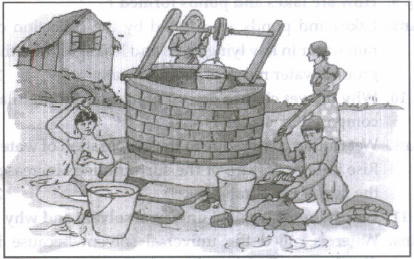
Write down activities shown in this figure in which water is being used.
35.
What is fog?
36.
How does water cycle help in maintaining global climate?
37.
Which property of water is responsible to maintain the body temperature?
38.
Water is present on earth in which states of matter?
1.
()
monsoon
2.
()
recharge
3.
()
vapours, evaporation, transpiration, clouds, rains, snow/hails
4.
()
Evaporation
5.
()
evoporation
6.
(a)
7.
(b)
8.
(b)
9.
(a)
10.
(b)
11.
Some water pipes burst in winters because during winter, cold develops enormous pressure in the pipes and due to this high pressure, water pipes burst.
12.
Wet clothes placed on a clothesline get dry after some time due to evaporation. In this process, water present in wet clothes is converted into water vapour which is released into atmosphere .
13.
Yes, oxygen is soluble in water. This is the source of oxygen supply for aquatic habitats.
14.
These processes are evaporation and transpiration.
15.
Two activities which require use of more than one bucket of water is washing more than 10 clothes and irrigating a crop field.
16.
Water is getting polluted:
(i) By industrial waste
(ii) By human activities
Measures to stop water pollution:
(i) We should not throw waste materials and garbage into water.
(ii) We should sensitize people about harmful effects of water pollution.
Associated Value : We should discourage any activity in our life that may cause water pollution
17.
(a) The droplets appear due to the process of condensation, i.e. when hot vapours strike the lid surface they cool down and become drops.
(b) If lid is opened during cooking, steam will be seen rising from the vessel which is another phase of water.
(c) Sachin is intelligent, curious and has interest in acquiring new facts .
18.
Areas covered with concrete affect the availability of groundwater because concrete reduces the seepage of rainwater into the ground which leads to reduction in the availability of groundwater.
19.
There is a need for conserving water because of the following reasons
(i) Increasing population is creating more demand for usable water.
(ii) Availability of freshwater is decreasing day-by-day.
20.
Wet clothes placed on a clothes line dry after sometime because water present in wet clothes is converted into water vapour and released in atmosphere due to evaporation which leaves them dry.
21.
In this process, the rain water is collected from the rooftop to a storage tank, through pipes. This water may contain soil from the roof and need filtering before it is used. Instead of collecting rain water in the tank, the pipes can go directly into a pit in the ground. This then seeps into the soil to recharge the ground water.
22.
Water is used:
(i) for drinking and cooking
(ii) for bathing and cleaning.
(iii) in agriculture, to produce food.
(iv) in Industries, to perform different activities
23.
Sea water reaches a lake or pond is represented by a diagram:
24.
(a)
salt water
25.
(b)
Evaporation
26.
(d)
Saving rain water
27.
(c)
rainwater harvesting
28.
(d)
All of the above
29.
(d)
groundwater
30.
(c)
two glasses
31.
(d)
release water in the form of water vapour
32.
(c)
A glass of water kept in a room
33.
(d)
Drying wet clothes
34.
()
The activities, in which water is being used are given below:
(i) Bathing
(ii) Washing of clothes
35.
()
Fog is a form of condensed water vapours on dust particles in air and it occurs near the surface of the earth during winter season
36.
()
Water cycle plays an important role in maintaining the global climate as :
(i) Water cycle maintains the temperature on land.
(ii) Water cycle regulates the groundwater level.
37.
()
Evaporation
38.
()
In all three states, i.e., solid, liquid and vapour.

6th Standard CBSE Syllabus & Materials
6th Standard CBSE
CBSE 6th Social Science Locating Places on the Earth - New Sample Question Papers Study Material - QB365 Set A
NEW6th Standard CBSE
CBSE 6th Science A Journey Through States of Water - New Sample Question Papers Study Material - QB365 Set A
NEW6th Standard CBSE
CBSE 6th Science Temperature and its Measurement - New Sample Question Papers Study Material - QB365 Set A
NEW6th Standard CBSE
CBSE 6th Science Materials Around Us - New Sample Question Papers Study Material - QB365 Set A



CBSE 6th Standard CBSE Subjects
CBSE Standards




