
 100% FREE ACCESS
6th Standard Syllabus & Materials
6th Standard
TN 6th Tamil பருவம் 1 - இயல் 1 - மொழி -தமிழ்த்தேன் - இன்பத்தமிழ் Sample Question Papers Study Material - QB365 Set A
NEW6th Standard
TN 6th English T1 - Supplementary - The Apple Tree and The Farmer Sample Question Papers Study Material - QB365 Set A
NEW6th Standard
TN 6th English T1 - Prose - When The Trees Walked Sample Question Papers Study Material - QB365 Set A
NEW6th Standard
TN 6th Social Science T3 - CIV - Road Safety Sample Question Papers Study Material - QB365 Set A
NEW6th Standard
TN 6th Social Science T3 - CIV - Local Bodies - Rural and Urban Sample Question Papers Study Material - QB365 Set A
NEW6th Standard
TN 6th Social Science T3 - CIV - Democracy Sample Question Papers Study Material - QB365 Set A

Published on: 30/11/2018
This is the most important model half yearly model question paper for 6th social science. In this question paper, all the important questions were included.
Our aim is to bring out the best scores on board exams. By practicing with this important model question paper student can gain more knowledge and confidence to crack the exams. With this model objective questions, you can get good scores by practicing.
Using the model question papers, every student can get an idea about the exam questions in a subject wise and collect more information to score high marks on the board.
Download Tamil Nadu 6th Standard Social Science question papers, model tests, one-mark questions, important questions, and public exam papers in PDF format. Free study materials and answer keys for TN State Board students.
Questions + Answers key
Take MCQ Social Science Test
1.
Which article of the Constitution says discrimination against any citizen on grounds only of religion, race, caste, sex, place of birth or any of them is not permitted?
14(1)
15(1)
16(1)
17(1)
2.
Gender-based stereotypes are often portrayed in
films
advertisements
TV serials
All of these
3.
Mohiniyattam is a classical dance of
Kerala
Tamil Nadu
Manipur
Karnataka
4.
Which one of the following religion is not practised in India
Sikhism
Islam
Zoarastrianism
Confucianism
5.
Which of the following oceans is the busiest ocean?
The Pacific Ocean
The Atlantic Ocean
The Indian Ocean
The Arctic Ocean
6.
The galaxy in which our solar system is found is
Andromeda
Magellanic clouds
Milky Way
Starburst
7.
Which is not the oldest city among the following ones?
Madurai
Kancheepuram
Poompuhar
Chennai
8.
Which one of the following is a Tamil city?
Iraq
Harappa
Mohenjo-Daro
Kancheepuram
9.
River valleys are said to be the cradle of civilisation because
Soil is very fertile.
They experience good climate
They are useful for transportation.
Many civilisations flourished on river valleys.
10.
What was the step taken by the early man to collect his food?
Trade
Hunting
Painting
Rearing of animals
11.
The Flag which was flown in 1947 Independence day was weaved in __________________.
12.
_______________ was the earliest capital of Magadha.
13.
_____________ was the founder of Buddhism.
14.
____________ was a tax collected from the people in Vedic period.
15.
Deltas are _______ order landforms.
16.
As per the 2011 Census the lowest Sex ratio was in _____________
17.
Bihu festival is celebrated in__________
18.
The Equator faces the Sun directly on ___________and ____________.
19.
Masathuvan means ____________ .
20.
The main occupations of the ancient humans were ____________ and ____________ .
21.
What is Preamble?
22.
What was the necessity for the invention of money?
23.
What do the colours in our National Flag represent?
24.
Tertiary activities.
25.
Complete the given table with the help of an atlas. Follow the example
| S.No | Mountain Ranges | Peaks | Continents | Elevation (m) |
| 1. | The Himalayas | Everest | Asia | 8,848 |
| 2. | The Rockies | |||
| 3. | The Andes | |||
| 4. | The Alps | |||
| 5. | The Eastern Ghats |
26.
What is Prejudice?
27.
Name the oceans which surround North America and South America.
28.
Why is India called the land of unity in diversity?
29.
Mention the other names of Madurai.
30.
What do you know about the Great Bath?
31.
Describe the ancient methods of hunting?
32.
Mark the following places in the given India map:
a.Mohenjo-Daro
b.Chanhudaro
c.Harappa
d.Mehergarh
e.Lothal
33.
Write any five welfare measures you would do if you were a king like Ashoka?
34.
Observe the following features of Indus Civilisation and compare that with the present day.
a. Lamp post
b. Burnt bricks
c. Underground drainage system
d. Weights and measurement
e. Dockyard
35.
Give the important features of the Pacific Ocean.
36.
Explain the characteristics of the various spheres of the Earth.
37.
Neithal
38.
Equinox
39.
Mercury
40.
Ambedkar
41.
The Mariana Trench
42.
Dussehra
43.
Red Planet
44.
Herodoturs
45.
Mehergarh
46.
Written records
1.
(b)
15(1)
2.
(d)
All of these
3.
(a)
Kerala
4.
(d)
Confucianism
5.
(b)
The Atlantic Ocean
6.
(c)
Milky Way
7.
(d)
Chennai
8.
(d)
Kancheepuram
9.
(d)
Many civilisations flourished on river valleys.
10.
(b)
Hunting
11.
()
Gudiyatham
12.
()
Rajagriha
13.
()
Gautama Buddha
14.
()
Bali
15.
()
Second
16.
()
Dharmapuri Dist
17.
()
Assam
18.
()
21st March and 23rd september
19.
()
A big trader
20.
()
hunting and gathering
21.
(i) The Preamble of our constitution stresses on the justice, liberty, equality and fraternity.
(ii) According to it, India is a Sovereign, Socialist, Secular democratic republic.
22.
(i) When they exchange commodities, they may lead to certain problems, when comparing the differences in the value of commodity.
(ii) To solve this problein, people invented a tool called money.
23.
(i) The tricolour flag is our National flag
(ii) The saffron at the top represents. valour and sacrifice.
(iii) The green at the bottom represents fertility and prosperity.
(iv) The white band in between represents honesty peace and purity.
(v) The Ashoka chakra or the wheel in navy blue represents truth and peace.
24.
Tertiary activities are basically concerned with the distribution of primary and secondary products through a system of transport and trade. (e.g) Banking, Trade and Communications.
25.
| S.No | Mountain Ranges | Peaks | Continents | Elevation (m) |
| 1. | The Himalayas | Everest | Asia | 8,848 |
| 2. | The Rockies | Elbert | N. America | 4,401 |
| 3. | The Andes | Aconcagna | S. America | 1,069 |
| 4. | The Alps | Mont Blanc | Europe | 806 |
| 5. | The Eastern Ghats | lindhagada | Asia (In A.P, India) | 1,690 |
26.
Prejudice means to judge other people in a negative or inferior manner, without knowing much about them. It happens when people have false belief and ideas.
27.
1. Pacific Ocean
2. Atlantic Ocean
28.
The feeling of oneness and unity among the people of various religions, castes of a country is called unity in diversity
29.
(i) Sangam Valartha Nagaram
(ii) Thoonga Nagaram (the city that never sleeps).
(iii) Koodal nagar are the other names of Madurai.
30.
(i) The great bath was a large, rectangular tank in a courtyard. It may be the earliest example of a water-proof structure.
(ii) The bath was lined with bricks, coated with plaster and made water-tight using layers of natural bitumen.
(iii) There were steps on the north and south leading into the tank.
(iv) There were rooms on three sides.
(v) Water was drawn from the well, located in the courtyard and drained out after use.
31.
(i) Go as a group and hunt the prey.
(ii) Dig a pit and trap the animals and hunt.
32.
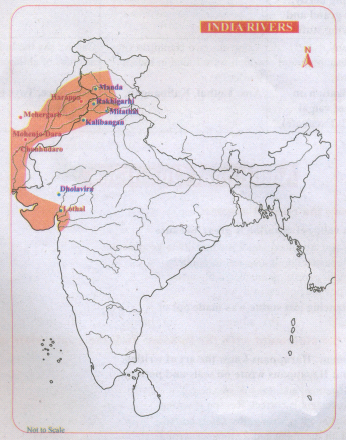
33.
If I were a King like Ashoka; I will implement some schemes.
Education:
To provide quality and equal free education to all from primary to higher studies.
Medical Aid:
To provide quality and free medical aid to all.
Health:
To provide basic needs like food, shelter, dress to all.
Economics:
To develop the economic status of our country giving importance to agricultural activities.
Employment:
To create employment opportunities for growing population from long term schemes.
Information technology:
Due to up coming technologies in the world I will implement new schemes to modernise the
34.
(a) Lamp post
(i) Each house and street had a lamp post in Indus civilisation.
(ii) Now a days there is no electric lamp post in deep rural area.
(b) Burnt bricks
(i) The houses were built using baked bricks and mortar.
(ii) Present days we built varity of houses like concrete house, thatch house, etc....
(c) Underground drainage system
(i) Many of these cities in Indus has covered drains. The drains were covered with slabs or bricks.
(ii) Now a days underground drainage system is functioning only major cities.
(d) Weights and measurement
(i) Indus people had developed a systern of standardised weights and measures.
(ii) Present day we used electronic weighing machine also.
(e) Dockyard
(i) A naval dockyard has been discovered in Lothal in Gujarath. It shows the manitime activities of the Indus people.
(ii) Now a days there are so many seaports spread in all over India.
35.
(i) The important features of the pacific ocean:
(ii) The pacific ocean is the largest and deepest ocean on the earth.
(iii) It covers about one-third of the earth's total area and spreads for about 168.72 million sq.km
(iv) This oceans shape is roughly triangular with its apex in the north at the bering strait which connects the pacific ocean with the arctic ocean.
(v) The bering sea, the china sea and the Philippines sea, the sea of Japan and Tasman sea are some of the marginal seas of the pacific ocean.
(vi) Indonesia, philippines, japan, hawaii, newzealand are some of the islands located in this ocean.
(vii) The deepest point mariana trench is 10,994m and is located in the pacific ocean.
(viii) A chain of volcanoes is located around the pacific ocean called the pacific ring of fire.
36.
(i) The earth is the most suitable planet to support life.
(ii) It has thrge major components that we call as the realms of the Earth lithosphere, hydrosphere and atmosphere.
Lithosphere:
(i) The lithosphere is the land on which we live.
(ii) It is the solid outer layer of the earth consisting of rocks and soils.
Hydrosphere:
(i) The hydrosphere consists of water bodies such as oceans, seas, rivers, lakes, ice caps.on mountains and water vapour in the atmosphere.
Atmosphere:
(i) Atmosphere is the envelope of air that surrounds the earth.
(ii) Different types of gases make up the atmosphere.
(iii) The major gases are Nitrogen 78% and Oxygen 21%.
(iv) The other gases like Carbon dioxide, Hydrogen, Helium, Argon and Ozone are present in meager amounts.
Biosphere:
(i) The narrow belt of interaction among the lithosphere, the hydrosphere and the atmosphere, where life exists is known as biosphere.
(ii) Bio means life in Greek.
(iii) It consists of distinct zones.
(iv) Each zone has its own climate, plant and animal life.
(iv) These zones are known as ecosystems.
37.
Coastal Region
38.
21st March
39.
Innner planet
40.
India's first law minister
41.
The Pacific Ocean
42.
Festival
43.
Mars
44.
Father of History
45.
Neolithic
46.
copper plates

6th Standard Syllabus & Materials
6th Standard
TN 6th Social Science T3 - GEO - Understanding Disaster Sample Question Papers Study Material - QB365 Set A
NEW6th Standard
TN 6th Social Science T3 - GEO - Globe Sample Question Papers Study Material - QB365 Set A
NEW6th Standard
TN 6th Social Science T3 - GEO - Asia and Europe Sample Question Papers Study Material - QB365 Set A
NEW6th Standard
TN 6th Social Science T3 - HIS - South Indian Kingdoms Sample Question Papers Study Material - QB365 Set A



Tamilnadu Stateboard 6th Standard Subjects
Tamilnadu Stateboard Standards



