
 100% FREE ACCESS
6th Standard CBSE Syllabus & Materials
6th Standard CBSE
CBSE 6th Social Science The Value of Work - New Sample Question Papers Study Material - QB365 Set A
NEW6th Standard CBSE
CBSE 6th Social Science Family and Community - New Sample Question Papers Study Material - QB365 Set A
NEW6th Standard CBSE
CBSE 6th Social Science India's Cultural Roots - New Sample Question Papers Study Material - QB365 Set A
NEW6th Standard CBSE
CBSE 6th Social Science India,That is Bharat - New Sample Question Papers Study Material - QB365 Set A
NEW6th Standard CBSE
CBSE 6th Social Science Timeline and sources of history - New Sample Question Papers Study Material - QB365 Set A
NEW6th Standard CBSE
CBSE 6th Social Science Oceans and Continents - New Sample Question Papers Study Material - QB365 Set A

Published on: 25/10/2025
Download CBSE Class 6th Standard CBSE Social Science question papers, sample papers, important questions, and previous year solved papers in PDF format. Get free study materials, NCERT solutions, and exam preparation resources for Class 6th Standard CBSE Social Science
Questions + Answers key
Take MCQ Social Science Test
1.
Who composed the national song of India? Who has done the English translation of this song?
2.
Look around you in the classroom: do you see anyone who looks exactly like you do?
3.
Who was given the credit of bringing Christianity to India?
St. Columbus
St. Thomas
Lord Macaulay
Lord Wellesley
4.
What is common between Kerala and Ladakh in terms of cultural influences?
Both have similar climatic conditions
Both have similar trading influences
Both have similar products
Both have similar land area
5.
Which of the following alternatives is an incorrect reason for diversity in India?
Caste
Language
Religion
Culture
6.
Which of the following is not a condition for "unity in diversity"?
Unity despite differences in cultures
Unity despite differences in languages
Unity despite differences in religions
Unity despite differences in nationalities
7.
Ladakh is also known as :
Little Tibet
Little Nepal
Little Thailand
Little China
8.
Who composed our National Anthem?
Pt. Jawaharlal Nehru
Rabindranath Tagore
Mahatma Gandhi
Dr. Rajendra Prasad
9.
Onam festival is celebrated in
Kerala
Punjab
Karnataka
Jammu nd Kashmir
10.
'Discovery of India' was written by
Indira Gandhi
Pt. Jawaharlal Nehru
Sardar Vallabhbhai Patel
Mahatma Gandhi
11.
Where did the Jallianwala Bagh Massacre take place?
Ludhiana
Rohtak
Amritsar
Bhatinda
12.
Where are Pashmina shawls woven
Kashmir
Haryana
Punjab
Himachal Pradesh
13.
What does the term 'Cheena-Vala' mean?
14.
Who discovered the sea route to India?
15.
What does Nehru try to say about India's unity in his book, "The Discovery of India?"
16.
Give an example of diversity in India?
17.
Why was Samir Do tense?
18.
The caste system is a form of__________.
19.
Both Kerala and Ladakh were influenced by______and_______traders.
20.
The 'Discovery of India' is a book by_________.
21.
When people travel to other places,_________of cultures takes place.
22.
Habitat is associated with the _______________ one lives in
23.
India's diversity has always been__________ as a __________ of its strength.
24.
Local versions of the Tibetan national epic the _____________ are performed by, both Muslims and Buddhists.
25.
The Apostle of Christ, _____________ is believed to have come to Kerala nearly 2000 years ago.
26.
All Indian share the national anthem.
27.
Samir Ek belongs to Islam religion.
28.
Pt. Jawaharlal Nehru was the first Prime Minister of India.
29.
Caste system is another example of inequality.
30.
The geography of Ladakh allows cultivation of wheat.
31.
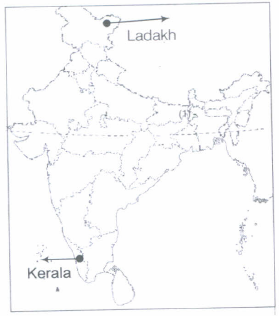
Look at the map of India in an Atlas and locate Kerala and Ladakh. Can you list three ways in which the different geographical location of these two regions would influence the following?
(i) The food people eat
(ii) The clothes they wear
(iii) The work they do.
32.
Explain the Jallianwalla Bagh massacre.
1.
The national song of India was composed by Bankim Chandra Chatterjee in Bengali language. The English translation of the song was done by Shree Aurobindo.
2.
No, no one around me in the classroom looks exactly like me.
3.
(b)
St. Thomas
4.
(b)
Both have similar trading influences
5.
(a)
Caste
6.
(d)
Unity despite differences in nationalities
7.
(a)
Little Tibet
8.
(b)
Rabindranath Tagore
9.
(a)
Kerala
10.
(b)
Pt. Jawaharlal Nehru
11.
(c)
Amritsar
12.
(a)
Kashmir
13.
()
The term 'Cheena-Vala' is used for the fishing nets used in Kerala, and they are called so, as they look like the Chinese fishing nets.
14.
()
The Portuguese discovered the sea route to India from Europe, when Vasco-da-Gama landed with his ship here.
15.
()
Nehru said that India's unity is not something imposed from outside, but it is something deeper and within its fold, the widest tolerance of beliefs and customs is practised and every variety is acknowledged and even encouraged.
16.
()
There are many different languages which are spoken by us. It is an example of diversity in India
17.
()
Samir Do was tense because riots had broken out in Meerut, where his family lived.
18.
()
Inequality
19.
()
Chenise, Arab
20.
()
Jawaharlal Nehru
21.
()
Intermixing
22.
()
geographical area
23.
()
recognised, source
24.
()
Kesar Saga
25.
()
St. Thomas
26.
(a)
27.
(b)
28.
(a)
29.
(a)
30.
(b)
31.
Yes, we can list three ways in which the different geographical location of these regions (Kerala and Ladakh) would be influence:
| Kerala | ladakh | |
|---|---|---|
| Food | Rice, fish, vegetables | Meat and milk. |
| Clothes | Cotton and synthetic cloths. Loose cotton. No woollen clothes | Woolen and fur clothes. |
| Work | Fishing, agriculture | Sheep rearing, wool collection, trading |
32.
(i) The British Army Officer, Dyer commanded his troops to enter into the JallianwallaBagh on Baisakhi Day (April 13).
(ii) The troops opened fire without a warning to the unarmed protestors, who were demanding the release of two natural leaders, Satyapal and Saibuddin kitchlew.
(iii) Dyer's troops fired and killed hundreds and stopped only when they ran out of ammunition.
(iv) The Bagh, enclosed from all four sides with buildings, had only one main entrance that was blocked by Dyer's troops.
(v) Other smaller gates were locked and people fleeing from the firing were shot.
(vi) Many of them jumped to their death in a well inside the garden.

6th Standard CBSE Syllabus & Materials
6th Standard CBSE
CBSE 6th Social Science Locating Places on the Earth - New Sample Question Papers Study Material - QB365 Set A
NEW6th Standard CBSE
CBSE 6th Science A Journey Through States of Water - New Sample Question Papers Study Material - QB365 Set A
NEW6th Standard CBSE
CBSE 6th Science Temperature and its Measurement - New Sample Question Papers Study Material - QB365 Set A
NEW6th Standard CBSE
CBSE 6th Science Materials Around Us - New Sample Question Papers Study Material - QB365 Set A



NCERT Books

Syllabus

Exam Pattern

Sample Question Papers

Previous year Question Papers

Important Notes

MCQ Practice test

NCERT Exemplers

Case study Questions

Image Based Questions

Passage based Questions

HOT Questions

Value Based Questions

Model Questions Papers
NCERT ( Book Back ) Questions

Assertion and Reason
Important Questions And Answers

CBSE 6th Standard CBSE Subjects
CBSE Standards


