
 100% FREE ACCESS
6th Standard CBSE Syllabus & Materials
6th Standard CBSE
CBSE 6th Social Science The Value of Work - New Sample Question Papers Study Material - QB365 Set A
NEW6th Standard CBSE
CBSE 6th Social Science Family and Community - New Sample Question Papers Study Material - QB365 Set A
NEW6th Standard CBSE
CBSE 6th Social Science India's Cultural Roots - New Sample Question Papers Study Material - QB365 Set A
NEW6th Standard CBSE
CBSE 6th Social Science India,That is Bharat - New Sample Question Papers Study Material - QB365 Set A
NEW6th Standard CBSE
CBSE 6th Social Science Timeline and sources of history - New Sample Question Papers Study Material - QB365 Set A
NEW6th Standard CBSE
CBSE 6th Social Science Oceans and Continents - New Sample Question Papers Study Material - QB365 Set A

Published on: 25/10/2025
Download CBSE Class 6th Standard CBSE Social Science question papers, sample papers, important questions, and previous year solved papers in PDF format. Get free study materials, NCERT solutions, and exam preparation resources for Class 6th Standard CBSE Social Science
Questions + Answers key
Take MCQ Social Science Test
1.
What is called the 'Universal Adult Franchise'?
2.
Why do we need a government?
3.
Can you believe that there was a time when governments did not allow women and the poor to participate in elections?
4.
Who gives the government this power to make decisions and enforce laws?
5.
Who chained themselves to railing in the public places?
Women
Senior citizens
Men
Adults
6.
Women in UK got voting rights in the year
1928
1927
1920
1919
7.
The final decisions remain in the hands of the king/queen. This is related with
representative government
democratic government
monarchical government
All of the above
8.
In which type of government is the leader chosen by the people?
Monarchy
Dictatorship
Democracy
King or Queen
9.
Every country needs a government to
make decisions and get things done
understand the people
build hotels and residential quarters
All of the above
10.
Why is a mark put on the finger after the voter has cast his/her vote?
11.
What do you mean by monarchy?
12.
Which level of government maintains peaceful relations with neighbouring countries?
13.
Why does every country need a government?
14.
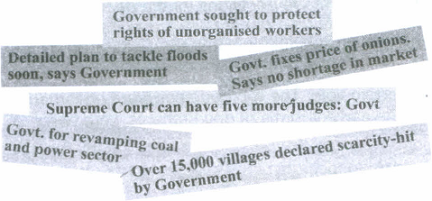
Look at the newspaper headlines above and list the different kinds of activities that the government is reported to be doing in these newspaper headlines.
1. 2. 3. 4.
(a) Isn't this a wide range of activities?
(b) What do you think government is? Discuss in class.
15.
When did the women's struggle get strengthened and why was this struggle called women's suffrage movement? How did women get the Right to Vote?
16.
The government also has the job of protecting the _____________ of the country.
17.
The government makes law and ___________ who lives in the ____________ has to follow these.
18.
Democratic governments in our times are usually referred to as __________ democracies.
19.
The ____________ demanded the right to vote for all ___________
20.
In a _________, it is the people who give the government power.
21.
Government does other important things such as running postal and railway services.
22.
A national level government relates to an entire state like Haryana or Assam.
23.
Democratic governments in our times are usually referred to as Monarchy Government.
24.
Ambedkar wrote the journal 'Young India'.
25.
American women got the right to vote in 1928
26.
Young India
27.
People's government
28.
Decision made by king
29.
Bharat Petroleum
30.
Highest court
1.
Universal Adult Franchise refers to the right of every adult citizen of a country to cast one vote in the elections irrespective of his/her caste, class, creed, religion, sex, etc.
2.
When human beings live and work together, there needs to be some amount of organisation so that decisions can be made by government. The whole work related to managing border security, public welfare facilities or services etc are managed by the government and it is necessary for them to do so.
Thus, we need a government to run the country.
3.
Yes, I believe that there was a time when governments did not allow women and the poor to participate in elections, because:
(i) In earliest times, only men who owned property and were educated were allowed to vote.
(ii) The country was governed by the rules and regulations that these few men made.
4.
The power to take decisions and make laws depends on the form or type of government are:
(i) In democracy, it is the people who give this power to the government through the process of elections.
(ii) In monarchy, the King or the Queen has the power to make decisions and enforce laws. The monarch may have a small group to discuss matters but the final decision lies with the monarch.
5.
(a)
Women
6.
(a)
1928
7.
(c)
monarchical government
8.
(c)
Democracy
9.
(a)
make decisions and get things done
10.
()
A mark is put on the finger to make sure that a person casts only one vote.
11.
()
In monarchy, the monarch has the power to make decisions and run the government.
12.
()
TheNational Government maintains peaceful relations with neighbouring countries.
13.
()
Every country needs a government to make decisions and get things done like building roads, school, etc.
14.
List of the different kinds of activities that the government is reported to be doing in these newspaper headlines is:
(i) The Government protects the rights of unorganised workers.
(ii) The Government fixes the price of onions when they are in short supply.
(iii) The Government plans to tackle natural disasters like floods, earthquake, tsunami, ere as soon as possible.
(iv) Government revamps the coal and power sectors.
(a) Yes, the government has a wide range of activities.
(b) The government is the organisation which makes the decision with regard to:
• building roads and schools
• reducing the prices of essential commodities
• increasing the supply of electricity
• implementing several programmes to help the poor
15.
Women's struggle for right to vote got strengthened during the First World War. During the war, many men were away for fighting and because of this, women were called upon to do the work earlier done by men.
When people saw this, they began to realise that they had created many unfair stereotypes about women. Then women organised themselves and demanded equal right as men. This movement is called the women's suffrage movement as the term suffrage usually means the right to vote.
All women demanded the right to vote for themselves and to get their demands heard, they chained themselves to railing in public places. Many suffragettes were imprisoned and went on hunger strikes.
Finally, in 1920 America provided voting right for women and later in 1928 UK also gave them the right to vote.
16.
()
boundaries
17.
()
everyone, country
18.
()
representative
19.
()
suffragettes, women
20.
()
democracy
21.
(a)
22.
(b)
23.
(b)
24.
(b)
25.
(b)
26.
()
Gandhiji
27.
()
Democracy
28.
()
Monarchy
29.
()
Public Sector
30.
()
Supreme Court

6th Standard CBSE Syllabus & Materials
6th Standard CBSE
CBSE 6th Social Science Locating Places on the Earth - New Sample Question Papers Study Material - QB365 Set A
NEW6th Standard CBSE
CBSE 6th Science A Journey Through States of Water - New Sample Question Papers Study Material - QB365 Set A
NEW6th Standard CBSE
CBSE 6th Science Temperature and its Measurement - New Sample Question Papers Study Material - QB365 Set A
NEW6th Standard CBSE
CBSE 6th Science Materials Around Us - New Sample Question Papers Study Material - QB365 Set A



NCERT Books

Syllabus

Exam Pattern

Sample Question Papers

Previous year Question Papers

Important Notes

MCQ Practice test

NCERT Exemplers

Case study Questions

Image Based Questions

Passage based Questions

HOT Questions

Value Based Questions

Model Questions Papers
NCERT ( Book Back ) Questions

Assertion and Reason
Important Questions And Answers

CBSE 6th Standard CBSE Subjects
CBSE Standards


