
 100% FREE ACCESS
6th Standard CBSE Syllabus & Materials
6th Standard CBSE
CBSE 6th Social Science The Value of Work - New Sample Question Papers Study Material - QB365 Set A
NEW6th Standard CBSE
CBSE 6th Social Science Family and Community - New Sample Question Papers Study Material - QB365 Set A
NEW6th Standard CBSE
CBSE 6th Social Science India's Cultural Roots - New Sample Question Papers Study Material - QB365 Set A
NEW6th Standard CBSE
CBSE 6th Social Science India,That is Bharat - New Sample Question Papers Study Material - QB365 Set A
NEW6th Standard CBSE
CBSE 6th Social Science Timeline and sources of history - New Sample Question Papers Study Material - QB365 Set A
NEW6th Standard CBSE
CBSE 6th Social Science Oceans and Continents - New Sample Question Papers Study Material - QB365 Set A

Published on: 25/10/2025
Download CBSE Class 6th Standard CBSE Social Science question papers, sample papers, important questions, and previous year solved papers in PDF format. Get free study materials, NCERT solutions, and exam preparation resources for Class 6th Standard CBSE Social Science
Questions + Answers key
Take MCQ Social Science Test
1.
What are important parallels of latitude.
2.
Why is the value of each latitude followed by the letter either 'N' or 'S'?
3.
Explain why the time zones are important for the world?
4.
What are the parallels of latitude and meridians of longitude?
5.
What is a globe?
6.
The time of India is ahead of Prime Meridian by
5 hours
6 hours
2 hours
5 hours and 30 mintues
7.
The globe and the Earth are different in
shape
tilt
size
None of these
8.
Which of the following are shown on the globe in their correct size?
Continents
Oceans
Countries
All of these
9.
Grid is a network of
parallels of latitudes and meridians of longitudes.
the tropic of Cancer and the tropic of Capricorn
the North Pole and the South Pole.
10.
The total number of longitudes are
360
180
90
11.
The Arctic circle is located in the ________ hemisphere.
12.
The distance between the longitudes decreases towards _________.
13.
The 0° meridian is also known as ___________.
14.
The Standard Meridian of India is ___________.
15.
The tropic of Capricorn is located at _________.
16.
What is the best mean of measuring time?
17.
What is a grid?
18.
How many time zones are there on the Earth?
19.
What is axis?
20.
Which is the place considered as standard for time all over the world?
21.
Draw a diagram of the globe showing the earth's axis, the equator, tropics of Cancer and Capricorn,
Arctic circle and Antarctic circle and answer the question that follow.
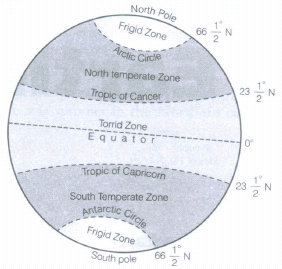
(i) What is value of the Tropic of Cancer?
(ii) Which of the following zones is situated between 66o30 's and poles?
22.
What is the difference between local time and standard time?
1.
There are four important parallels of latitudes on the Earth. They are:
(i) Tropic of Cancer It is an imaginary line that crosses at 23 1 / 2° in Northern hemisphere.
(ii) Tropic of Capricorn It is an imaginary line that crosses at 23 1 / 2° in Southern hemisphere.
(iii) Arctic Circle It is a circle at 66 1 / 2° North of the equator.
(iv) Antarctic Circle It is a circle at 66 1 / 2° South of the equator.
2.
The value of each latitude is followed by the letter 'N' or'S'. The parallel of latitudes in the North of the equator is represented as 'N' while the parallel of latitudes in South of the equator is represented as'S'.
3.
The local time of places on different meridians are bound to differ. The time difference within a country may be more than two hours. Therefore, it is necessary to have a standard time for a country. That's why the Earth is divided into 24 time zones.
4.
Parallels of latitudes: All parallel circles from the equator upto the poles are called parallels of latitudes. This is an imaginary line and measured in degree.
Meridians of longitudes: All of the imaginary lines running from the North Pole to South Pole. The distance between them is measured in degrees.
5.
A globe is a true model of the earth. It shows the earth in its real shape with continents, oceans and
tilt on its axis.
6.
(d)
5 hours and 30 mintues
7.
(c)
size
8.
(d)
All of these
9.
(a)
parallels of latitudes and meridians of longitudes.
10.
(a)
360
11.
()
Northern
12.
()
Poles
13.
()
Prime Meridian
14.
()
821/2 °E or 82° 30' E
15.
()
231/2°N or 23°30' N
16.
()
The best way of measuring time is by the movement of the Earth.
17.
()
A grid is a network of parallels of latitude and meridians of longitude.
18.
()
There are 24 time zones on the Earth.
19.
()
An axis is a needle-through which globe is fixed and can be moved on its axis.
20.
()
Greenwich is the place in Britain considered as standard for time all over the world.
21.
(i) 23°30' N is value of the Tropic of Cancer.
(ii) Frigid zone is situated between 66030' and poles.
22.
Local time is based on the local meridian passing through that place. The places lying North and South on the same meridian will have the same local time and the places lying East or West of that meridian will have different local times. It is important because the time for any country is measured by the local time. The local time of places on different meridians are different. Therefore, it will be difficult to prepare time-table for trains which cross several longitudes.
For example There will be a difference of about 1 hour and 45 minutes in the local times of Dwarka in Gujarat and Dibrugarh in Assam. Therefore, it is necessary to adopt the local time of some central meridian of a country as the standard time for the country.

6th Standard CBSE Syllabus & Materials
6th Standard CBSE
CBSE 6th Social Science Locating Places on the Earth - New Sample Question Papers Study Material - QB365 Set A
NEW6th Standard CBSE
CBSE 6th Science A Journey Through States of Water - New Sample Question Papers Study Material - QB365 Set A
NEW6th Standard CBSE
CBSE 6th Science Temperature and its Measurement - New Sample Question Papers Study Material - QB365 Set A
NEW6th Standard CBSE
CBSE 6th Science Materials Around Us - New Sample Question Papers Study Material - QB365 Set A



NCERT Books

Syllabus

Exam Pattern

Sample Question Papers

Previous year Question Papers

Important Notes

MCQ Practice test

NCERT Exemplers

Case study Questions

Image Based Questions

Passage based Questions

HOT Questions

Value Based Questions

Model Questions Papers
NCERT ( Book Back ) Questions

Assertion and Reason
Important Questions And Answers

CBSE 6th Standard CBSE Subjects
CBSE Standards


