
 100% FREE ACCESS
6th Standard CBSE Syllabus & Materials
6th Standard CBSE
CBSE 6th Social Science The Value of Work - New Sample Question Papers Study Material - QB365 Set A
NEW6th Standard CBSE
CBSE 6th Social Science Family and Community - New Sample Question Papers Study Material - QB365 Set A
NEW6th Standard CBSE
CBSE 6th Social Science India's Cultural Roots - New Sample Question Papers Study Material - QB365 Set A
NEW6th Standard CBSE
CBSE 6th Social Science India,That is Bharat - New Sample Question Papers Study Material - QB365 Set A
NEW6th Standard CBSE
CBSE 6th Social Science Timeline and sources of history - New Sample Question Papers Study Material - QB365 Set A
NEW6th Standard CBSE
CBSE 6th Social Science Oceans and Continents - New Sample Question Papers Study Material - QB365 Set A

Published on: 24/10/2025
Download CBSE Class 6th Standard CBSE Social Science question papers, sample papers, important questions, and previous year solved papers in PDF format. Get free study materials, NCERT solutions, and exam preparation resources for Class 6th Standard CBSE Social Science
Questions + Answers key
Take MCQ Social Science Test
1.
The commissioner and the administrative staff implement the decisions taken by the Councillor's Committees and the Councillors.
2.
Plateaus are vast stretches of flat land
3.
The rulers of 'Mahajanapadas' depended on occasional gifts brought by people
4.
Military leaders were paid huge salaries.
5.
The movements of people restrict the enrichment of our cultural traditions.
6.
The number of major religions in the world is :
Seven
Eight
Nine
Ten
7.
Celestial bodies include
Sun
Moon
both (a) and (b)
None of these
8.
Archaeologists discovered houses built by the people in Burzahom were generally made of :
marble
glass
in the ground in pits
hay
9.
Where does Nirmala work?
In an export garment unit
In a ticket booking centre
In Sudha's office
In a market street
10.
Who is the owner of Grassland?
Raghu
Mohan
Madhya Pradesh Government
Ratan Lal
11.
Which of the following races is/are not allowed to mingle with each other?
Black
Indian
Coloured
All of these
12.
Which of the following continents lies completely in the Northern hemisphere?
Australia
Europe
South America
Africa
13.
Mangrove forests can thrive in
saline water
fresh water
polluted water
14.
Technique of making silk was first invented in
China
South India
Sri Lanka
None of these
15.
Where did the word Jaina come from?
Tina
Jina
Vika
Dika
16.
Define street vendors
17.
Who was the Chairman of the Constitutional Drafting Committee?
18.
What are the types of mountains?
19.
What is cist?
20.
Which is the smallest and largest planet in the solar system?
21.
What are the main constituents of the atmosphere? How are they essential for life?
22.
What do you mean by inequality? Give an example of it.
23.
You live in Inamgaon 3000 years ago and the chief has died the previous night. Today your parents are preparing for the burial. Describe the scene including how food is being prepared for the funeral. What do you think would be offered?
24.
Describe at least two ways in which you think the lives of kings would have been different from those farmers.
25.
How did people react when the government increase the money for electricity?
26.
What are the stars and why can't all celestial bodies called stars?
27.
What is an Orbital Plane?
28.
______________ processions, and ______________ can sometimes lead to conflicts.
29.
____________a mathematician and astronomer, wrote a book in Sanskrit known as the Aryabhatiyam
30.
________________ occur in the areas which receive heavy rainfall.
31.
Dr. Bhimrao Ambedkar was one of the ______________of India.
32.
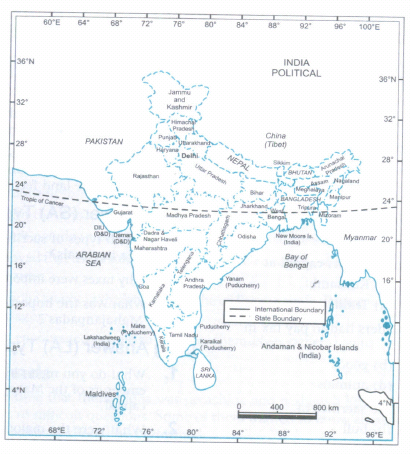
Find the state in which you live in the political map on page 136. Were there any janapada in your state? If yes, name them.
If not, name the janapadas that would have been the closest to your state, and mention whether they
were to the East, West, North or South.
33.
Making of the iron pillar
34.
Sanskrit Ramayana
35.
Cai Lun
36.
Iron pillar
37.
Shikhara
38.
How is the continent of North America different from that of South America?
39.
What is the structure of the judiciary in India?
40.
What symbolises the end of the civilisation?
41.
Describe the composition and function of each Varna in the Varna system.
42.
Discuss the lives of hawkers in the city.
43.
Discuss the different types of seasons found in India.
1.
(a)
2.
(b)
3.
(b)
4.
(b)
5.
(b)
6.
(b)
Eight
7.
(c)
both (a) and (b)
8.
(c)
in the ground in pits
9.
(a)
In an export garment unit
10.
(c)
Madhya Pradesh Government
11.
(d)
All of these
12.
(b)
Europe
13.
(a)
saline water
14.
(a)
China
15.
(b)
Jina
16.
()
Street vendor is a retail salesperson without an established place of business. Vendors sell things that are regularly prepared at home by their families. For example, those who sell food or snacks on the streets, prepare most of these at home.
17.
()
Dr. Bhim Rao Ambedkar was the Chairman of the Constitutional Drafting Committee.
18.
()
There are three types of mountains. They are: Fold mountains, Block mountains and the Volcanic mountains.
19.
()
A type of megalith is known as a cist. Some cists have port-holes which could be used as an entrance.
20.
()
Mercury is the smallest and Jupiter is the largest planet in the solar system.
21.
Our earth is surrounded by a layer of gases which is known as the atmosphere. It is mainly composed of 78% Nitrogen, 21% Oxygen, 1% Carbon dioxide and other gases. They are essential for life in the following ways:
(i) Required in various forms to maintain the fertility of soil.
(ii) Help plants to grow which provide us food.
(iii) Carbon dioxide helps plant to manufacture food in the presence of sunlight.
22.
Inequality means the unavailability of resources and opportunities for different people. The caste system is an example of inequality. Inequality has various forms like :
Economic inequality comprises all disparities in the distribution of economic assets and income.
Social inequality refers to the lack of social equality, where individuals in a society do not have equal social status, adequate provision of healthcare facilities, etc.
Political inequality exists where people are not given voting rights, freedom of speech and assembly, freedom to contest elections and so on.
23.
The chief had died last night. The whole community had gathered near his house to pay their last homage. May be they were wearing white coloured clothes. In the fields outside, people had collected things needed for the burial. The fire was lighted and some people were cooking food. May be rice was being cooked along with vegetables in the mud pot or they may be cooking that food which was relished by the chief. The people may be chanting the holy prayers, otherwise there was silence all round.
24.
The Lives of kings and the Lives offormers were different in this manner:
(i) The kings usually lived in urban areas in their palaces. forts while the farmers lived in rural areas in their small houses or huts.
(ii) The kings were depended on others for the supplies offood while the farmers produced food for
themselves and for others also.
25.
When in August 2005, the government increased the money people had to pay for electricity, this is how people reacted:
(i) They were very angry and expressed their disapproval very sharply.
(ii) They took out rallies and also organised a signature campaign.
26.
The celestial bodies that have their own light and heat and they emit it in large amount are called stars. They are generally big in size and hot. They are made-up of gases.
Every celestial body doesn't have their own light and heat, that's why we can't call them stars.
27.
()
The plane formed by an orbit is known as Orbital Plane.
28.
()
Religious, celebrations
29.
()
Aryabhata,
30.
()
Tropical rain forests
31.
()
greatest leaders
32.
Hints for students
(i) Name and location of your state or Union Territory, write the name of your region.
(ii) Look carefully in the map, is any janapada site in your state/UTs.
(iii) If yes, name that janapadas.
(iv] If not, look all directions of your state (East, West, North, South).
(v) See the map
33.
()
1500 years ago
34.
()
Valmiki
35.
()
Invented paper
36.
()
Situated in Delhi
37.
()
Tower
38.
North America:
(i) North America is the third largest continent of the world.
(ii) It is linked to South America by a very narrow strip of land called the Isthmus of Panama.
(iii) The continent lies completely in the Northern and Western Hemisphere.
(iv) Three oceans which surround this continent are the Pacific Ocean, Atlantic Ocean and Arctic Ocean.
South America:
(i) South America lies mostly in the Southern Hemisphere.
(ii) The Andes, world's longest mountain range runs through its length from North to South.
(iii) South America has the world's largest river, the Amazon River.
39.
(i) There are three different levels of courts in India. There are several courts at the lower level and only one court at the apex level.
(ii) The courts that most people interact with called as District Courts. These are at the district or Tehsil or towns and they hear all kinds of cases.
(iii) Every State has a High Court which is the highest court of appeal of that State.
(iv) At the top is the Supreme Court which is presided over by the Chief Justice of India.
(v) The decisions made by the Supreme Court are binding on all the other courts in India.
40.
(i) Around 3900 years ago, we find the beginning of a major change. People stopped living in many of the cities.
(ii) Writing, seals and weights were no longer used.
(iii) Raw materials brought from distant places became rare.
(iv) In Mohenjodaro, we find that garbage was piled up on the streets, the drainage system broke down, and new, less impressive houses were built, even over the streets.
41.
(i) The first Varna was that of the Brahmin. Brahmins were expected to study (and teach) the Vedas, perform sacrifices and receive gifts.
(ii) In the second place were the rulers, also known as Kshatriyas. They were expected to fight battles and protect people.
(iii) Third were the Vish or the Vaishyas. They were expected to be farmers, herders, and traders. Both the Kshatriyas and Vaishyas could perform sacrifices.
(iv) Last were the Shudras, who had to serve the other three groups and could not perform any rituals. Often, women were also grouped with the Shudras. Both women and Shudras were not allowed to study the Vedas.
42.
The hawkers face many things per day.
These are following:
(i) They work on their own, they are not employed by anyone. They sell their products from one place to another.
(ii) Their shops are usually temporary structures like some boards or papers spread over discarded boxes or may be a canvas sheet hung up on a few poles.
(iii) They may also use their own carts or simply a plastic sheet spread on the pavement.
(iv) They can be asked to dismantle their shops at any time by the police.
(v) There are certain parts of the city where these hawkers are not allowed to enter.
43.
Broadly. the major seasons recognised in India are:
Cold Weather Season (Winter) December to February: During the winter season. cool. dry winds blow from North to South.
Hot Weather Season (Summer) March to May: In the hot weather season, sun rays more or less directly fall in this region.
South-West Monsoon Season (Rainy) June to September: This season is marked by the onset and advance of monsoon. The winds blow from Arabian Sea and Bay of Bengal towards the land.
Season of Retreating Monsoon (Autumn) October and November: Winds move back from the mainland to the Bay of Bengal. This is the season of the retreating monsoons.

6th Standard CBSE Syllabus & Materials
6th Standard CBSE
CBSE 6th Social Science Locating Places on the Earth - New Sample Question Papers Study Material - QB365 Set A
NEW6th Standard CBSE
CBSE 6th Science A Journey Through States of Water - New Sample Question Papers Study Material - QB365 Set A
NEW6th Standard CBSE
CBSE 6th Science Temperature and its Measurement - New Sample Question Papers Study Material - QB365 Set A
NEW6th Standard CBSE
CBSE 6th Science Materials Around Us - New Sample Question Papers Study Material - QB365 Set A



NCERT Books

Syllabus

Exam Pattern

Sample Question Papers

Previous year Question Papers

Important Notes

MCQ Practice test

NCERT Exemplers

Case study Questions

Image Based Questions

Passage based Questions

HOT Questions

Value Based Questions

Model Questions Papers
NCERT ( Book Back ) Questions

Assertion and Reason
Important Questions And Answers

CBSE 6th Standard CBSE Subjects
CBSE Standards


