
 100% FREE ACCESS
6th Standard CBSE Syllabus & Materials
6th Standard CBSE
CBSE 6th Social Science The Value of Work - New Sample Question Papers Study Material - QB365 Set A
NEW6th Standard CBSE
CBSE 6th Social Science Family and Community - New Sample Question Papers Study Material - QB365 Set A
NEW6th Standard CBSE
CBSE 6th Social Science India's Cultural Roots - New Sample Question Papers Study Material - QB365 Set A
NEW6th Standard CBSE
CBSE 6th Social Science India,That is Bharat - New Sample Question Papers Study Material - QB365 Set A
NEW6th Standard CBSE
CBSE 6th Social Science Timeline and sources of history - New Sample Question Papers Study Material - QB365 Set A
NEW6th Standard CBSE
CBSE 6th Social Science Oceans and Continents - New Sample Question Papers Study Material - QB365 Set A

Published on: 25/10/2025
Download CBSE Class 6th Standard CBSE Social Science question papers, sample papers, important questions, and previous year solved papers in PDF format. Get free study materials, NCERT solutions, and exam preparation resources for Class 6th Standard CBSE Social Science
Questions + Answers key
Take MCQ Social Science Test
1.
Ursa major is an example of which of the following?
Star
Satellite
Constellation
Planet
2.
At what speed does light travel?
300,000 km/sec
400,000 km/sec
200,000 km/sec
100,000 km/sec
3.
In ancient India, the Milky Way Galaxy was known as
Akash Ganga
Nakshatra Ganga
Antariksha
Vyom
4.
How much time does Mercury take to complete one round of the sun?
27 days
365 days
88 days
100 days
5.
The planet known as the "Earth's twin" is
Jupiter
Saturn
Venus
6.
Why can't we see stars during day time.
7.
How did ancient people determine direction during night?
8.
During a vacation, visit a planetarium and describe your experience in the class.
9.
Find out whether any Indian has landed on the moon?
10.
Which planet takes maximum time in completing one orbit around the sun?
11.
What causes a flash of light in the sky?
12.
Which is the smallest and largest planet in the solar system?
13.
How many planets are there in the solar system?
14.
Which is the nearest star of the Earth?
15.
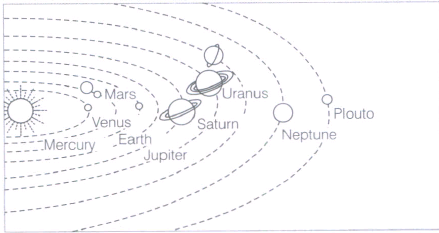
(i) How many satellites does Mars have?
(ii) How many planets are there in above picture?
16.
Write down some words originated from 'Geo' or 'Ge'?
17.
How can we say that asteroids and meteoroids are different from each other? How meteoroids are connected with the Earth?
18.
How is planet different from satellites in origin and characteristics?
19.
Mars
20.
Saturn
21.
Jupiter
22.
Neptune
23.
Earth
24.
The Greek word which is the origin of the word "planets" means ______________
25.
The shadows on the moon's surface are due to _________ and _________
26.
Three planets having rings around them are _________and _________
27.
Stars are celestial bodies that are _____________ and ____________
28.
___________are elongated fixed paths in which a celestial body always remains
1.
(c)
Constellation
2.
(a)
300,000 km/sec
3.
(a)
Akash Ganga
4.
(c)
88 days
5.
(c)
Venus
6.
The stars cannot be seen during day time because of the very bright sunlight. The powerful light of the sun makes moon and stars invisible during day time.
7.
The ancient people determined directions during night with the help of stars. The Pole Star always remains to the same direction and indicates North direction.
8.
I visited Nehru planetarium at Delhi during vacation. I went there with my parents and elder brother. My experience of planetarium was fantastic and enjoying. I have learnt a lot after visiting there. I got to know about the movement of planet and satellites. I also came to know about the stars and constellations. I learnt about thefonctioning offollowing things by visiting the planetarium:
(i) Solar system: The live show about the structure and functioning of solar system revealed the arrangement of planets, satellites, asteroids and meteoroids. I also came to know about how the entire solar system is moving because of gravitation. It showed 'how sun emits light and heat'.
(ii) Structure of planets: The programme showed structure of each planet's surrounding and surface with 'how was it made'.
(iii) Structure of satellites: The show also revealed the structure and movement of satellites like moon and artificial satellites ete. The functioning of artificial satellites was shown.
(iv) Eclipse: Half an hour programme explained the cause that creates the condition of both solar and lunar eclipse.
(v) Stars: The short film
9.
()
Rakesh Sharma is an Indian who landed on the moon
10.
()
Neptune takes 164 years in completing one orbit around trre sun, which is the highest among other planets.
11.
()
Meteoroids while dropping to the Earth get heated and burnt due to friction with air and causes a flash of light in the sky.
12.
()
Mercury is the smallest and Jupiter is the largest planet in the solar system.
13.
()
There are eight planets in our solar system.
14.
()
The sun is the nearest star of the Earth.
15.
(i) Mars has two satellites.
(ii) There are eight planets in above picture.
16.
Many words we use in Geography have originated from Greek or Roman words. 'Geo' or 'Ge' are Greek words meaning Earth.
Some of the words originated from 'geo' or 'ge' are as follows.
Geo + graphia = 'Geography' meaning description of the Earth.
Geo-i- metry = 'Geometry' meaning measurement of the Earth.
Geo + logy = 'Geology' meaning study of the Earth.
Geo+ oid = 'Geoid' meaning the shape that resembles with the Earth.
Geo-r grapher = 'Geographer' meaning one who studies geography.
17.
Apart from the planets, asteroids are the tiny celestial bodies which also move around the sun. These bodies are found in large number between the orbits of Mars and Jupiter, These are believed to be the part of a planet that exploded many years ago.
Meteoroids are the small pieces of rocks that move around the sun, These meteoroids sometimes come close to the Earth and tend to drop upon Earth.
During their drop on the Earth, they get heated up and burnt due to friction with air and cause flash of light. Sometimes, it creates a hollow on the Earth if it is not burnt completely.
18.
Satellite is a celestial body that moves around the planet in the same way as the planets move around the sun, A satellite may be artificial or natural.
Some of the planets have different number of satellites, Saturn has maximum number of satellites Artificial satellites are sent in the orbit of the Earth through rocket.
Planets move around the sun in fixed path (orbit). These paths are elongated, The various planets take different time to complete a round of sun depending upon the distance of particular planet from the sun.
19.
()
Inner planet
20.
()
Have largest number of moons
21.
()
Have rings
22.
()
Outer planet
23.
()
Blue planet
24.
()
wanderers.
25.
()
mountains, plains, depressions
26.
()
Jupiter, Saturn, Uranus
27.
()
big, hot
28.
()
Orbits

6th Standard CBSE Syllabus & Materials
6th Standard CBSE
CBSE 6th Social Science Locating Places on the Earth - New Sample Question Papers Study Material - QB365 Set A
NEW6th Standard CBSE
CBSE 6th Science A Journey Through States of Water - New Sample Question Papers Study Material - QB365 Set A
NEW6th Standard CBSE
CBSE 6th Science Temperature and its Measurement - New Sample Question Papers Study Material - QB365 Set A
NEW6th Standard CBSE
CBSE 6th Science Materials Around Us - New Sample Question Papers Study Material - QB365 Set A



NCERT Books

Syllabus

Exam Pattern

Sample Question Papers

Previous year Question Papers

Important Notes

MCQ Practice test

NCERT Exemplers

Case study Questions

Image Based Questions

Passage based Questions

HOT Questions

Value Based Questions

Model Questions Papers
NCERT ( Book Back ) Questions

Assertion and Reason
Important Questions And Answers

CBSE 6th Standard CBSE Subjects
CBSE Standards


