
 100% FREE ACCESS
6th Standard CBSE Syllabus & Materials
6th Standard CBSE
CBSE 6th Social Science The Value of Work - New Sample Question Papers Study Material - QB365 Set A
NEW6th Standard CBSE
CBSE 6th Social Science Family and Community - New Sample Question Papers Study Material - QB365 Set A
NEW6th Standard CBSE
CBSE 6th Social Science India's Cultural Roots - New Sample Question Papers Study Material - QB365 Set A
NEW6th Standard CBSE
CBSE 6th Social Science India,That is Bharat - New Sample Question Papers Study Material - QB365 Set A
NEW6th Standard CBSE
CBSE 6th Social Science Timeline and sources of history - New Sample Question Papers Study Material - QB365 Set A
NEW6th Standard CBSE
CBSE 6th Social Science Oceans and Continents - New Sample Question Papers Study Material - QB365 Set A

Published on: 25/10/2025
Download CBSE Class 6th Standard CBSE Social Science question papers, sample papers, important questions, and previous year solved papers in PDF format. Get free study materials, NCERT solutions, and exam preparation resources for Class 6th Standard CBSE Social Science
Questions + Answers key
Take MCQ Social Science Test
1.
Write a few lines on Ashoka.
2.
What impact did the war of Kalinga have on Ashoka?
3.
Who was Kautilya?
4.
How are empires different from kingdom?
5.
Discuss the Great Wall of China.
6.
What were the other methods followed by Ashoka to spread dhamma?
7.
Write a short paragraph explaining to Roshan why the lions are shown on our currency notes. list at least one other object on which you see them.
8.
Make a list of the occupations of the people who lived within the Mauryan empire.
9.
How did the Kalinga war bring about a change in Ashoka's attitude towards war?
10.
Why do you think the king (Chandragupta) had special servants to taste the food he ate?
11.
Ashoka founded the Mauryan empire
12.
The 'dhamma' also reached other countries.
13.
Messengers went to and fro, and spies kept a watch on the emperor.
14.
Most Ashokan inscriptions are in the Brahmi script.
15.
Chandragupta's ideas were written down in the Arthashastra.
16.
Kalinga is the ancient name of
Coastal Karnataka
Coastal Odisha
Coastal Goa
Coastal Maharashtra
17.
What did people provide to Mauryan officials?
Elephants
Timber
Honey and wax
All of these
18.
Which was a gateway to the North-West?
Pataliputra
Ujjain
Taxila
Rupnath
19.
Arthashastra was written by
Ashoka
Kautilya
Chandragupta
Vishvamitra
20.
A very big kingdom is known as
Empire
State
Hotel
Resort
21.
Where did Ashoka get his messages inscribed on?
Rocks and pillars
Paper
Walls
None of these
22.
Ashoka was inspired by the teachings of
Bindusara
Bimbisara
Buddha
Chandragupta
23.
Ashoka gave up war after winning over
Taxila
Pataliputra
Ujjain
Kalinga
24.
Who was the grandfather of Ashoka?
Chandragupta
Ashoka
Balwan
Samudragupta
25.
Who was the son of Chandragupta Maurya?
Bindusara
Ashoka
Bimbisara
Samudragupta
26.
How was the empire ruled by the Mauryas?
27.
How has Megasthenes described the emperor's appearance in public?
28.
The empire was a vast territory. How did the emperors run the empire?
29.
Mark the following places on the outline map of India:
(i) Pataliputra
(ii) Ujjain
(iii) Rampurwa
(iv) Kaushambi
30.
Many of Chanakya's ideas were written down in a book called the ______________
31.
The empire that Ashoka ruled was founded by his grandfather _______________more than 2300 years ago
32.
Ashoka's____________did not involve worship of a good or performance of a sacrifice
33.
______________is the ancient name of coastal Orissa.
34.
The most famous ___________ruler was Ashoka
1.
(i) The empire that Ashoka ruled was founded by his grandfather, Chandragupta Maurya, more than 2300years ago.
(ii) He was the first ruler who tried to spread his message to the people through inscriptions. Most of Ashoka's inscriptions were in Prakrit and were written in Brahmi script.
(iii)He is the only king in the history of the world who gave up conquest after winning a war.
2.
Kalinga is the ancient name of coastal Odisha. Ashoka fought a war to conquer Kalinga. However, he was so horrified when he saw the violence and bloodshed, that he decided not to fight any more wars. He is the only king in the history of the world who gave up conquest after winning a war
3.
Chandragupta Maurya was supported by a wise man named Chanakya or Kautilya. Many of Chanakya's ideas were written down in a book called' Arthashastra'.
4.
Empires need more resources than kingdoms because empires are larger than kingdoms and need to be protected. They also need a larger number of officials who collect taxes.
5.
Somewhat before the time of the Mauryan empire, about 2400 years ago, emperors in China began building the Great Wall to protect the northern frontier of the empire from pastoral people. Additions to the wall were made over a period of 2000 years because the frontiers of the empire kept shifting. The wall is about 6400 km long, and is made of stone and brick, with a road along the top. Several thousand people worked to build the wall. There are watch towers all along, at distances of about 100-200 m.
6.
Ashoka felt it was his duty to solve the problems of the people of his empire. So, he appointed officials, known as the dhamma mahamatta who went from place to place teaching people about dhamma. Ashoka also sent messengers to spread ideas about dhamma to other lands, such as Syria, Egypt, Greece and Sri Lanka.
7.
The lions are part of the Lion Capital in Sarnath. These lions are shown on our currency notes in honour of one of the greatest kings of India, Ashoka, who built the capital. We can see the lions on stamp paper also.
8.
The different occupations followed by the people were:
(i) Farming
(ii) Pastoral farming
(iii) Carpentery
(iv) Masonary
(v) Government officials
(vi) Many people were employed in Royal army.
9.
When Ashoka became the king, Kalinga was not the part of Maury an empire. He decided to conquer Kalinga. He invaded Kalinga and conquered it. But both the armies suffered heavy losses. According to Ashoka, 1,00,000 people were killed in this war, and 1,50,000 were taken prisoners. Ashoka saw the wounded and dying soldiers, and the widows, orphans and the misery and sufferings that war had brought to the people. This caused Ashoka much grief and remorse. So, he decided that he would not fight any more wars in future.
10.
The king was afraid that someone might try to kill him, so he had special servants to taste the food before he ate.
11.
(b)
12.
(a)
13.
(b)
14.
(a)
15.
(b)
16.
(b)
Coastal Odisha
17.
(d)
All of these
18.
(c)
Taxila
19.
(b)
Kautilya
20.
(a)
Empire
21.
(a)
Rocks and pillars
22.
(c)
Buddha
23.
(d)
Kalinga
24.
(a)
Chandragupta
25.
(a)
Bindusara
26.
As the empire was very large, different parts were ruled differently by various Mauryans.
(i) The area around Pataliputra was under the direct control of the emperor. The officials were appointed to collect taxes from farmers, herders, craftspersons, and traders who lived in villages and towns in the area. Officials also punished those who disobeyed the ruler's orders.
(ii) There were other areas or provinces. Each of them was ruled from a provincial capital such as Taxila or Ujjain and there was some amount of control from Pataliputra. Royal princes were often sent as Governors.
(iii)Besides, there were vast areas between these centres. Here, the Mauryas tried to control roads and rivers which were important for transport and to collect whatever resources were available as tax and tribute.
(iv) There were also the forested regions. People living in these areas were more or less independent but were expected to provide elephants, timber, honey, and wax to the Mauryan officials.
27.
Megasthenes described the emperor's appearance in public as:
• The occasions on which the emperor appeared in public were celebrated with grand royal processions.
• He was carried in a golden palanquin. His guards rode elephants decorated with gold and silver.
• Some of the guards carried trees on which live birds, including a flock of trained parrots, circle about the head of the emperor. The king was normally surrounded by armed women.
• He was afraid that someone might try to kill him.
28.
The emperors run the empire as:
• The ruling pattern was varying in empires due to the largeness of the empire.
• The area around Pataliputra was under the direct control of the emperor meant that officials were appointed to collect taxes from farmers, herders, craftspersons and traders, who lived in villages and towns in the area.
• Many of these officials were given salaries and these officials punished those who disobeyed the ruler's orders.
• Messengers went to and fro, and spies kept a watch on the officials and of course the emperor supervised them all, with the help of members of the royal family, and senior ministers.
• The other areas or provinces were ruled from a provincial capital such as Taxila or Ujjain although there was some amount of control from Pataliputra.
• The royal princes were often sent as governors, local customs and rules were probably followed.
29.
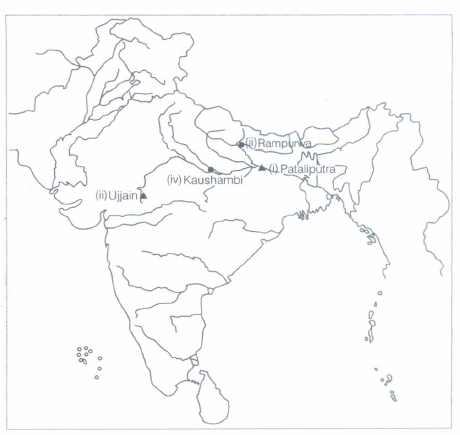
30.
()
Arthashastra
31.
()
Chandragupta Maurya
32.
()
Dhamma
33.
()
Kalinga
34.
()
Mauryan

6th Standard CBSE Syllabus & Materials
6th Standard CBSE
CBSE 6th Social Science Locating Places on the Earth - New Sample Question Papers Study Material - QB365 Set A
NEW6th Standard CBSE
CBSE 6th Science A Journey Through States of Water - New Sample Question Papers Study Material - QB365 Set A
NEW6th Standard CBSE
CBSE 6th Science Temperature and its Measurement - New Sample Question Papers Study Material - QB365 Set A
NEW6th Standard CBSE
CBSE 6th Science Materials Around Us - New Sample Question Papers Study Material - QB365 Set A



NCERT Books

Syllabus

Exam Pattern

Sample Question Papers

Previous year Question Papers

Important Notes

MCQ Practice test

NCERT Exemplers

Case study Questions

Image Based Questions

Passage based Questions

HOT Questions

Value Based Questions

Model Questions Papers
NCERT ( Book Back ) Questions

Assertion and Reason
Important Questions And Answers

CBSE 6th Standard CBSE Subjects
CBSE Standards


