
 100% FREE ACCESS
6th Standard CBSE Syllabus & Materials
6th Standard CBSE
CBSE 6th Social Science The Value of Work - New Sample Question Papers Study Material - QB365 Set A
NEW6th Standard CBSE
CBSE 6th Social Science Family and Community - New Sample Question Papers Study Material - QB365 Set A
NEW6th Standard CBSE
CBSE 6th Social Science India's Cultural Roots - New Sample Question Papers Study Material - QB365 Set A
NEW6th Standard CBSE
CBSE 6th Social Science India,That is Bharat - New Sample Question Papers Study Material - QB365 Set A
NEW6th Standard CBSE
CBSE 6th Social Science Timeline and sources of history - New Sample Question Papers Study Material - QB365 Set A
NEW6th Standard CBSE
CBSE 6th Social Science Oceans and Continents - New Sample Question Papers Study Material - QB365 Set A

Published on: 25/10/2025
Download CBSE Class 6th Standard CBSE Social Science question papers, sample papers, important questions, and previous year solved papers in PDF format. Get free study materials, NCERT solutions, and exam preparation resources for Class 6th Standard CBSE Social Science
Questions + Answers key
Take MCQ Social Science Test
1.
You have a manuscript which a Chinese pilgrim would like to carry back with him. Describe your conversation.
2.
Why do you think he did not want to throw away his books and statues?
3.
Why did kings want to control the Silk Route?
4.
List the reasons why Xuan Zang wanted to study in Nalanda
5.
Why do you think Fa Xian did not want to throw away his books and statues?
6.
The word Bhaj means 'to divide or share'.
7.
It was about 7000 years ago, making of silk was discovered.
8.
Gautamiputra Shri Satakarni is one of the Satavahana rulers.
9.
The chiefs focused on collecting regular taxes
10.
Central India was famous for gold and spices
11.
___________________poems mention the word muvendar.
12.
Buddha's attainment of enlightenment was shown by sculptures of the_______________tree.
13.
Bhakti comes from Sanskrit word_______________
14.
In______________ system, devotee worships the chosen deity with pure heart
15.
____________________is a unique centre of Buddhist learning
16.
Technique of making silk was first invented in
China
South India
Sri Lanka
None of these
17.
Dakshinapatha literally refers to route leading to
North
South
East
West
18.
The Southern half of the sub-continent is marked by
hills
plateaus
river valleys
All of these
19.
Roman Empire found Black Gold in
Central India
North India
South India
East India
20.
South India was famous for
gold
pepper
precious stones
All of these
21.
What were the two major centres of power of Kushanas?
22.
Who were the best known rulers who controlled the Silk Route?
23.
What makes silk a highly valued fabric?
24.
Who came to be known as lords of the dakshinapatha?
25.
How did we come to know about Gautamiputra?
26.
Answer the following questions based on the picture given below:
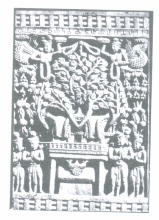
(i) What does the empty seat below tree represent?
(ii)Where the above sculpture belongs to?
27.
Give an account of the beginning of Bhakti.
28.
'Each of these pilgrims left an account of his journey'. Discuss.
1.
Fa-Xian: What is this in your hand?
Ravi: It is a manuscript which my father gave me to read.
Fa-Xian: May I see this manuscript?
Ravi: Why not, It is our precious inheritance and I think you will get a lot of knowledge about our culture and tradition.
Fa-Xian: After observing keenly Amazing it is a great thing, if you permit me to carry with me.
Ravi: Yes, I'll feel great pleasure, if you tell your people about us and our heritage.
Fa-Xian: May I See this manuscript?
2.
Fa-Xian did not throw away his books and statues because he loved them and they were all an important collection for preservation.
3.
The kings wanted to control the Silk Route, because they could benefit from taxes, tributes and gifts that were brought by the traders along the Silk Route
4.
Nalanda was a unique centre of Buddhist learning and the most famous Buddhist monastery of that period
Xuan Zang wanted to study in Nalanda as:
• The teachers are men of the highest ability and talent. They follow the teachings of the Buddha in all sincerity.
• The rules of the monastery are strict and everyone has to follow them.
5.
Fa Xian began his journey back home from Bengal. He boarded a ship belonging to some merchants. They had barely travelled for two days when they we caught in a storm. The merchants began throwing their merchandise overboard so as to lighten the load and save the ship from sinking. FaXian threw away his meagre personal belongings, but clung to his books and the statues of the Buddha that he had collected. The books and statues were very precious for him, so he did not want to throw away his books and statues.
6.
(a)
7.
(a)
8.
(a)
9.
(b)
10.
(b)
11.
()
Sangam
12.
()
peepal
13.
()
Bhaj
14.
()
Bhakti
15.
()
Nalanda
16.
(a)
China
17.
(b)
South
18.
(d)
All of these
19.
(c)
South India
20.
(d)
All of these
21.
()
Peshawar and Mathura were the two major centres of power of Kushanas.
22.
()
Kushanas were the best known rulers who controlled the Silk Route.
23.
()
The rich, glossy colours of silk and its smooth texture makes it a highly valued fabric.
24.
()
Gautamiputra Shri Satakarni and other Satavahana rulers were called as lords of the dakshinapatha.
25.
()
We came to know about Gautamiputra from an inscription composed by his mother, Gautami Balashri.
26.
(i)It indicates that the Buddha had attained enlightenment while meditating under the tree
(ii)The sculpture belongs to the Stupa at Sanchi
27.
The starting of the Bhakti became Central feature of later Hinduism. It was the time when certain deities were worshipped such as Shiva, Vishnu and Goddesses as Durga. Bhakti refers to a persons's devotion to his or her chosen deity. Anybody could follow the path of Bhakti, be it rich or poor, people belonging to 'high' or 'low' caste, man or woman. The concept of Bhakti is also present in sacred book of the Hindus i.e. 'Bhagavad Gita', included in the Mahabharata. This type of worship spread to various parts of the country. The people who followed Bhakti focused on devotion and individual worship of a God or Goddess and not on the performance of elaborate sacrifices.
28.
Each pilgrim left experiences of their journies
• They wrote about the dangers they faced and experiences during their travels to the
countries and the monasteries.
• They wrote about the books they carried back with them
• Xuan Zang went back China through the land route. He carried statues of Buddha made of
gold, silver and sandalwood
• He also took about 600 manuscripts loaded on about 20 horses He spent his life converting the manuscripts from Sanskrit to Chinese.
• Fa Xian also took many manuscripts with him He also gave us detailed description of his journey and contemporary Indian society.

6th Standard CBSE Syllabus & Materials
6th Standard CBSE
CBSE 6th Social Science Locating Places on the Earth - New Sample Question Papers Study Material - QB365 Set A
NEW6th Standard CBSE
CBSE 6th Science A Journey Through States of Water - New Sample Question Papers Study Material - QB365 Set A
NEW6th Standard CBSE
CBSE 6th Science Temperature and its Measurement - New Sample Question Papers Study Material - QB365 Set A
NEW6th Standard CBSE
CBSE 6th Science Materials Around Us - New Sample Question Papers Study Material - QB365 Set A



NCERT Books

Syllabus

Exam Pattern

Sample Question Papers

Previous year Question Papers

Important Notes

MCQ Practice test

NCERT Exemplers

Case study Questions

Image Based Questions

Passage based Questions

HOT Questions

Value Based Questions

Model Questions Papers
NCERT ( Book Back ) Questions

Assertion and Reason
Important Questions And Answers

CBSE 6th Standard CBSE Subjects
CBSE Standards


