
 100% FREE ACCESS
6th Standard CBSE Syllabus & Materials
6th Standard CBSE
CBSE 6th Social Science The Value of Work - New Sample Question Papers Study Material - QB365 Set A
NEW6th Standard CBSE
CBSE 6th Social Science Family and Community - New Sample Question Papers Study Material - QB365 Set A
NEW6th Standard CBSE
CBSE 6th Social Science India's Cultural Roots - New Sample Question Papers Study Material - QB365 Set A
NEW6th Standard CBSE
CBSE 6th Social Science India,That is Bharat - New Sample Question Papers Study Material - QB365 Set A
NEW6th Standard CBSE
CBSE 6th Social Science Timeline and sources of history - New Sample Question Papers Study Material - QB365 Set A
NEW6th Standard CBSE
CBSE 6th Social Science Oceans and Continents - New Sample Question Papers Study Material - QB365 Set A

Published on: 25/10/2025
Download CBSE Class 6th Standard CBSE Social Science question papers, sample papers, important questions, and previous year solved papers in PDF format. Get free study materials, NCERT solutions, and exam preparation resources for Class 6th Standard CBSE Social Science
Questions + Answers key
Take MCQ Social Science Test
1.
Mathura was famous because it was a
port
forested area
religious centre
All of the above
2.
In South India the Cholas, Cheras and Pandyas ruled between
2500 and 2000 years ago
2200 and 1800 years ago
3500 and 3000 years ago
3000 and 2000 years ago
3.
Which kinds of inscriptions have been found in Mathura?
Stone slabs and statues
Mud bricks
Palaces inscriptions
None of the above
4.
The palaces of early cities (2500 years ago) did not survive because they were made of
wood
iron
mud brick
Both 'a' and 'c'
5.
When did the use of iron begin in the sub-continent?
Around 3000 years ago
Around 2300 years ago
Around 2500 years ago
Around 3500 years ago
6.
How was Arretine Ware made?
7.
What do you understand by Arikamedu?
8.
Why were Varanasi and Madurai famous?
9.
How did the dasa karmakaras earn a living?
10.
Mention the occupations of people who lived in Mathura?
11.
Write a note on the shrenis.
12.
What is the Sangam literature and when were they composed?
13.
Write a short note on Bharuch.
14.
What archaeological sources have been excavated in Arikamedu?
15.
Discuss the scene of a smith's shop.
16.
Answer the following questions based on picture given below:
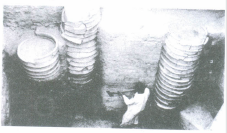
(i) What does this picture represent?
(ii) These are made-up of which material?
(iii) What was the function of the above picture?
17.
Explain the main features of Arikamedu settlement.
18.
Landless labourers were known as ________________
19.
Uzhavar were ordinary ______________
20.
In the Tamil region, large landowners were known as ______________
21.
The largest collections of _____________and weapons were found in the _________burials.
22.
The use of iron began in the sub-continent around___________
23.
Sangam literature
24.
Arikamedu
25.
Mathura
26.
Earliest coins
27.
Irrigation work
1.
(c)
religious centre
2.
(b)
2200 and 1800 years ago
3.
(a)
Stone slabs and statues
4.
(d)
Both 'a' and 'c'
5.
(a)
Around 3000 years ago
6.
()
The Arretine Ware was made by pressing wet clay into a stamped mould. It was red-glazed pottery.
7.
()
Between 2200 and 1900 years ago, Arikamedu was a coastal settlement where ships unloaded goods from distant lands.
8.
()
Varanasi and Madurai were famous for manufacturing of cloth.
9.
()
The dasa karmakaras did not own land and they used to work on the fields owned by others.
10.
()
People living in Mathura were goldsmiths, blacksmiths, weavers, basket makers, garland makers and perfumers.
11.
Many craftspersons and merchants formed associations known as shrenis.
These shrenis of craftspersons provided training, procured raw material and distributed the finished product. Then shrenis of merchants organised the trade. Shrenis also served as banks, where rich men and women deposited money.
This was invested, and part of the interest was returned or used to support religious institutions, such as monasteries.
12.
The earliest works in Tamil, known as Sangam literature, were composed around 2300 years ago. These texts were called Sangam because they were supposed to have been composed and compiled in assemblies (known as Sangams) of poets that were held in the city of Madurai.
13.
The gulf is very narrow at Bharuch and it was very difficult to navigate for those coming from the sea. Only experienced, skilful local fishermen employed by the king could do that.
The imports into Bharuch were wine, copper, tin, lead, coral, topaz, cloth, gold and silver coins. Exports included plants from the Himalayas, ivory, agate, carnelian, cotton, silk and perfumes.
14.
A massive brick structure, which may have been a warehouse, was found at Arikamedu. Other finds include pottery like amphorae (tall double-handled jars that contained liquids such as wine or oil), stamped red-glazed pottery, Roman lamps, glassware, gems etc.
15.
At shop of a smith, we can see a small bench on which iron tools are laid out, ready for sale. We can also see a bright fire burning and two men heating and. beating metal rods into shape
It is generally very hot and noisy, and yet it IS fascinating to watch what is happening.
16.
(i)The picture shows the rows of pots which are known as ring wells.
(ii)These are made-up of ceramics.
(iii)The function of the ringwells have been used as toilets in·some cases, and as drains and garbage dumps. These ringwells are usually found in individual houses.
17.
(i) Arikamedu is located in Pondicherry. Between 2200 and 1900 years ago, this site was a coastal settlement where ships unloaded goods from distant lands.
(ii) A massive brick structure, which may have been a warehouse, was found at the site.
(iii) Other finds of Arikamedu included pottery from the Mediterranean region, such as amphorae, stamped red-glazed pottery, local made pottery which used Roman designs.
(iv) Roman lamps, glassware and gems have also been found at the site.
(vi) Small tanks have been found that were probably used to dye cloth.
(vii) There is plenty of evidence for the making of beads from semi-precious stones and glass.
18.
()
kadaisiyar
19.
()
plough men
20.
()
vellalar
21.
()
iron tools, megalithic
22.
()
3000 years ago
23.
()
Around 2300 years ago
24.
()
Pondicherry
25.
()
Second capital of the Kushanas
26.
()
Silver or copper
27.
()
Around 2500 years ago

6th Standard CBSE Syllabus & Materials
6th Standard CBSE
CBSE 6th Social Science Locating Places on the Earth - New Sample Question Papers Study Material - QB365 Set A
NEW6th Standard CBSE
CBSE 6th Science A Journey Through States of Water - New Sample Question Papers Study Material - QB365 Set A
NEW6th Standard CBSE
CBSE 6th Science Temperature and its Measurement - New Sample Question Papers Study Material - QB365 Set A
NEW6th Standard CBSE
CBSE 6th Science Materials Around Us - New Sample Question Papers Study Material - QB365 Set A



NCERT Books

Syllabus

Exam Pattern

Sample Question Papers

Previous year Question Papers

Important Notes

MCQ Practice test

NCERT Exemplers

Case study Questions

Image Based Questions

Passage based Questions

HOT Questions

Value Based Questions

Model Questions Papers
NCERT ( Book Back ) Questions

Assertion and Reason
Important Questions And Answers

CBSE 6th Standard CBSE Subjects
CBSE Standards


