
 100% FREE ACCESS
6th Standard CBSE Syllabus & Materials
6th Standard CBSE
CBSE 6th Social Science The Value of Work - New Sample Question Papers Study Material - QB365 Set A
NEW6th Standard CBSE
CBSE 6th Social Science Family and Community - New Sample Question Papers Study Material - QB365 Set A
NEW6th Standard CBSE
CBSE 6th Social Science India's Cultural Roots - New Sample Question Papers Study Material - QB365 Set A
NEW6th Standard CBSE
CBSE 6th Social Science India,That is Bharat - New Sample Question Papers Study Material - QB365 Set A
NEW6th Standard CBSE
CBSE 6th Social Science Timeline and sources of history - New Sample Question Papers Study Material - QB365 Set A
NEW6th Standard CBSE
CBSE 6th Social Science Oceans and Continents - New Sample Question Papers Study Material - QB365 Set A

Published on: 25/10/2025
Download CBSE Class 6th Standard CBSE Social Science question papers, sample papers, important questions, and previous year solved papers in PDF format. Get free study materials, NCERT solutions, and exam preparation resources for Class 6th Standard CBSE Social Science
Questions + Answers key
Take MCQ Social Science Test
1.
Rome is one of the oldest cities in Europe, and developed around the same time as the cities in the Ganga valley. Rome was the capital of one of the largest empires, one that spread across Europe, North Africa and West Asia. Augustus, one of the most important emperors, who ruled about 2000 years ago, said that he found Rome a city of brick and made it into a city of marble. He and later rulers, built temples and palaces. They also built huge amphitheatres- open arenas surrounded by tiers of seats- where citizens could watch all kinds of shows and public baths (with separate timings for men and women), where people met and relaxed. Huge aqueducts- channels to supply water- were built to bring water to the city- for the baths, fountains and toilets.
Why do you think the amphitheatres and aqueducts have survived?
2.
What is the Sangam literature and when were they composed?
3.
Discuss the scene of a smith's shop.
4.
Compare the drainage system in your locality with that of the cities mentioned in the lesson. What similarities and differences do you notice?
5.
Look at the chart, you will find that some of the stages in the construction of irrigation works are mentioned. fill in the rest by using the following phrases:
• Labour is provided by the people.
• Farmers also benefit because crop production is more certain.
• Farmers have to increase production to pay taxes.
• Kings provide money and plan irrigation works.
| 1. Kings need money for armies, palaces, forts. | 2. They demand taxes from farmers. |
| 3. ______________ | 4. This is possible with irrigation. |
| 5. ______________ | 6. __________________ |
| 7.Production increases. | 8. So does revenue. |
| 9._______________ | |
6.
Landless labourers were known as ________________
7.
Uzhavar were ordinary ______________
8.
The largest collections of _____________and weapons were found in the _________burials.
9.
Ploughmen were known as ______________in Tamil.
10.
____________was a word used for large landowners in Tamil.
11.
Mathura was famous because it was a
port
forested area
religious centre
All of the above
12.
Which kinds of inscriptions have been found in Mathura?
Stone slabs and statues
Mud bricks
Palaces inscriptions
None of the above
13.
When did the use of iron begin in the sub-continent?
Around 3000 years ago
Around 2300 years ago
Around 2500 years ago
Around 3500 years ago
14.
Which of the following religions is related to Jataka?
Jaina
Buddhism
Hindu
Christian
15.
Ring wells were used as
bathing
washing clothes
irrigation
drainage
16.
What was used as a dye cloth?
17.
How was Arretine Ware made?
18.
Why were Varanasi and Madurai famous?
19.
What was the use of iron tools?
20.
Which kinds of places or markets did not survive?
21.
List the craftspersons in most of villages.
22.
What were the irrigation works built around 2500 years ago?
23.
When did the use of iron begin?
24.
What do you mean by Tamil-Brahmi inscriptions?
25.
What was being done by Prabhakar?
26.
Answer the following questions based on picture given below:
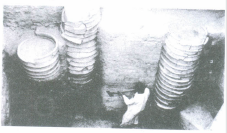
(i) What does this picture represent?
(ii) These are made-up of which material?
(iii) What was the function of the above picture?
27.
Explain the main features of Arikamedu settlement.
1.
The amphitheatre and aqueducts were made of bricks and cement mortar. Romans were the first to find cement
2.
The earliest works in Tamil, known as Sangam literature, were composed around 2300 years ago. These texts were called Sangam because they were supposed to have been composed and compiled in assemblies (known as Sangams) of poets that were held in the city of Madurai.
3.
At shop of a smith, we can see a small bench on which iron tools are laid out, ready for sale. We can also see a bright fire burning and two men heating and. beating metal rods into shape
It is generally very hot and noisy, and yet it IS fascinating to watch what is happening.
4.
In our locality, the drainage system include pipes and drains.
Similarities: I live in a city. Our locality has good drainage system. Every individual house or building also has a good drainage system.
Differences: Nowadays, everything is well-maintained and made up of good raw materials. But in early cities mud bricks and thatch had been used, might not have been survived long.
5.
| 1. Kings need money for armies, palaces, forts. | 2. They demand taxes from farmers. |
| 3. Farmers have to increase production to pay taxes. | 4. This is possible with irrigation. |
| 5. Kings provide money and plan irrigation works. | 6. Labour is provided by the people |
| 7.Production increases. | 8. So does revenue. |
| 9. Farmers also benefit because crop production is more certain. | |
6.
()
kadaisiyar
7.
()
plough men
8.
()
iron tools, megalithic
9.
()
uzhavar
10.
()
Vellalar
11.
(c)
religious centre
12.
(a)
Stone slabs and statues
13.
(a)
Around 3000 years ago
14.
(b)
Buddhism
15.
(d)
drainage
16.
()
Small tanks have been found that were probably dyeing vats, used to dye cloth
17.
()
The Arretine Ware was made by pressing wet clay into a stamped mould. It was red-glazed pottery.
18.
()
Varanasi and Madurai were famous for manufacturing of cloth.
19.
()
Iron tools were used for clearing forests and for increasing agricultural production.
20.
()
The places or markets which were made up of wood, mud brick and thatch, may not have survived.
21.
()
In most villages there were also some crafts persons such as the blacksmiths, potters, carpenters and weavers.
22.
()
The irrigation works that were built around 2500 years ago were canals wells. tanks and artificial lakes
23.
()
The use of iron began in the sub-continent around 3000 years ago
24.
()
Several pieces of pottery have inscriptions in the early Brahmi script, which was used to write Tamil. These are called Tamil-Brahmi inscriptions
25.
()
Prabhakar sat watching the smiths at the local shop.
26.
(i)The picture shows the rows of pots which are known as ring wells.
(ii)These are made-up of ceramics.
(iii)The function of the ringwells have been used as toilets in·some cases, and as drains and garbage dumps. These ringwells are usually found in individual houses.
27.
(i) Arikamedu is located in Pondicherry. Between 2200 and 1900 years ago, this site was a coastal settlement where ships unloaded goods from distant lands.
(ii) A massive brick structure, which may have been a warehouse, was found at the site.
(iii) Other finds of Arikamedu included pottery from the Mediterranean region, such as amphorae, stamped red-glazed pottery, local made pottery which used Roman designs.
(iv) Roman lamps, glassware and gems have also been found at the site.
(vi) Small tanks have been found that were probably used to dye cloth.
(vii) There is plenty of evidence for the making of beads from semi-precious stones and glass.

6th Standard CBSE Syllabus & Materials
6th Standard CBSE
CBSE 6th Social Science Locating Places on the Earth - New Sample Question Papers Study Material - QB365 Set A
NEW6th Standard CBSE
CBSE 6th Science A Journey Through States of Water - New Sample Question Papers Study Material - QB365 Set A
NEW6th Standard CBSE
CBSE 6th Science Temperature and its Measurement - New Sample Question Papers Study Material - QB365 Set A
NEW6th Standard CBSE
CBSE 6th Science Materials Around Us - New Sample Question Papers Study Material - QB365 Set A



NCERT Books

Syllabus

Exam Pattern

Sample Question Papers

Previous year Question Papers

Important Notes

MCQ Practice test

NCERT Exemplers

Case study Questions

Image Based Questions

Passage based Questions

HOT Questions

Value Based Questions

Model Questions Papers
NCERT ( Book Back ) Questions

Assertion and Reason
Important Questions And Answers

CBSE 6th Standard CBSE Subjects
CBSE Standards


