
 100% FREE ACCESS
6th Standard CBSE Syllabus & Materials
6th Standard CBSE
CBSE 6th Social Science The Value of Work - New Sample Question Papers Study Material - QB365 Set A
NEW6th Standard CBSE
CBSE 6th Social Science Family and Community - New Sample Question Papers Study Material - QB365 Set A
NEW6th Standard CBSE
CBSE 6th Social Science India's Cultural Roots - New Sample Question Papers Study Material - QB365 Set A
NEW6th Standard CBSE
CBSE 6th Social Science India,That is Bharat - New Sample Question Papers Study Material - QB365 Set A
NEW6th Standard CBSE
CBSE 6th Social Science Timeline and sources of history - New Sample Question Papers Study Material - QB365 Set A
NEW6th Standard CBSE
CBSE 6th Social Science Oceans and Continents - New Sample Question Papers Study Material - QB365 Set A

Published on: 24/10/2025
Download CBSE Class 6th Standard CBSE Social Science question papers, sample papers, important questions, and previous year solved papers in PDF format. Get free study materials, NCERT solutions, and exam preparation resources for Class 6th Standard CBSE Social Science
Questions + Answers key
Take MCQ Social Science Test
1.
This is a picture of an aqueduct in Rome. Answer the following questions related to this picture:
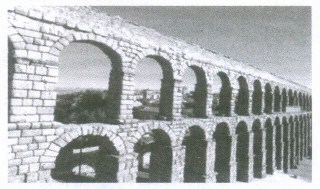
(i) What are aqueducts?
(ii) Why did the Roman emperor build huge aqueducts?
(iii) What are amphitheatres?
(iv) Mention one important emperor of the Roman empire.
2.
Read the following passage and answer the questions given below:
"The gulf is very narrow at Barygaza and very hard to navigate for those coming from the sea. Ships had to be steered in by skillful and experienced local fishermen who were employed by the King. The imports into Barygaza were wine, copper, tin, lead, coral, topaz, cloth, gold and silver coins. Exports from the towns included plants from the Himalayas, ivory, agate, carnelian, cotton, silk and perfumes. Special gifts were brought by merchants for the King. These included vessels of silver, singing boys, beautiful women, fine wines and fine cloth."
(i) What did the merchants bring for the King?
(ii) Make a list of the imports and exports from Barygaza.
(iii)Who steered the ships?
3.
Why is the city of Arikamedu historically important?
4.
What is the importance of the city of Mathura?
5.
What type of life was there in villages and towns?
6.
Answer the following questions based on picture given below:
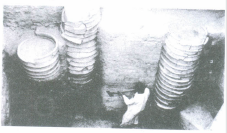
(i) What does this picture represent?
(ii) These are made-up of which material?
(iii) What was the function of the above picture?
7.
Answer the questions based on the figure given below:
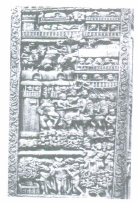
(i) The above sculpture is associated with which state?
(ii) Write anyone use of this sculpture
(iii) It has been found from where?
8.
How do we find out about early cities of the sub-continent?
9.
Explain the main features of Arikamedu settlement.
10.
Write about grama bhojaka.
1.
(i) Aqueducts were huge channels to supply water.
(ii) The Roman emperors built these aqueducts to bring water to the city for the baths, fountains and toilets.
(iii) Amphitheatres were open arenas surrounded by tiers of seats where citizens could watch all kinds of shows.
(iv) King Augustus was one of the important emperors of the Roman empire.
2.
(i) Merchants brought special gifts like vessels of silver, singing boys, beautiful women, fine wines and fine cloth for the King.
(ii) Wine, copper, tin, lead, coral, topaz, cloth, gold and silver coins were imported into Barygaza. While exports from the town included plants from the Himalayas, ivory, agate, carnelian, cotton, silk and perfumes.
(iii) Ships were steered in by skillful and experienced local fishermen.
3.
(i) Between 2200 and 1900 years ago, Arikamedu was a coastal settlement where ships unloaded goods from distant lands.
(ii) A massive brick structure, which may have been a warehouse was found at the site.
(iii) Other findings include pottery from the Mediterranean region, such as amphorae (tall double-handled jars that contained liquids such as wine or oil) and stamped red-glazed pottery, known as Arretine Ware which was named after a city in Italy.
(iv) Roman lamps, glassware and gems have also been found at the site.
(v) Small tanks have been found that were probably dyeing vats, used to dye cloth.
4.
(i) Mathura has been an important settlement for more than 2500 years. It was important because it was located at the crossroads of two major routes of travel and trade - from the North- West to the East and from North to South.
(ii) Mathura was also a centre where some extremely fine sculptures were produced.
(iii) Around 2000 years ago, Mathura became the second capital of the Kushanas.
(iv) Mathura was also a religious centre - there were Buddhist monasteries, Jain shrines and it was an important centre for the worship of Krishna.
5.
(i) Growth of towns: The establishment of kingdoms and empires led to an increase in agriculture and trade. Internal and overseas trade routes opened up. These developments resulted in the growth of towns.
(ii) Greater agriculture production: Agricultural production increased due to an increased use of iron tools. It became possible to produce more from the same land. Iron tools such as axe helped in clearing forests. The kings of the period also encouraged the building of irrigation works and dug wells, tanks and canals.
(iii) Growth of crafts: Arts and crafts also flourished. Each village had potters, weavers, dyers, metal workers, carpenters, blacksmiths, goldsmiths, garland makers, basket makers and other craftsmen.
(iv) Functions of town: Some towns were religious centres, while others were administrative centres. Broach, Sopara and Tamralipti were trading centres.
6.
(i)The picture shows the rows of pots which are known as ring wells.
(ii)These are made-up of ceramics.
(iii)The function of the ringwells have been used as toilets in·some cases, and as drains and garbage dumps. These ringwells are usually found in individual houses.
7.
(i)The sculpture is associated with stupas in Madhya Pradesh.
(ii)It helps us to find about old cities
(iii)The sculpture has been found in Sanchi Madhya Pradesh.
8.
We find out about early cities of the sub-continent through the following sources:
(i) Stories The Jatakas were stories that were probably composed by ordinary people and then written down and preserved by Buddhist monks. The Jatakas throw sufficient light on the lives of the people who used to live there.
(ii) Accounts of travellers and sailors Another way of finding out about early cities is from the accounts of sailors and travellers who visited them.
(iii) Sculptures We can use other kinds of evidences to find out about life in some of these early cities. Sculptors carved scenes depicting peoples lives in towns and villages, as well as in the forest.
(iv) Archaeological findings In many early cities, archaeologists have found rows of pots or ceramic rings arranged one on top of the other. They have also found many silver and copper coins. From all these findings, many important facts about the early cities can be known.
9.
(i) Arikamedu is located in Pondicherry. Between 2200 and 1900 years ago, this site was a coastal settlement where ships unloaded goods from distant lands.
(ii) A massive brick structure, which may have been a warehouse, was found at the site.
(iii) Other finds of Arikamedu included pottery from the Mediterranean region, such as amphorae, stamped red-glazed pottery, local made pottery which used Roman designs.
(iv) Roman lamps, glassware and gems have also been found at the site.
(vi) Small tanks have been found that were probably used to dye cloth.
(vii) There is plenty of evidence for the making of beads from semi-precious stones and glass.
10.
In the Northern part of the country, the village headman was known as the grama bhojaka. The post was hereditary, i.e. men from the same family held the position for generations.
The grama bhojaka was often the largest landowner. He had slaves and hired workers to cultivate the land. The king often used him to collect taxes from the village. He also functioned as a judge and sometimes as a policeman.

6th Standard CBSE Syllabus & Materials
6th Standard CBSE
CBSE 6th Social Science Locating Places on the Earth - New Sample Question Papers Study Material - QB365 Set A
NEW6th Standard CBSE
CBSE 6th Science A Journey Through States of Water - New Sample Question Papers Study Material - QB365 Set A
NEW6th Standard CBSE
CBSE 6th Science Temperature and its Measurement - New Sample Question Papers Study Material - QB365 Set A
NEW6th Standard CBSE
CBSE 6th Science Materials Around Us - New Sample Question Papers Study Material - QB365 Set A



NCERT Books

Syllabus

Exam Pattern

Sample Question Papers

Previous year Question Papers

Important Notes

MCQ Practice test

NCERT Exemplers

Case study Questions

Image Based Questions

Passage based Questions

HOT Questions

Value Based Questions

Model Questions Papers
NCERT ( Book Back ) Questions

Assertion and Reason
Important Questions And Answers

CBSE 6th Standard CBSE Subjects
CBSE Standards


