
 100% FREE ACCESS
6th Standard CBSE Syllabus & Materials
6th Standard CBSE
CBSE 6th Social Science The Value of Work - New Sample Question Papers Study Material - QB365 Set A
NEW6th Standard CBSE
CBSE 6th Social Science Family and Community - New Sample Question Papers Study Material - QB365 Set A
NEW6th Standard CBSE
CBSE 6th Social Science India's Cultural Roots - New Sample Question Papers Study Material - QB365 Set A
NEW6th Standard CBSE
CBSE 6th Social Science India,That is Bharat - New Sample Question Papers Study Material - QB365 Set A
NEW6th Standard CBSE
CBSE 6th Social Science Timeline and sources of history - New Sample Question Papers Study Material - QB365 Set A
NEW6th Standard CBSE
CBSE 6th Social Science Oceans and Continents - New Sample Question Papers Study Material - QB365 Set A

Published on: 25/10/2025
Download CBSE Class 6th Standard CBSE Social Science question papers, sample papers, important questions, and previous year solved papers in PDF format. Get free study materials, NCERT solutions, and exam preparation resources for Class 6th Standard CBSE Social Science
Questions + Answers key
Take MCQ Social Science Test
1.
List some of the common features of all the burials.
2.
How were the oracle bones used by the kings in China?
3.
Write a short note on the Rigveda.
4.
Can we make out whether a skeleton was that of a man or a woman?
5.
Was iron used in the Harappan cities?
6.
What is the feminine of dasa?
dasi
dasay
dasasi
dasyu
7.
The Rigveda is composed in the form of
poetry
dialogues
hymns
stories
8.
What were used for entering the burial places?
Surface-holes
Burial-holes
Port-holes
Stone-holes
9.
Stone circles or boulders on the surface were used to cover the
house
burial places
port-holes
All of these
10.
______ were used for various kind of work.
Carpenters
Farmers
Slaves
Labour
11.
Who were dasas?
12.
Mention three important Rigvedic Gods.
13.
Who were Aryas?
14.
When was the Rigveda composed?
15.
How many Vedas are there?
16.
Answer the questions based on the picture given below:
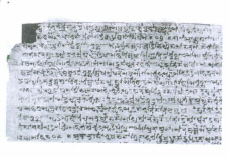

(i) Above manuscript belongs to which Vedic period?
(ii) Name the place where this manuscript was found?
(iii) At present time where it is preserved?
17.
What were the silent sentinels behind the story of the megaliths?
18.
What does the Rigveda tell about battles?
19.
In ________, one skeleton was buried with 33 gold beads, 2 stone beads, 4 copper bangles and one conch shell, while other skeletons have only a few pots.
20.
The manuscript of Rigveda, or birch bark, was found in Kashmir about ________ years ago.
21.
The people who composed the hymns described themselves as _______ .
22.
In a hymn in the Rigveda, speaks to two rivers, _________ and _______ who were worshipped as Goddesses.
23.
Inamgaon is situated on the river _______ a tributary of the _________.
24.
The practice of erecting megaliths began about 3000 years ago.
25.
Yajnas were for kings and rulers.
26.
In Inamgaon, adults were generally buried in the ground, laid out straight, with the head towards the South.
27.
The Chinese kings lived in palaces and amassed vast quantities of wealth, but they did not know the use of iron.
28.
The dead were buried with distinctive pots, which are called Grey and Pink Ware.
1.
The burials have some common features as:
(i) The dead were buried with distinctive pots, which are called Black and Red Ware.
(ii) Moreover tools and weapons of iron and sometimes, skeletons of horses, horse equipment and ornaments of stone and gold are found in these burials.
2.
Kings of China got suribes to write questions on the bones of animal called oracle bones. For example would they win battles? Would the harvest be good Would they have sons? The bones were then put into the fire, and they cracked because of the heat. Fortunetellers studied the cracks of oracle bones. They tried to predict the future. They sometimes made mistakes also.
3.
The Rigveda is the oldest Veda, composed about 3500 years ago. It includes more than a thousand hymns called sukta or "well-said". These hymns are in praise of various Gods and Goddesses. Three Gods are especially important:Agni, the God of fire; Indra, a warrior God, and Soma, a plant from which a special drink was prepared.
4.
Sometimes people decide on the basis of what is found with the skeleton. For instance, if a skeleton is found with jewellery, it is sometimes thought to be that of a woman. However, there are problems with this, often men also wore ornaments like women. A better way of deciding the sex of a skeleton is to look at the bone structure. The hip or the pelvic area of women is generally larger to enable child bearing. This modern skeletal studies help us to determine correctly the sex of a skeleton.
5.
Tools and weapons made up of iron are found in the Harappan cities.
6.
(a)
dasi
7.
(c)
hymns
8.
(c)
Port-holes
9.
(b)
burial places
10.
(c)
Slaves
11.
()
Dasas or dasyus were peeple who did not perform sacrifices and probably spoke different languages, and were recognised as slaves.
12.
()
The three important Rigvedic Gods are:
(i) Agni - the God of fire
(ii) Indra - a warrior God
(iii) Soma - a plant from which a special drink was prepared
13.
()
Sometimes, the people who composed the hymns described themselves as Aryas.
14.
()
The oldest Veda is the Rigveda, composed about 3500 years ago.
15.
()
There are four Vedas:
(i) RigVeda (ii) Samaveda (iii) Yajurveda (iv) Atharvaveda
16.
(i) Rigveda
(ii) Kashmir
(iii) Pune, Maharashtra
17.
The silent sentinels behind the story of the megaliths were as follow:
(i) The big stones or the stone boulders are known as megaliths which were carefully arranged by people, and were used to mark burial sites.
(ii)The practice of erecting'megaliths began about 3000 years ago, and was prevalent throughout the Deccan, South India, in the North-East and Kashmir.
(iii) Some of the megaliths can be seen on the surface, other megalithic burials are often underground.
(iv) Archaeologists often find that a circle of stone boulders or a single large stone standing on the ground, are the only indications of burials.
(v) The burials have some common features as the dead were buried with distinctive pots, which are' called Black and Red Ware. Tools and weapons of iron and sometimes, skeletons of horses, horse equipment and ornaments of stone and gold are also found.
18.
From the Rigveda we know that there was no regular army at that time. There were assemblies where people met and discussed matters of war and peace. Most men took part in the battle. They chose leader who were brave and skilful warriors. Leaders used horse chariot in the battlefield. Battles were usually fought for land and water. Sometimes battles were also fought for cattle and people Capturing people the rajas made them as dasas (slaves). The power and strength of the Raja depend on land and cattle they had. Initially the struggle was between the Arya tribes and non-Arya tribes As the domination of Arya tribes increased, the power struggle between the Arya tribes seem to have begun.
19.
()
Brahmagiri
20.
()
150
21.
()
Aryas
22.
()
Vishvamitra, Beas, Sutlej.
23.
()
Ghod, Bhima
24.
(a)
25.
(b)
26.
(b)
27.
(a)
28.
(b)

6th Standard CBSE Syllabus & Materials
6th Standard CBSE
CBSE 6th Social Science Locating Places on the Earth - New Sample Question Papers Study Material - QB365 Set A
NEW6th Standard CBSE
CBSE 6th Science A Journey Through States of Water - New Sample Question Papers Study Material - QB365 Set A
NEW6th Standard CBSE
CBSE 6th Science Temperature and its Measurement - New Sample Question Papers Study Material - QB365 Set A
NEW6th Standard CBSE
CBSE 6th Science Materials Around Us - New Sample Question Papers Study Material - QB365 Set A



NCERT Books

Syllabus

Exam Pattern

Sample Question Papers

Previous year Question Papers

Important Notes

MCQ Practice test

NCERT Exemplers

Case study Questions

Image Based Questions

Passage based Questions

HOT Questions

Value Based Questions

Model Questions Papers
NCERT ( Book Back ) Questions

Assertion and Reason
Important Questions And Answers

CBSE 6th Standard CBSE Subjects
CBSE Standards


