
 100% FREE ACCESS
6th Standard CBSE Syllabus & Materials
6th Standard CBSE
CBSE 6th Social Science The Value of Work - New Sample Question Papers Study Material - QB365 Set A
NEW6th Standard CBSE
CBSE 6th Social Science Family and Community - New Sample Question Papers Study Material - QB365 Set A
NEW6th Standard CBSE
CBSE 6th Social Science India's Cultural Roots - New Sample Question Papers Study Material - QB365 Set A
NEW6th Standard CBSE
CBSE 6th Social Science India,That is Bharat - New Sample Question Papers Study Material - QB365 Set A
NEW6th Standard CBSE
CBSE 6th Social Science Timeline and sources of history - New Sample Question Papers Study Material - QB365 Set A
NEW6th Standard CBSE
CBSE 6th Social Science Oceans and Continents - New Sample Question Papers Study Material - QB365 Set A

Published on: 25/10/2025
Download CBSE Class 6th Standard CBSE Social Science question papers, sample papers, important questions, and previous year solved papers in PDF format. Get free study materials, NCERT solutions, and exam preparation resources for Class 6th Standard CBSE Social Science
Questions + Answers key
Take MCQ Social Science Test
1.
What do you mean by Indo-European languages?
2.
What did the people at Inamgaon eat?
3.
List some of the common features of all the burials.
4.
How do you think Charaka found out about the human body in such great detail?
5.
There were several things that people did to make megaliths. We have made a list here. Try and arrange them in the correct order: digging pits in the earth, transporting stones, breaking boulders, placing stones in position, finding suitable stone, shaping stones, burying the dead.
6.
Do you think chariots were also important? Give reasons for your answer. Read the verses and find out what are the modes of transport that are mentioned.
7.
List the languages you have heard about, and try and identify the families to which they belong.
8.
The word __ means big stone.
chalcolith
neolith
microlith
megalith
9.
A popular drink __ was prepared from milk and
sura
ghee
butter
soma
10.
Horse equipment, axes and a dagger was found from
Palaeolithic age
Mesolithic age
Neolithic age
Megalithic burials
11.
The Vedic people are generally referred to as the
Brahmans
Aryans
Dasyu
Vaishyas
12.
Which of the following is not a Veda?
Rigveda
Ayurveda
Samaveda
Yajurveda
13.
What is the feminine of dasa?
dasi
dasay
dasasi
dasyu
14.
The language spoken in Jharkhand and parts of Central India belongs to the
Austro-Asiatic family
Indo-European family
Tibeto-Burman family
Indo-Asiatic family
15.
The Rigveda is composed in the form of
poetry
dialogues
hymns
stories
16.
What were used for entering the burial places?
Surface-holes
Burial-holes
Port-holes
Stone-holes
17.
Stone circles or boulders on the surface were used to cover the
house
burial places
port-holes
All of these
18.
Answer the questions based on the picture given below:
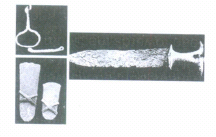
(i) Which metal was used for the preparation of the above equipments?
(ii) These equipments were found from which burials?
19.
How are people described in the Rigveda?
20.
What were the silent sentinels behind the story of the megaliths?
21.
What does the Rigveda tell about battles?
1.
Sanskrit is part of a family of languages known as Indo-European. Some Indian languages such as Assamese, Gujarati, Hindi, Kashmiri and Sind hi, and many European languages such as English, French, German, Greek, Italian and Spanish belong to this family. They are called a family because they originally had words in common. For example, the words 'matr' (Sanskrit), 'ma' (Hindi) and 'mother' (English) had the word 'ma' in common.
2.
The people at Inamgaon ate grains like barley, wheat, rice, pulses, millets, peas and sesame. Bones of a number of animals, many bearing cut marks that show they may have been used as food, have also been found. These include cattle, buffalo, goat, sheep, dog, horse, ass, pig, sambhar, spotted deer, blackbuck, antelope, hare and mongoose, besides birds, crocodile, turtle, crab and fish. There is evidence that fruits such as ber, amla, jamun, dates and a variety of berries were consumed by the people.
3.
The burials have some common features as:
(i) The dead were buried with distinctive pots, which are called Black and Red Ware.
(ii) Moreover tools and weapons of iron and sometimes, skeletons of horses, horse equipment and ornaments of stone and gold are found in these burials.
4.
About 2000 years ago, Charaka was a famous physician who wrote a book on medicine, Charaka Samhita. There he states that the human body has 360 bones. This is a much larger number than the 200 bones that are recognised in modern anatomy. Charaka arrived at this figure by counting the teeth, joints and cartilage.
5.
The correct order is:
(i) finding suitable stone
(ii) breaking boulders
(iii) shaping stones
(iv) transporting stones
(v) digging pits in the earth
(vi) burying the dead
(vii) placing stones in position
6.
Chariots were important because they were main means of transport. The other famous means of transport was the carts.
7.
Other languages used in the sub-continent belong to different families. For instance, those used in the North-East belong to the Tibero-Burrnan family. South Indian languages like, Tamil, Telugu, Kannada and Malayalam belong to the Dravidian family. The languages spoken in Jharkhand and parts of Central India belong to the Ausrro-Asiatic family.
8.
(d)
megalith
9.
(d)
soma
10.
(d)
Megalithic burials
11.
(b)
Aryans
12.
(b)
Ayurveda
13.
(a)
dasi
14.
(a)
Austro-Asiatic family
15.
(c)
hymns
16.
(c)
Port-holes
17.
(b)
burial places
18.
(i) Iron metal was used for the preparation of the above equipments.
(ii) Megalithic equipments were found from burials
19.
In the Rigveda, there are two groups who are described in terms of their work - the priests, sometimes called brahmins, who performed various rituals, and the rajas.
(i) At that time, rajas did not have capital cities, palaces or armies, nor did they collect taxes. Generally, sons did not automatically succeed fathers as rajas.
(ii) In the Rigveda, to describe the people or the community as a whole, the words - 'jana' and 'vish' were used.
(iii) Several vish or jana are mentioned, for example, the Puru jana or vish, the Bharata jana or vish, the Yadu jana or vish, and so on.
(iv) The people who composed the hymns described themselves as Aryas and called their opponents as Dasas or Dasyus.
20.
The silent sentinels behind the story of the megaliths were as follow:
(i) The big stones or the stone boulders are known as megaliths which were carefully arranged by people, and were used to mark burial sites.
(ii)The practice of erecting'megaliths began about 3000 years ago, and was prevalent throughout the Deccan, South India, in the North-East and Kashmir.
(iii) Some of the megaliths can be seen on the surface, other megalithic burials are often underground.
(iv) Archaeologists often find that a circle of stone boulders or a single large stone standing on the ground, are the only indications of burials.
(v) The burials have some common features as the dead were buried with distinctive pots, which are' called Black and Red Ware. Tools and weapons of iron and sometimes, skeletons of horses, horse equipment and ornaments of stone and gold are also found.
21.
From the Rigveda we know that there was no regular army at that time. There were assemblies where people met and discussed matters of war and peace. Most men took part in the battle. They chose leader who were brave and skilful warriors. Leaders used horse chariot in the battlefield. Battles were usually fought for land and water. Sometimes battles were also fought for cattle and people Capturing people the rajas made them as dasas (slaves). The power and strength of the Raja depend on land and cattle they had. Initially the struggle was between the Arya tribes and non-Arya tribes As the domination of Arya tribes increased, the power struggle between the Arya tribes seem to have begun.

6th Standard CBSE Syllabus & Materials
6th Standard CBSE
CBSE 6th Social Science Locating Places on the Earth - New Sample Question Papers Study Material - QB365 Set A
NEW6th Standard CBSE
CBSE 6th Science A Journey Through States of Water - New Sample Question Papers Study Material - QB365 Set A
NEW6th Standard CBSE
CBSE 6th Science Temperature and its Measurement - New Sample Question Papers Study Material - QB365 Set A
NEW6th Standard CBSE
CBSE 6th Science Materials Around Us - New Sample Question Papers Study Material - QB365 Set A



NCERT Books

Syllabus

Exam Pattern

Sample Question Papers

Previous year Question Papers

Important Notes

MCQ Practice test

NCERT Exemplers

Case study Questions

Image Based Questions

Passage based Questions

HOT Questions

Value Based Questions

Model Questions Papers
NCERT ( Book Back ) Questions

Assertion and Reason
Important Questions And Answers

CBSE 6th Standard CBSE Subjects
CBSE Standards


