
 100% FREE ACCESS
6th Standard Syllabus & Materials
6th Standard
TN 6th Tamil பருவம் 1 - இயல் 1 - மொழி -தமிழ்த்தேன் - இன்பத்தமிழ் Sample Question Papers Study Material - QB365 Set A
NEW6th Standard
TN 6th English T1 - Supplementary - The Apple Tree and The Farmer Sample Question Papers Study Material - QB365 Set A
NEW6th Standard
TN 6th English T1 - Prose - When The Trees Walked Sample Question Papers Study Material - QB365 Set A
NEW6th Standard
TN 6th Social Science T3 - CIV - Road Safety Sample Question Papers Study Material - QB365 Set A
NEW6th Standard
TN 6th Social Science T3 - CIV - Local Bodies - Rural and Urban Sample Question Papers Study Material - QB365 Set A
NEW6th Standard
TN 6th Social Science T3 - CIV - Democracy Sample Question Papers Study Material - QB365 Set A

Published on: 25/11/2019
Download Tamil Nadu 6th Standard Social Science question papers, model tests, one-mark questions, important questions, and public exam papers in PDF format. Free study materials and answer keys for TN State Board students.
Questions + Answers key
Take MCQ Social Science Test
1.
Why did Agriculture is called as primary oceupatlon?
2.
Explain in detail classification on the basis of distribution.
3.
Kalinga war became a turning point in Ashoka’s life. How?
4.
Karma – a person’s action. Name any 10 good actions (deeds).
5.
Write briefly about the archaeological site at Kodumanal.
6.
__________are classified on the basis of the availability of raw materials, capital and ownership.
7.
The needs of__________s are ever changing
8.
Our National tree is the _________________.
9.
____________________ were appointed to spread Dhamma all over the empire.
10.
How did they form the Indian constitution?
11.
What do you know about the drafting committee?
12.
Is agriculture the primary occupation?
13.
Agriculture is the primary occupation
14.
Mention the upper parts ofthe national emblem?
15.
How many parts are their in national emblem?
16.
What is called World's largest Pharmacy?
17.
What is meant by primary activities?
18.
Place the following words in the appropriate column.
Words: Jina, Mahayana, Tirthankaras, Stupas Nirvana, Digambara, Tripitakas, Agama
| Jainism | Buddhism |
19.
List out the special features of the Constitution of India.
20.
Name the city centred industries.
21.
What is Savings?
22.
Human resources.
23.
Which one is not a secondary sector in Transport?
Roadways
walking
waterways
airways
24.
Which one is not a secondary sector in Mineral based industries?
Cement
Iron
Aluminium Industries
Cotton textiles-
25.
_________grows in muddy water it blooms with beauty
Banyan tree
Lotus
Peacock
Tiger
26.
________were the earliest gathering places of men
northern India
Kalinga
Janapadas
Magadha
27.
A________ is the one who revealed religious truth at different times
the shower of stars
to sacrificial rites
Tirthankaras
28.
Agroup of villages was called______
Gramani
Viz
Grama
29.
The Constituent Assembly accepted the Constitution of India in the year
1946
1950
1947
1949
30.
The time taken to play the National Anthem is ____________
50 seconds
52 minutes
52 seconds
20 seconds
31.
_____________ was the ambassador of Seleucus Nicator.
Ptolemy
Kautilya
Xerxes
Megasthenese
32.
What was the ratio of land revenue collected during Vedic Age
1/3
1/6
1/8
1/9
33.
9th December 1946
34.
Commodity
35.
Abiotic resources
36.
Right to Education
37.
National Micro organism
38.
Megasthenese
39.
Angas
40.
Porunthal
41.
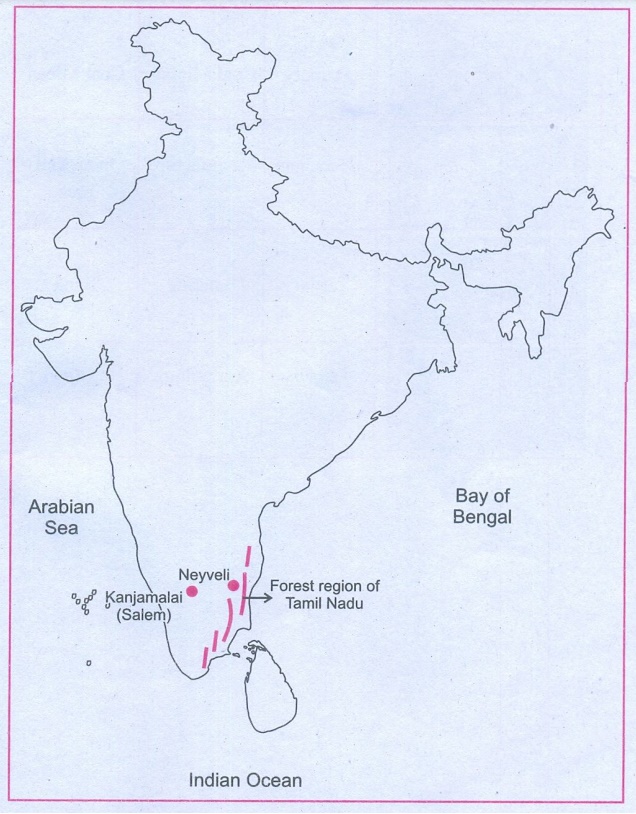
Mark the following in the outline map of India.
1. Neyveli
2. Bay of Bengal
3. Arabian Sea
4. Forest region of Tamil Nadu
5. Indian Ocean
6. Iron mining in Kanjamalai(Salem)
1.
(i) Agriculture is the primary occupation.
(ii) There won't be any kind of facilities like our cities.
(iii) At the same time, they get their basic needs fulfilled easily.
(iv) There are small shops.
(v) Vegetables are grown in'abundance.just like rice and pulses.
(vi) Though the sugar that isadded in our milk, coffee and tea is produced in sugar mills, the raw material sugarcane is cultivated in villages.
(vii) From chilies to mustard, all those provisions used for food are grown in villages.
2.
ON THE BASIS OF DISTRIBUTION:
On the basis of distribution, resources can be classified into localized resources and universal resources.
(i) When resources are present in specific regions they are called localized resources.
(e.g.) Minerals.
(ii) Some resources are present everywhere Such resources are called universal resources.
(e.g.) Sunlight and air.
(ii) On National resources are resources within the political boundaries and oceanic area of a country.
(e.g.) Tropical forest regions of India.
3.
(i) Ashoka fought the Kalinga war in 261 B.C.
(ii) He won the war and captured Kalinga.
(iii) The horror of war was described by the king himself in the Rock Edict XIII.
(iv) After the battle of Kalinga, Ashoka became a Buddhist.
(v) He under took tours to different parts of the country instructing people on policy of Dhamma.
(vi) Ashoka sent his son Mahindra and his daughter Sanghamitra to Srilanka to propagate Buddhism.
(vii) He took importance in the welfare of the people like hospitals, laying roads, irrigation, etc.
(viii) So, Ashoka was considered as a great emperor of ancient India.
4.
(i) Not to kill any living things.
(ii) Not to steal in any situation;
(iii) No sexual miscontacts.
(iv) Right speech and thoughts.
(v) Right livelyhood.
(vi) No greed.
(vii) No Anger.
(viii) Good View.
(ix) Right efforts.
(x) Right knowledge.
5.
Kodumanal Erode District
(i) It is identified with the Kodumanarn of Pathitrupathu.
(ii) More than 300 pottery inscriptions in Tarnil-Brahmi have been discovered there.
(iii) Archaeologists have also discovered spindles, whorls (used for making thread from cotton) and pieces of cloth, along with tools, weapons, ornaments, beads, particularly carnelian.
(iv) A Menhir found at burial site is assigned tothe Megalithic period.
6.
()
Industries
7.
()
human being
8.
()
Banyan
9.
()
Mahamattas
10.
The constitutions of nearly 60 countries including the UK., USA former USSR, France, Switzerland etc., were thoroughly examined and their best features have been adopted by our constitution.
11.
(i) When the Cons titution was drafted, there were 395 articles in 22 parts and 8 schedules.
(ii) At present our Indian Constitution contains 448 articles in 25 parts and 12 schedules.
12.
Yes, there are certain other primary activities like farming.
13.
Even Gandhiji has said that the villages are the backbone of our country
14.
The upper part has four lions facing the North, South, East and West. This is on a circular pedestal. One can only see three lions at a time.
15.
The National emblem consists of two parts- the upper and the lower parts.
16.
Tropical rain forests are called the 'World's largest Pharmacy' as 25% of the natural vegetation are medicinal plants. (e.g.) Cinchona
17.
primary activities such as hunting, food gathering, fishing and forestry
18.
| Jainism | Buddhism |
| Jina, Tirthankaras, Digambara,Agama | Mahayana, Stupas Nirvana,Tripitakas, |
19.
(i) The Constitution of India is the ultimate law.
(ii) We have to abide by it.
(iii) It explains the fundamental concepts of structure, methods, powers and the duties of Government bodies.
(iv) It also lists the fundamental rights and duties of the citizens.
(v) Directive Principles are also mentioned in the constitution.
(vi) So it is holistic in nature.
20.
(i) Automobile industry
(ii) Manufacturing industry
(iii) Iron and steel industry
(iv) Textile industry
(v) Banking, etc.
21.
The amount from the income which is left for future needs after consumption is called savings.
22.
Human resources are groups of individuals who use nature to create more resources.
23.
(b)
walking
24.
(d)
Cotton textiles-
25.
(b)
Lotus
26.
(c)
Janapadas
27.
(c)
Tirthankaras
28.
(b)
Viz
29.
(b)
1950
30.
(c)
52 seconds
31.
(d)
Megasthenese
32.
(a)
1/3
33.
The committeemet for the first
34.
products
35.
Water
36.
April 1
37.
Lacto bacillus
38.
Indica
39.
Jain text
40.
tip of ploughs
41.

6th Standard Syllabus & Materials
6th Standard
TN 6th Social Science T3 - GEO - Understanding Disaster Sample Question Papers Study Material - QB365 Set A
NEW6th Standard
TN 6th Social Science T3 - GEO - Globe Sample Question Papers Study Material - QB365 Set A
NEW6th Standard
TN 6th Social Science T3 - GEO - Asia and Europe Sample Question Papers Study Material - QB365 Set A
NEW6th Standard
TN 6th Social Science T3 - HIS - South Indian Kingdoms Sample Question Papers Study Material - QB365 Set A



Tamilnadu Stateboard 6th Standard Subjects
Tamilnadu Stateboard Standards



