
 100% FREE ACCESS
6th Standard Syllabus & Materials
6th Standard
TN 6th Tamil பருவம் 1 - இயல் 1 - மொழி -தமிழ்த்தேன் - இன்பத்தமிழ் Sample Question Papers Study Material - QB365 Set A
NEW6th Standard
TN 6th English T1 - Supplementary - The Apple Tree and The Farmer Sample Question Papers Study Material - QB365 Set A
NEW6th Standard
TN 6th English T1 - Prose - When The Trees Walked Sample Question Papers Study Material - QB365 Set A
NEW6th Standard
TN 6th Social Science T3 - CIV - Road Safety Sample Question Papers Study Material - QB365 Set A
NEW6th Standard
TN 6th Social Science T3 - CIV - Local Bodies - Rural and Urban Sample Question Papers Study Material - QB365 Set A
NEW6th Standard
TN 6th Social Science T3 - CIV - Democracy Sample Question Papers Study Material - QB365 Set A

Published on: 04/12/2018
It's nearing the examination. This is the right time to grab the model question papers and practice for the board exams. Start revising all the portions for half yearly and get good marks in your examination. Here is the model question paper for the nearing half yearly examination for Samacheer 6th social science. The questions are prepared based on the state board syllabus. It is a very useful question paper for Matriculation and state board students for their exam preparation.
All the important questions from every chapter are covered in this question paper. By practicing repeatedly you will get the idea of answering the questions and this improves the speed of answering. This will save the time and you can complete all the questions without any last our tension. Get more model question papers and practice for your examination.
Everyone has the same aim that is to reach the top rank list. We are paving the way for you to reach your goal. practice with important question papers and get set ready to crack your exams with confidence.
Download Tamil Nadu 6th Standard Social Science question papers, model tests, one-mark questions, important questions, and public exam papers in PDF format. Free study materials and answer keys for TN State Board students.
Questions + Answers key
Take MCQ Social Science Test
1.
____________ protects our fundamental rights.
2.
______________ resources are being used in the present.
3.
Thiruparthikundram, a village in Kanchipuram was once called_________.
4.
Deltas are _______ order landforms.
5.
Fossil remains belongs to_______________sources
6.
Lothal is situated on the banks of a tributary of__________ river
7.
__________ was the independent India’s first Law Minister
8.
_________________ planet has many natural satellites.
9.
____________ were used to store grains.
10.
Inscriptions are ___________ sources
11.
___________is self luminous and gives light on its own
sun
Moon
Star
Earth
12.
Ahil was a
Port
Fragrant wood
Educated centre
Ornament
13.
Humans with the help of flint made __________.
sharp weapons
vessels
carts
boats
14.
As per the 2011 Census the highest literate district in Tamil Nadu
Namakkal
Salem
Kanyakumari
Sivagangai
15.
Gender-based stereotypes are often portrayed in
films
advertisements
TV serials
All of these
16.
India is known as a
Continent
Sub continent
Island
None of these
17.
The Malacca Strait connects
The Pacific and Atlantic Oceans
The Pacific and Southern Oceans
The Pacific and Indian Oceans
The Pacific and Arctic Oceans
18.
The movement of the Earth on its axis is called
Revolution
Seasons
Rotation
Circulation
19.
Which one of the following is a Tamil city?
Iraq
Harappa
Mohenjo-Daro
Kancheepuram
20.
Tanzania is situated in the continent of
Asia
Africa
America
Europe
21.
The lions on the currency notes is taken from the Rampurwa bull capital.
22.
Emperor Ashoka followed Buddhism.
23.
The greatness of Ashoka had been unknown till 20th century
24.
Women also purchased from Allangadi of Madurai without fear.
25.
The first scientific invention of humans was wheel.
26.
List out the fundamental duties that you would like to fulfil.
27.
What was the reason for the development of settlements near water bodies?
28.
What are the articles that are discussing the equality in the Indian Constitution?
29.
Name the scholars who were born at Kancheepuram.
30.
Write a brief note on ancient cities of India.
31.
On the outline map of India, mark the following places:
1.Adichanallur
2.Attirampakkam
3.Bhimbetka
4.Hunasagi Valley
5.Lothal
32.
How are natural resources classified? Explain any three with examples.
33.
December 11 International Mountain Day.
34.
Explain the solution to the removal of inequality and discrimination in Indian society?
35.
How were dogs useful to pre historic men?
36.
Distinguish between inner and outer planets.
37.
Orbit
38.
The Eurasian basin
39.
Somersaulting Planet
40.
Edicts
41.
Radar
1.
()
Constitution
2.
()
Actual
3.
()
Jina Kanchi.
4.
()
Second
5.
()
Archaeological
6.
()
Sabarmati
7.
()
Dr. B.R. Ambedkbar
8.
()
Jupiter
9.
()
Granaries
10.
()
archaeological
11.
(a)
sun
12.
(b)
Fragrant wood
13.
(a)
sharp weapons
14.
(c)
Kanyakumari
15.
(d)
All of these
16.
(b)
Sub continent
17.
(c)
The Pacific and Indian Oceans
18.
(c)
Rotation
19.
(d)
Kancheepuram
20.
(b)
Africa
21.
(b)
22.
(a)
23.
(a)
24.
(a)
25.
(a)
26.
(i) There are duties respecting the National flag and National Anthem.
(ii) Respect and protect the Constitution, follow our great leaders who fought for our freedom, to protect our country, readiness to serve our country if necessary, treating everyone as brothers irrespective of their castes, religions, languages, races etc., to conserve our ancient heritage, and conserve natural elements like forests, rivers and lakes and fauna to develop science, humanity and feelings of reformation to avoid non-violence and Protect government property, parents or guardians providing educational opportunities to children between 6-14 years etc., have been added as our duties
27.
1. Early man, who hunted and gathered food, later learnt to cultivate crops.
2. When they found rivers which provided them water, settled down permanently near the rivers.
3. These permanent settlements were called villages.
28.
(1) Article 14 of the Indian constitution provides equality before the law or equal protection within the territory of India.
(2) Article 15(1) of the Constitution states that the State shall not to discriminate against any citizen on grounds only of religion, race, caste, sex, place of birth or any of them.
(3) Article 17(1) of the Indian constitution, untouchability is totally abolished.
29.
Scholars like Dharmabalar, Jothibalar, Sumathi and Bodhi Dharamar where born in Kanchi.
30.
1. Harappa
2. Mohenjo - Daro
31.
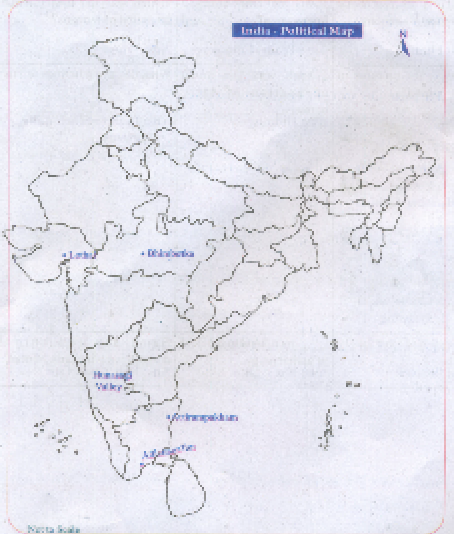
32.
Classification of Natural Resources:
Natural resources can be classified into different groups depending on origin, development, renewability, distribution, ownership etc
ON THE BASIS OF ORIGIN:
On the basis of origin, resources can be classified into biotic and abiotic resources.
(i) All living resources are biotic resources, plants, animals and other micro organisms are biotic resources.
(ii) Abiotic resources are non-living things. Land, water, air and minerals are abiotic resources.
ON THE BASIS OF DEVELOPMENT:
Based on the level of development, resources can be divided into actual and potential resources.
(i) Actual resources are resources that are being used and the quantity available is ' known. (e.g.) Coal at Neyveli.
(ii) Potential resources are resources that are not being used in the present and its quantity and location are not known. The technology to extract such resources is also yet to be developed. (e.g.) Marine yeast found in the Bay of Bengal and Arabian Sea.
ON THE BASIS OF EXllAUSTFFILLITY:
On the basis of renewability resources can be classified as renewable resources and nonrenewable resources.
(i) Resources once consumed can be renewed with the passage of time are called renewable resources. (e.g.) Air, Water, Sunlight. Misuse of such resources can also limit its available quantity. So, they have to be used wisely.
(ii) Natural resources which are limited can be called non-renewable resources. They become exhausted after use and the time they take to replace does not match the life cycle. (e.g.) Coal, petroleum, natural gas and other minerals.
33.
Prepare slogans, posters and placards to celebrate International Mountain Day.
(i) "Mountains are among the most beautiful land masses in the world."
(ii) "Mountains are beautiful as they rise up above the clouds and show just how grand the world can be."
(iii) "Great things are done when men and mountains meet."
(iv) "How glorious a greeting the Sun gives the mountains."
(v) "Mountains are earth's undecaying monuments."
(vi) "The mountains, forests and seas render men savage, they develop fierce, but yet do not destroy the human. "
(vii) "Men stumble over pebbles, never over mountains."
(viii) "Each fresh peak ascended teaches something."
(ix) "Mountains are the beginning and end of all natural scenery."
(x) "He who climbs upon the highest mountains laughs at all tragedies, real or imaginary.
34.
The remedial measures for abolishing inequality and discrimination in Indian society are as follows.
(i) Wider access to quality based services like healthcare and education for all.
(ii) Be aware of current gender bias.
(iii) Make women more visible in public life and institution to eradicate gender disparity.
(iv) Be open to learning about other religions.
(v) Promoting community dining in the classroom may help the students to sit together without any bias of caste, religion or gender.
(vi) Socialise with people of all types outside home.
(vii) Effective implementation of laws.
35.
(i) In ancient period, the people lived in caves.
(ii) Hunting was their main occupation.
(iii) Caves did not live in such a safe environment.
(iv) There might have been changes of wild animals entering caves.
(v) But they realised that dogs could help them prevent the entry of such dangerous animal by sniffing skill.
(vi) Hence they started domesticating dog for their protection and hunting activities.
36.
| S.No | Inner planets | Outer planets |
| 1 | The four planets nearer to the sun are called Inner or Terrestrial planets. |
The last four plangts are called as Outer planets of Jovian planets. |
| 2 | Mercury, venus, earth and mars. | Jupiter, Saturn, Uranus and Neptune. |
| 3 | The inner planets are comparatively smaller in size and are compased of rocks |
They are also called Gaseous Giants. |
| 4 | The surface of inner planets has mountains, volcanoes and craters |
An asteriod belt is found between mars and jupiter. |
37.
Curved path
38.
The Arctic Ocean
39.
Uranus
40.
Archaeological source
41.
Remote sensing

6th Standard Syllabus & Materials
6th Standard
TN 6th Social Science T3 - GEO - Understanding Disaster Sample Question Papers Study Material - QB365 Set A
NEW6th Standard
TN 6th Social Science T3 - GEO - Globe Sample Question Papers Study Material - QB365 Set A
NEW6th Standard
TN 6th Social Science T3 - GEO - Asia and Europe Sample Question Papers Study Material - QB365 Set A
NEW6th Standard
TN 6th Social Science T3 - HIS - South Indian Kingdoms Sample Question Papers Study Material - QB365 Set A



Tamilnadu Stateboard 6th Standard Subjects
Tamilnadu Stateboard Standards



