
 100% FREE ACCESS
6th Standard CBSE Syllabus & Materials
6th Standard CBSE
CBSE 6th Social Science The Value of Work - New Sample Question Papers Study Material - QB365 Set A
NEW6th Standard CBSE
CBSE 6th Social Science Family and Community - New Sample Question Papers Study Material - QB365 Set A
NEW6th Standard CBSE
CBSE 6th Social Science India's Cultural Roots - New Sample Question Papers Study Material - QB365 Set A
NEW6th Standard CBSE
CBSE 6th Social Science India,That is Bharat - New Sample Question Papers Study Material - QB365 Set A
NEW6th Standard CBSE
CBSE 6th Social Science Timeline and sources of history - New Sample Question Papers Study Material - QB365 Set A
NEW6th Standard CBSE
CBSE 6th Social Science Oceans and Continents - New Sample Question Papers Study Material - QB365 Set A

Published on: 22/09/2018
Important Five Mark Question Paper
Download CBSE Class 6th Standard CBSE Social Science question papers, sample papers, important questions, and previous year solved papers in PDF format. Get free study materials, NCERT solutions, and exam preparation resources for Class 6th Standard CBSE Social Science
Questions + Answers key
Take MCQ Social Science Test
1.
You are travelling with your parents about 4000 years ago, from Lethal to Mohanjodaro. Describe how you would travel, what your parents might carry with them and what would you see in Mohanjodaro.
2.
Discuss the salient features of the earliest Hindu temples.
3.
Discuss the varna system, which was made by the priests.
4.
How are seasons changed on the Earth?
5.
The rotation of the Earth is responsible for causing day and night. Explain with the proper example?
6.
How can we calculate rate of time difference?
7.
What is the difference between local time and standard time?
8.
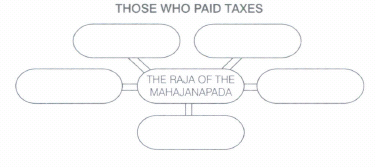
Fill in the chart given below with the terms: hunter-gatherers, farmers, traders, crafts persons, herders.
9.
Who was Pulakeshin II? Mention his main achievements, as describes his prashasti?
10.
Describe some of the main achievements of the Pallavas and the Chalukyas.
11.
How are people described in the Rigveda?
12.
How do we find out about early cities of the sub-continent?
13.
Write down some words originated from 'Geo' or 'Ge'?
14.
How can we say that asteroids and meteoroids are different from each other? How meteoroids are connected with the Earth?
15.
What could be the probable reasons as suggested by the archaeologists for the end of Harappa?
16.
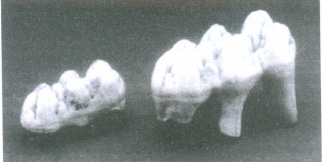
Look at these two sets of teeth. Which do you think belongs to a wild pig and which to a domesticated one?
17.
What were the main teachings of the Buddha?
18.
Answer the questions based on the picture given below:
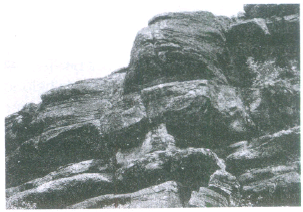
(i) Where are the above sites located?
(ii) Bhimbetka is located in which state?
(iii) Which valley is closer to these rock shelters?
19.
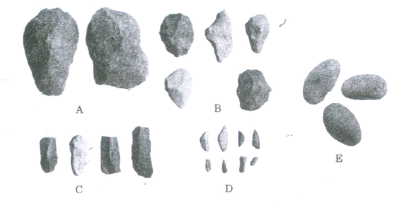
Make a list of what these tools given below were used for and try and decide which of these tasks could be performed using a natural pebble. Give reasons for your answer.
20.
Why were the earlier cities mostly developed over the banks of river?
1.
Lothal to Mohanjodaro's journey will be done on bullock carts along the dusty roads. My parents will carry food, water and clothes. In Mohanjodaro, I would see:
(i) Citadels
(ii) Big storehouses
(iii)A great tank i.e., the Great Bath
(iv) Wells
(v) Streets with covered drains
(vi) Houses of one or two storeys.
2.
The earliest Hindu temples were built 2000-1500 years ago. Deities such as Vishnu, Shiva and Durga were worshipped in these temples.
The most important part of the temple was the room known as the garbhagriha, where image of the chief deity was placed. It was here that priests performed religious rituals and devotees offered worship to the deity.
The garbhagriha had a tower, known as the Shikhara which was built on top of the garbhagriha. It is marked as the sacred place. Building shikharas required careful planning. Most temples also had a space known as the mandapa. It was a hall where people could assemble. Some of the finest stone temples were built in Mahabalipuram and Aihole about 1400-1500 years ago.
3.
The priests divided people into four groups, called varnas. According to them, each varna had a different set of functions. The priests also said that these groups were decided on the basis of birth. The groups were as follow:
(i) The first varna was Brahmin. Brahmins were expected to study and teach the Vedas, perform sacrifices and receive gifts.
(ii) In the second varna, there were rulers, also known as kshatriyas. They were expected to fight battles and protect people.
(iii) The third varna was vaishyas or vish. They were expected to be farmers, herders and traders. Both the kshatriyas and the vaishyas could perform sacrifices.
4.
The seasons are changed on the Earth because of the inclination of the Earth's axis in a fixed direction and due to the change in the position of the Earth around the sun.
On 21st June, the Northern hemisphere is tilted towards the sun. These areas receive more heat because the sun rays fall directly on the tropic of Cancer.
The tropic of Capricorn receives direct sun rays due to tilting of South Pole towards the sun on 22nd December.
The Northern hemisphere experiences autumn season while Southern hemisphere spring season on 23rd September. On 21st March, itIS spring in Northern hemisphere and autumn in Southern hemisphere.
5.
The Earth rotates from West to East on its axis. The Earth takes about 24 hours to complete one rotation around its axis. The period of rotation is known as the earthday. The spherical shape of the Earth allows only one half of the Earth to receive sunlight at a time.
The portion facing the sun experiences day, while the other half away from the sun experiences night. It is because of the rotation of the Earth that allows day and night following each other regularly.
6.
The rate of difference of time can be calculated as follows:
The Earth rotates 360o in about 24 hours, i.e. 360/24 = 15o/ hour
15o in1 hour means, 60 minutes/15 = 4 minutes for 1o.
For example (i) When it is 12 noon at Greenwich, what time will be at 15o East of Greenwich?
(i) The time at 15o East of Greenwich (when it is 12 noon at Greenwich) will be 15x4 =60 minutes or 1 hour ahead of Greenwich, it means 1 p.m.
(ii) When it is 12 noon at Greenwich, what time wil be at 15o West of Greenwich? The time at 15o West of Greenwich (when it is 12 noon at Greenwich) will be 15x4 =60 minutes or 1 hour behind, it means 11 a.m.
The time at 180o will be 12 0' clock of mid-night when it is 12 noon at Greenwich.
7.
Local time is based on the local meridian passing through that place. The places lying North and South on the same meridian will have the same local time and the places lying East or West of that meridian will have different local times. It is important because the time for any country is measured by the local time. The local time of places on different meridians are different. Therefore, it will be difficult to prepare time-table for trains which cross several longitudes.
For example There will be a difference of about 1 hour and 45 minutes in the local times of Dwarka in Gujarat and Dibrugarh in Assam. Therefore, it is necessary to adopt the local time of some central meridian of a country as the standard time for the country.
8.
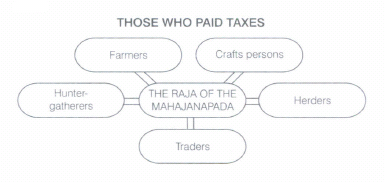
9.
(i) The best known Chalukya ruler was Pulakeshin II. We known about him from a prashasti. This prashasti (inscription) was composed by Pulakeshin II's court poet Ravikirti. This tells us about his ancestors, who are traced back through four generations from father to son.
(ii) Pulakeshin II evidently got the Kingdom from his uncle. According to Ravikirti
(a) He led expeditions along both the West and the East coast.
(b) Pulakeshin II checked the advance of Harsha. Harsha means happiness.
(c) Pulakeshin II also attacked the Pallava king, who took shelter behind the walls of Kanchipuram. However the successors of Pulakeshin II were not very capable and therefore the Chalukyas victory was short-lived.
10.
The main achievements of the Pallavas and the Chalukyas were:
(i) The Pallavas and Chalukyas were that most important ruling dynasties in South India. The kingdom of the Pallavas spread from the region around their capital, Kanchipuram to the Kaveri delta, while that of the Chalukyas was centred around the Raichur Doab, between the rivers Krishna and Tungabhadra.
(ii) The Pallavas and Chalukyas frequently attacked one another's areas, particularly they attacked the capital cities, which were prosperous towns.
(iii) Aihole, the capital of the Chalukyas, was an important trading and commercial centre. Initially this town developed as a religious centre, with a number of temple.
(iv) During the days of Pulakeshin II, the Chalukyas defeated Harshavardhana. But this victory was short-lived.
(v)Ultimately, both the Pallavas and the Chalukyas gave way to new rulers belonging to Rashtrakuta and Chola dynasties.
11.
In the Rigveda, there are two groups who are described in terms of their work - the priests, sometimes called brahmins, who performed various rituals, and the rajas.
(i) At that time, rajas did not have capital cities, palaces or armies, nor did they collect taxes. Generally, sons did not automatically succeed fathers as rajas.
(ii) In the Rigveda, to describe the people or the community as a whole, the words - 'jana' and 'vish' were used.
(iii) Several vish or jana are mentioned, for example, the Puru jana or vish, the Bharata jana or vish, the Yadu jana or vish, and so on.
(iv) The people who composed the hymns described themselves as Aryas and called their opponents as Dasas or Dasyus.
12.
We find out about early cities of the sub-continent through the following sources:
(i) Stories The Jatakas were stories that were probably composed by ordinary people and then written down and preserved by Buddhist monks. The Jatakas throw sufficient light on the lives of the people who used to live there.
(ii) Accounts of travellers and sailors Another way of finding out about early cities is from the accounts of sailors and travellers who visited them.
(iii) Sculptures We can use other kinds of evidences to find out about life in some of these early cities. Sculptors carved scenes depicting peoples lives in towns and villages, as well as in the forest.
(iv) Archaeological findings In many early cities, archaeologists have found rows of pots or ceramic rings arranged one on top of the other. They have also found many silver and copper coins. From all these findings, many important facts about the early cities can be known.
13.
Many words we use in Geography have originated from Greek or Roman words. 'Geo' or 'Ge' are Greek words meaning Earth.
Some of the words originated from 'geo' or 'ge' are as follows.
Geo + graphia = 'Geography' meaning description of the Earth.
Geo-i- metry = 'Geometry' meaning measurement of the Earth.
Geo + logy = 'Geology' meaning study of the Earth.
Geo+ oid = 'Geoid' meaning the shape that resembles with the Earth.
Geo-r grapher = 'Geographer' meaning one who studies geography.
14.
Apart from the planets, asteroids are the tiny celestial bodies which also move around the sun. These bodies are found in large number between the orbits of Mars and Jupiter, These are believed to be the part of a planet that exploded many years ago.
Meteoroids are the small pieces of rocks that move around the sun, These meteoroids sometimes come close to the Earth and tend to drop upon Earth.
During their drop on the Earth, they get heated up and burnt due to friction with air and cause flash of light. Sometimes, it creates a hollow on the Earth if it is not burnt completely.
15.
Reasons for the fall of the Harappan cities were:
(i) Till date, no concrete reason has been found out by the scholars, but some of the scholars suggested that the rivers dried up.
(ii) While other scholars have suggested that there was deforestation because large quantity of fuel was required for baking bricks and for smelting copper ores.
(iii) Besides, grazing by large herds of cattle, sheep and goat may have destroyed the green cover. In some areas there were floods.
(iv) But none of these reasons can explain the end of all the cities since the flooding, or a river drying up would have had an effect in only some areas.
(v) Some sites in Sind and West Punjab (present-day Pakistan) were abandoned, while many people moved into newer, smaller settlements to the East and the South, it seems as if the rulers lost control over their subjects.
16.
The larger one is the teeth of a wild pig, and the smaller one is related to the domesticated one. Because the teeth and horns of wild animals are usually much larger than those of domesticated animals.
17.
The main teachings of the Buddha are:
(i) The Buddha taught that life is full of suffering and unhappiness. This is caused because we have cravings and desires (which cannot be fulfilled).
(ii) Sometimes, even if we get what we desire, we are not satisfied (permanently) and want (or desire) ever more and more (or other things). The Buddha described this as thirst or tanha.
(iii) The Buddha taught that thirst or tanha or constant craving could be removed by following moderation everything.
(iv) He also taught people to be kind and to respect the lives of others, including animals.
(v) The Buddha believed that the results of our actions (called karma), whether good or bad, affect us both in this life and the next.
(vi) He also encouraged people to think for themselves rather than to simply what he (the Buddha) said.
(vii) The Buddha taught in Prakrit, which was the language of the ordinary people, so that everybody could understand his message.
18.
(i) These sites are located in Bhimbetka.
(ii) Bhimbetka is located in Madhya Pradesh.
(iii) The Narmada Valley is close to these rock shelters.
19.
(i) The tools (A) were used for:
1.grinding the grains.
2.making of tools.
(ii) The tools (B) were used for:
1.cutting meat.
2.chopping fruits.
(iii) The tools (C) were used for:
1.digging soil.
(iv) The tools (D) were used for:
1.hunting animals.
(v) The tools (E) were natural pebbles which were also used for:
1. grinding grains.
20.
It is evident from the past that the earlier cities were mostly developed over the banks of river because of the following reasons:
(i) Thousand years ago, people lived along the banks of the Narmada river.
(ii) About 4700 years ago, some of the earliest cities flourished on the banks of river Indus and its tributaries.
(iii) Along the banks of the rivers, the necessary conditions for the living of human beings exist.
(iv) The necessities of living such as water, forest are easily available which fulfil the basic needs of the people.
(v) At that time, waterways were the most important means of transportation and communication.

6th Standard CBSE Syllabus & Materials
6th Standard CBSE
CBSE 6th Social Science Locating Places on the Earth - New Sample Question Papers Study Material - QB365 Set A
NEW6th Standard CBSE
CBSE 6th Science A Journey Through States of Water - New Sample Question Papers Study Material - QB365 Set A
NEW6th Standard CBSE
CBSE 6th Science Temperature and its Measurement - New Sample Question Papers Study Material - QB365 Set A
NEW6th Standard CBSE
CBSE 6th Science Materials Around Us - New Sample Question Papers Study Material - QB365 Set A



CBSE 6th Standard CBSE Subjects
CBSE Standards




