 100% FREE ACCESS
6th Standard Syllabus & Materials
6th Standard
TN 6th Tamil பருவம் 1 - இயல் 1 - மொழி -தமிழ்த்தேன் - இன்பத்தமிழ் Sample Question Papers Study Material - QB365 Set A
NEW6th Standard
TN 6th English T1 - Supplementary - The Apple Tree and The Farmer Sample Question Papers Study Material - QB365 Set A
NEW6th Standard
TN 6th English T1 - Prose - When The Trees Walked Sample Question Papers Study Material - QB365 Set A
NEW6th Standard
TN 6th Social Science T3 - CIV - Road Safety Sample Question Papers Study Material - QB365 Set A
NEW6th Standard
TN 6th Social Science T3 - CIV - Local Bodies - Rural and Urban Sample Question Papers Study Material - QB365 Set A
NEW6th Standard
TN 6th Social Science T3 - CIV - Democracy Sample Question Papers Study Material - QB365 Set A

Published on: 03/12/2019
Indus Civilisation
Download Tamil Nadu 6th Standard Social Science question papers, model tests, one-mark questions, important questions, and public exam papers in PDF format. Free study materials and answer keys for TN State Board students.
Questions + Answers key
Take MCQ Social Science Test
1.
The dancing girl statue was made out of
gold
silver
bronze
iron
2.
Indus valley civilization is great, because
It had advanced sanitation and drainage system
Repeated floods affected this area
Indus people maintained a big army
They did not use iron
3.
River valleys are said to be the cradle of civilisation because
Soil is very fertile.
They experience good climate
They are useful for transportation.
Many civilisations flourished on river valleys.
4.
Indus Civilisation belonged to
Old Stone age
Medieval stone age
New stone age
Metal age
5.
What metals were known to the people of Indus Civilization?
Copper, bronze, silver, gold, but not iron
Copper, silver, iron, but not bronze
Copper, gold, iron, but not silver
Copper, silver, iron, but not gold
6.
The earliest form of writing was developed by the__________
7.
In Indus civilisation settlements were built on_________grounds.
8.
A huge public building found at Mohenjodaro was the _________
9.
____________ were used to store grains.
10.
Archaeological Survey of India was founded by ____________ .
11.
Can you point out the special features of their drainage system?
12.
Indus Civilisation is called urban civilisation. Give reasons.
13.
What method is used to explore buried buildings nowadays?
14.
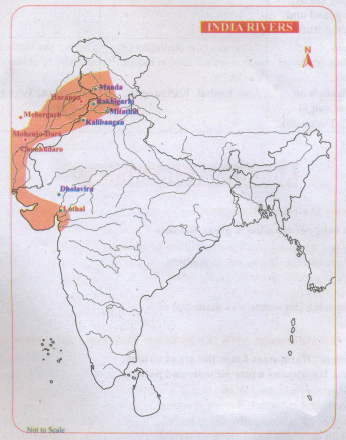
On the river map of India, colour the places where Indus civilisation spread.
15.
Can you guess what happened to the Harappan?
16.
A noval dockyard has been discovered in Lothal. What does it convey?
17.
Citadel
18.
Bronze
19.
Copper
20.
Mehergarh
21.
Charles Masson
1.
(c)
bronze
2.
(a)
It had advanced sanitation and drainage system
3.
(d)
Many civilisations flourished on river valleys.
4.
(d)
Metal age
5.
(a)
Copper, bronze, silver, gold, but not iron
6.
()
Sumerians
7.
()
elevated
8.
()
Assembly hall
9.
()
Granaries
10.
()
Alexander cunningham
11.
(i) They had well covered drains.The drains were covered with slabs or bricks.
(ii) Each drain had a gentle slope so that water could flow.
(iii) Manholes were provided at regular intervals to clear the drains.
(iv) House drains passed below many lanes before finally emptying into the main : drains.
(v) Every house had its own soak pit, which collected all the sediments and allowed only the water to flow into the street drain.
12.
Indus Civilisation is called urban civilisation because
(i) There was well-conceived town planning.
(ii) Astonishing masonry and architecture were found.
(iii) Priority was given for hygiene and public health.
(iv) They used Standardised weights and measures.
(v) They had solid agricultural and artisanal base.
13.
(i) Literary sources
(ii) Aerial photographs
(iii) Magnetic scanner
(iv) RADAR
(v) Remote sensing methods.
14.
15.
(i) By 1800 BCE, the Harappan culture had started declining.
(ii) It is assumed that the civilization met with
(a) repeated floods
(b) ecological changes
(c) invasions
(d) natural calamity
(e) climatic changes
(f) deforestation
(g) an epidemic might have disturbed the civilization.
16.
(i) A naval dockyard has been discovered in Lothal in Gujarat. It shows the maritime activities of the Indus people.
(ii) Cylindrical seals similar to those found in Persian Gulf and mesopotamia have also been found in the Indus area.
(iii) This shows the trade links between these two areas.
17.
raised platform
18.
alloy
19.
First metal
20.
Neolithic
21.
Explorer

6th Standard Syllabus & Materials
6th Standard
TN 6th Social Science T3 - GEO - Understanding Disaster Sample Question Papers Study Material - QB365 Set A
NEW6th Standard
TN 6th Social Science T3 - GEO - Globe Sample Question Papers Study Material - QB365 Set A
NEW6th Standard
TN 6th Social Science T3 - GEO - Asia and Europe Sample Question Papers Study Material - QB365 Set A
NEW6th Standard
TN 6th Social Science T3 - HIS - South Indian Kingdoms Sample Question Papers Study Material - QB365 Set A



Tamilnadu Stateboard 6th Standard Subjects
Tamilnadu Stateboard Standards