
 100% FREE ACCESS
6th Standard CBSE Syllabus & Materials
6th Standard CBSE
CBSE 6th Social Science The Value of Work - New Sample Question Papers Study Material - QB365 Set A
NEW6th Standard CBSE
CBSE 6th Social Science Family and Community - New Sample Question Papers Study Material - QB365 Set A
NEW6th Standard CBSE
CBSE 6th Social Science India's Cultural Roots - New Sample Question Papers Study Material - QB365 Set A
NEW6th Standard CBSE
CBSE 6th Social Science India,That is Bharat - New Sample Question Papers Study Material - QB365 Set A
NEW6th Standard CBSE
CBSE 6th Social Science Timeline and sources of history - New Sample Question Papers Study Material - QB365 Set A
NEW6th Standard CBSE
CBSE 6th Social Science Oceans and Continents - New Sample Question Papers Study Material - QB365 Set A

Published on: 27/07/2018
Based on the chapter What, Where, How and When? , some of the important questions are prepared in this question paper.
For parents, Please subscribe and get the plenty of question with answer for your children practice. For Subscription please Click here.
Download CBSE Class 6th Standard CBSE Social Science question papers, sample papers, important questions, and previous year solved papers in PDF format. Get free study materials, NCERT solutions, and exam preparation resources for Class 6th Standard CBSE Social Science
Questions + Answers key
Take MCQ Social Science Test
1.
What were the subjects on which books were written in the past? Which of these would you like to read?
2.
Why do you think ordinary men and women did not keep records of what they did?
3.
List one major difference between manuscripts and inscriptions.
4.
How was the name 'India' originated?
5.
What type of objects are considered by the archaeologists in their study?
6.
How are the dates counted?
7.
Can you think of the advantages of writing on a hard surface? And what could have been the difficulties?
8.
'About 4700 years ago'-also can be written as
4700 BC
2687 BC
2687 AD
4700 AD
9.
Which one is the tributary of the Ganga river?
Son
Gandak
Tapti
Narmada
10.
Where was rice grown first?
North of the Himalaya
North of the Vindhyas
On the bank of Narmada
The Garo hills
11.
Which crops began to grow by men and women to the region of Sulaiman and Kirthar hills?
Rice and wheat
Wheat and pulses
Pulses and barley
Wheat and barley
12.
The earliest people lived along the bank of Narmada river are called
farmers
merchants
hunters
skilled gatherers
13.
What is the purpose of exploration and excavation done by the archaeologists?
14.
Name one of the tributaries of river Indus?
15.
What do you mean by skilled gatherers?
16.
Answer the questions based on the picture given below:
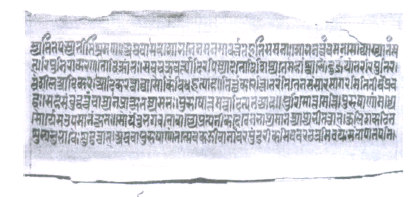
(i) How many years ago this manuscript was written?
(ii) How were books made from palm leaves?
(iii) What type of manuscripts is shown in the picture?
17.
Why were the earlier cities mostly developed over the banks of river?
18.
Despite of facing difficulties, people travelled from one part of the sub-continent to another. Explain with reasons.
19.
___________ is the earliest composition in Sanskrit language.
20.
The earliest people who lived on the banks of Narmada river were ________
21.
People have lived along the _________of Narmada river for several hundred thousand years ago.
22.
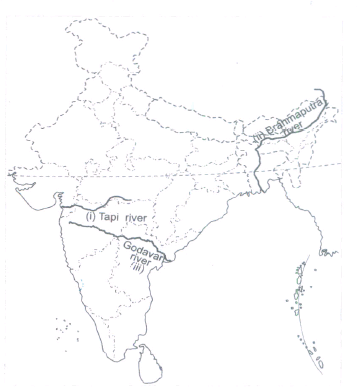
Locate the following of the outline physical map of India.
(i) Tapi river
(ii) Brahmaputra river
(iii) Godavari river
23.
Objects that are made of hard imperishable substances usually survive for a long time.
24.
In ancient times, the area along river Son to the South of Ganga was known as India.
1.
Several books on all subjects such as religious practices and beliefs. the lives of kings. medicine and science had been written. which are readable for all.
2.
The ordinary men and women did not keep their records of what they did because:
(i) They were not aware of s~ch writing skills in the earlier time.
(ii) They were illiterate and they had not a sound clue about the knowledge of scripts.
(iii) Such work had no importance in their life.
(iv) They never bothered of their past and had not any interest in the knowledge of the past. Generally. the kings and queens kept the records of their victories.
3.
One major diffirence between manuscripts and inscriptions is:
| Manuscripts | Inscriptions |
|---|---|
| Manuscripts were written on palm leaf or specifically on the birch. | Inscriptions were written on hard surfaces such as stone, metals etc. |
4.
The Iranians and the Greeks who came through the North-West about 2500 years ago and were familiar with the Indus, called it the Hindos or the Indos and the land to the East of the river was called India.
5.
Generally, the archaeologists study the remains of buildings made of stone and brick, paintings and sculptures. They also explore and excavate to find out the objects of daily use such as tools, weapons, pots, pans, ornaments and coins.
6.
The years (say, 2015) are counted from the date generally assigned to the birth of Jesus Christ, the founder of Christianity. So, 2015 means 2015 years after the birth of Christ. All dates before the birth of Christ are counted backwards and usually have the letters BC (Before Christ) added on.
7.
The advantages of writing on a hard surface are as follow:
(i) The hard surfaces are long-lasting.
(ii) They overcome all chances of destruction from all objects of nature i.e. wind, rain, sun etc.
(iii) They are preserved for future generations to know about our rich past and culture.
(iv) The insects could not eat such materials as they destroyed the manuscripts of the past.
The disadvantages of writing on hard surface are as follow:
(i) It is not easily portable.
(ii) Writing on hard surface is a very difficult task.
(iii) It needs much hard metal to write on the hard surface.
(iv) It requires a lot of time to complete the writing.
8.
(a)
4700 BC
9.
10.
(d)
The Garo hills
11.
(d)
Wheat and barley
12.
(d)
skilled gatherers
13.
()
The purpose of exploration is to find out tools, weapons, pots, pans, ornaments and coins of past and to make conclusion from these findings.
14.
()
One of the tributaries of the river Indus is Jhelum.
15.
()
The people who gathered their own food were called skilled gatherers.
16.
(i) This manuscript was written about a thousand years ago.
(ii) The palm leaves were cut into pages and tied together to make books.
(iii) A palm leaf manuscript.
17.
It is evident from the past that the earlier cities were mostly developed over the banks of river because of the following reasons:
(i) Thousand years ago, people lived along the banks of the Narmada river.
(ii) About 4700 years ago, some of the earliest cities flourished on the banks of river Indus and its tributaries.
(iii) Along the banks of the rivers, the necessary conditions for the living of human beings exist.
(iv) The necessities of living such as water, forest are easily available which fulfil the basic needs of the people.
(v) At that time, waterways were the most important means of transportation and communication.
18.
People travelled from one part of the sub-continent to another due to the following reasons:
(i) People travelled from one place to another in search of livelihood, to escape from natural disasters like floods or droughts.
(ii) Some people also travelled with the spirit of adventure, to find out the interesting facts and to discover new places.
(iii) Caravans or ships were the means of communication and transportation of food material for the merchants.
(iv) Religious teachers moved from one place to another to deliver their religious teachings to the people.
(v) Travelling emerged as a strong aspect of sharing ideas between the diversities.
19.
()
The Rigveda
20.
()
skilled gatherers
21.
()
banks
22.
23.
(a)
24.
(b)

6th Standard CBSE Syllabus & Materials
6th Standard CBSE
CBSE 6th Social Science Locating Places on the Earth - New Sample Question Papers Study Material - QB365 Set A
NEW6th Standard CBSE
CBSE 6th Science A Journey Through States of Water - New Sample Question Papers Study Material - QB365 Set A
NEW6th Standard CBSE
CBSE 6th Science Temperature and its Measurement - New Sample Question Papers Study Material - QB365 Set A
NEW6th Standard CBSE
CBSE 6th Science Materials Around Us - New Sample Question Papers Study Material - QB365 Set A



CBSE 6th Standard CBSE Subjects
CBSE Standards




