
 100% FREE ACCESS
6th Standard CBSE Syllabus & Materials
6th Standard CBSE
CBSE 6th Social Science The Value of Work - New Sample Question Papers Study Material - QB365 Set A
NEW6th Standard CBSE
CBSE 6th Social Science Family and Community - New Sample Question Papers Study Material - QB365 Set A
NEW6th Standard CBSE
CBSE 6th Social Science India's Cultural Roots - New Sample Question Papers Study Material - QB365 Set A
NEW6th Standard CBSE
CBSE 6th Social Science India,That is Bharat - New Sample Question Papers Study Material - QB365 Set A
NEW6th Standard CBSE
CBSE 6th Social Science Timeline and sources of history - New Sample Question Papers Study Material - QB365 Set A
NEW6th Standard CBSE
CBSE 6th Social Science Oceans and Continents - New Sample Question Papers Study Material - QB365 Set A

Published on: 30/07/2018
Some of the important questions are prepared from this chapter In the Earliest Cities. The questions are covers from the Higher Order Thinking Questions and Value Based Questions.
Download CBSE Class 6th Standard CBSE Social Science question papers, sample papers, important questions, and previous year solved papers in PDF format. Get free study materials, NCERT solutions, and exam preparation resources for Class 6th Standard CBSE Social Science
Questions + Answers key
Take MCQ Social Science Test
1.
How were the Harappan cities divided?
2.
How were the seals used in Harappa?
3.
How was the location of the Lothal city important?
4.
Describe the craft works of the Harappans.
5.
What was the role of rulers in the Harappan cities?
6.
How was the housing pattern of Harappans?
7.
Describe three important buildings in your city or village. Are they located in a special part of the settlement (For example the centre)? What are the activities that take place in these buildings?
8.
Why were metals, writing, the wheel and the plough important for the Harappans?
9.
Name two cities which had fire altars?
10.
How many divisions were of Harappan cities?
11.
Answer the questions based on given picture:
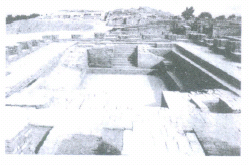

(i) What does above picture represent?
(ii) How this was constructed?
(iii) This was discovered from which site?
(iv) Write any two features of the above picture.
12.
Describe the drainage system of the Harappan cities.
13.
_________was an important centre for making objects out of stone, shell and metal.
14.
_______ and _________ were available around settlements.
15.
The signs on the top of the seal are part of a _______.
16.
To produce bronze, tin has to be mixed with _____ .
17.
Most cities had the Western part _______and _______ .
18.
Egypt is almost a dry desert except for the lands along the river Nile.
19.
The Harappan towns in the state of Gujarat have been found in Dholavira and Lethal.
20.
Harappans also collected fruits like apple, caught fish and hunted wild animals like the antelope.
21.
The Harappans probably got copper from present-day Rajasthan and even from Oman in West Asia.
22.
From the site of Dholavira, traces of wool have been found probably which were grown 7000 years ago.
23.
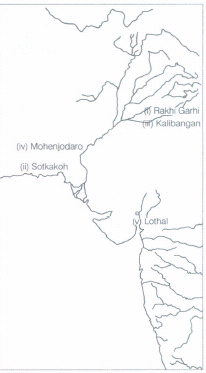
Show the following cities on the outline map of India
(i) Rakhi Garhi
(ii) Sotkakoh
(iii) Kalibangan
(iv) Mohenjodaro
(v) Lothal
1.
Many of the Harappan cities were divided into two or more parts. These were:
(i) The part to the West was smaller but higher, and the archaeologists described this as the citadel.
(ii) The part to the East was larger but lower, known as the lower town.
2.
Seals may have been used to stamp bags or packets containing goods that were sent from one place to another.
After a bag was closed or tied, a layer of wet clay was applied on the knot and the seal was pressed on it. The impression of the seal is known as a sealing.
3.
The city of Lothal stood beside a tributary of the Sabarmati, in Gujarat, close to the Gulf of Khambat. It was situated near areas where raw materials such as semi-precious stones were easily available. This was an important centre for making objects out of stone, shell and metal.
4.
Various objects that were made and found in Harappan cities were:
(i) Most of the things that have been found in Harappa by the archaeologists are made of stone, shell and metal, including copper, bronze, gold and silver.
(ii) Copper and bronze were used to make tools, weapons, ornaments and vessels. Gold and silver were used to make ornaments and vessels. Perhaps the most striking finds are those of beads, weights and blades.
5.
In Harappa, there were people who planned the construction of special buildings in the city. These were probably the rulers.
It is likely that the rulers sent people to distant lands to get metal, precious stones and other things that they wanted. They may have kept the most valuable objects of gold and silver with them.
6.
In Harappan civilisation, usually houses were either one or two storeys high, with rooms built around a courtyard.
Most houses had a separate bathing area and some had wells to supply water. Apart from these, Harappa had elaborated storehouses.
7.
The three important buildings in my city (Delhi) are:
(i) Rashtrapati Bhavan It is official residence of the President of India.
(ii) Parliament House In this house, elected Members of Parliament (MPs) meet and discuss all the important issues regarding the country.
(iii) Supreme Court It is the highest court of our country where all the major cases are decided.
All these are located in important areas of our national capital.
8.
Metals, writing, the wheel and the plough were important for the Harappans as:
Metals
Archaeologists have found things made of metal, including copper, bronze, gold and silver in Harappan cities. Copper and bronze were used to make tools, weapons, ornaments and vessels. Gold and silver were used to make ornaments and vessels. So, these were important for the Harappans.
Writing
There were scribes, people who knew how to write, they helped to prepare seals, kept a record and wrote on other materials that have not survived.
Wheel
It played a great role in the life of Harappans. For example
(i) People could travel long distances easily.
(ii) Goods were carried easily from one place to another.
Plough It was used to dig the earth for turning the soil and planting seeds.
9.
()
Lothal and Kalibangan had fire altars.
10.
()
There were two or three divisions of Harappan cities. One is called citadel, other is lower town and a large open area where public ceremonies could be held.
11.
(i) The Great Bath of Mohenjodaro
(ii) It was constructed by bricks and coated with plaster.
(iii) Harappan cities
(iv) (a) There were steps leading down to bottom.
(b) Water was drained out after use.
12.
Many of the Harappan cities had covered drains. These are as follow:
(i) We can notice how carefully these were laid out, in straight lines. However, each drain had a gentle slope so that water could flow through it.
(ii) The drains in houses were connected to those on the streets and smaller drains led into bigger ones.
(iii) As the drains were covered, inspection holes were provided at intervals to clean them. All three - houses, drains and streets - were probably planned and built at the same time.
13.
()
Lothal
14.
()
Water, pastures
15.
()
script
16.
()
copper
17.
()
smaller, higher
18.
(a)
19.
(a)
20.
(b)
21.
(a)
22.
(b)
23.

6th Standard CBSE Syllabus & Materials
6th Standard CBSE
CBSE 6th Social Science Locating Places on the Earth - New Sample Question Papers Study Material - QB365 Set A
NEW6th Standard CBSE
CBSE 6th Science A Journey Through States of Water - New Sample Question Papers Study Material - QB365 Set A
NEW6th Standard CBSE
CBSE 6th Science Temperature and its Measurement - New Sample Question Papers Study Material - QB365 Set A
NEW6th Standard CBSE
CBSE 6th Science Materials Around Us - New Sample Question Papers Study Material - QB365 Set A



CBSE 6th Standard CBSE Subjects
CBSE Standards




