
 100% FREE ACCESS
6th Standard Syllabus & Materials
6th Standard
TN 6th Tamil பருவம் 1 - இயல் 1 - மொழி -தமிழ்த்தேன் - இன்பத்தமிழ் Sample Question Papers Study Material - QB365 Set A
NEW6th Standard
TN 6th English T1 - Supplementary - The Apple Tree and The Farmer Sample Question Papers Study Material - QB365 Set A
NEW6th Standard
TN 6th English T1 - Prose - When The Trees Walked Sample Question Papers Study Material - QB365 Set A
NEW6th Standard
TN 6th Social Science T3 - CIV - Road Safety Sample Question Papers Study Material - QB365 Set A
NEW6th Standard
TN 6th Social Science T3 - CIV - Local Bodies - Rural and Urban Sample Question Papers Study Material - QB365 Set A
NEW6th Standard
TN 6th Social Science T3 - CIV - Democracy Sample Question Papers Study Material - QB365 Set A

Published on: 13/12/2019
Resources
Download Tamil Nadu 6th Standard Social Science question papers, model tests, one-mark questions, important questions, and public exam papers in PDF format. Free study materials and answer keys for TN State Board students.
Questions + Answers key
Take MCQ Social Science Test
1.
Collection of resources directly from nature is called __________.
2.
______________ resources are the most valuable resources.
3.
______________ resources are being used in the present.
4.
Conservation of resources is ______________ use of resources.
5.
Sugarcane is processed to make ______________.
6.
What is sustainable development?
7.
Tertiary activities.
8.
Individual resources.
9.
Human resources.
10.
Renewable resources.
11.
Explain in detail classification on the basis of distribution.
12.
Write about the resources?
13.
How are natural resources classified? Explain any three with examples.
14.
Write the Gandhian thought on conservation of resources.
15.
Secondary activities
16.
Universal resource
17.
Non-renewable
18.
Reduce, Reuse, Recycle
19.
Natural resource
20.
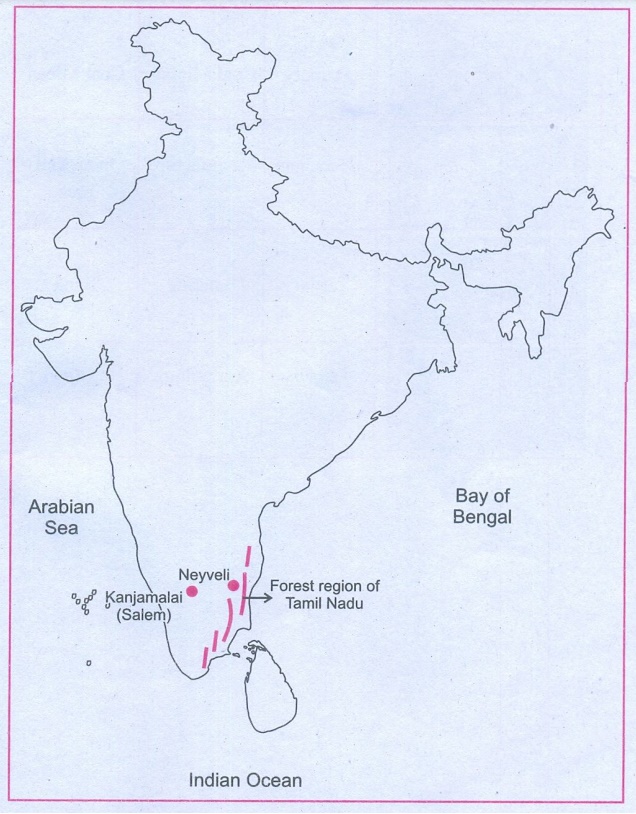
Mark the following in the outline map of India.
1. Neyveli
2. Bay of Bengal
3. Arabian Sea
4. Forest region of Tamil Nadu
5. Indian Ocean
6. Iron mining in Kanjamalai(Salem)
1.
()
Primary Activities
2.
()
Human
3.
()
Actual
4.
()
Careful
5.
()
Sugar
6.
The present needs of resources are met and the conserving of resources for the future are balanced, we call it sustainable development.
7.
Tertiary activities are basically concerned with the distribution of primary and secondary products through a system of transport and trade. (e.g) Banking, Trade and Communications.
8.
Individual resources are resources privately owned by individuals. (e.g.) Apartments.
9.
Human resources are groups of individuals who use nature to create more resources.
10.
Resources once consumed can be renewed with the passage of time are called renewable resources. (e.g) Air, Water, Sunlight.
11.
ON THE BASIS OF DISTRIBUTION:
On the basis of distribution, resources can be classified into localized resources and universal resources.
(i) When resources are present in specific regions they are called localized resources.
(e.g.) Minerals.
(ii) Some resources are present everywhere Such resources are called universal resources.
(e.g.) Sunlight and air.
(ii) On National resources are resources within the political boundaries and oceanic area of a country.
(e.g.) Tropical forest regions of India.
12.
Resource is anything that fulfills human needs.
(i) When anything is of some use it becomes valuable.
(ii) All resources have value.
(iii) The value can be either commercial or non-commercial. Commercial resources have great economic value. (e.g.) Petroleum.
(iv) The Non-commercial resources are very abundant in availability (e.g.) Air.
13.
Classification of Natural Resources:
Natural resources can be classified into different groups depending on origin, development, renewability, distribution, ownership etc
ON THE BASIS OF ORIGIN:
On the basis of origin, resources can be classified into biotic and abiotic resources.
(i) All living resources are biotic resources, plants, animals and other micro organisms are biotic resources.
(ii) Abiotic resources are non-living things. Land, water, air and minerals are abiotic resources.
ON THE BASIS OF DEVELOPMENT:
Based on the level of development, resources can be divided into actual and potential resources.
(i) Actual resources are resources that are being used and the quantity available is ' known. (e.g.) Coal at Neyveli.
(ii) Potential resources are resources that are not being used in the present and its quantity and location are not known. The technology to extract such resources is also yet to be developed. (e.g.) Marine yeast found in the Bay of Bengal and Arabian Sea.
ON THE BASIS OF EXllAUSTFFILLITY:
On the basis of renewability resources can be classified as renewable resources and nonrenewable resources.
(i) Resources once consumed can be renewed with the passage of time are called renewable resources. (e.g.) Air, Water, Sunlight. Misuse of such resources can also limit its available quantity. So, they have to be used wisely.
(ii) Natural resources which are limited can be called non-renewable resources. They become exhausted after use and the time they take to replace does not match the life cycle. (e.g.) Coal, petroleum, natural gas and other minerals.
14.
Mahatma Gandhi blamed "human beings" for depletion of resources because of
(i) Over exploitation of resources
(ii) Unlimited needs of human beings. So, conservation is very important
15.
Manufacturing
16.
Air
17.
Minerals
18.
Sustainable development
19.
Forest
20.

6th Standard Syllabus & Materials
6th Standard
TN 6th Social Science T3 - GEO - Understanding Disaster Sample Question Papers Study Material - QB365 Set A
NEW6th Standard
TN 6th Social Science T3 - GEO - Globe Sample Question Papers Study Material - QB365 Set A
NEW6th Standard
TN 6th Social Science T3 - GEO - Asia and Europe Sample Question Papers Study Material - QB365 Set A
NEW6th Standard
TN 6th Social Science T3 - HIS - South Indian Kingdoms Sample Question Papers Study Material - QB365 Set A



Tamilnadu Stateboard 6th Standard Subjects
Tamilnadu Stateboard Standards



