
 100% FREE ACCESS
6th Standard Syllabus & Materials
6th Standard
TN 6th Tamil பருவம் 1 - இயல் 1 - மொழி -தமிழ்த்தேன் - இன்பத்தமிழ் Sample Question Papers Study Material - QB365 Set A
NEW6th Standard
TN 6th English T1 - Supplementary - The Apple Tree and The Farmer Sample Question Papers Study Material - QB365 Set A
NEW6th Standard
TN 6th English T1 - Prose - When The Trees Walked Sample Question Papers Study Material - QB365 Set A
NEW6th Standard
TN 6th Social Science T3 - CIV - Road Safety Sample Question Papers Study Material - QB365 Set A
NEW6th Standard
TN 6th Social Science T3 - CIV - Local Bodies - Rural and Urban Sample Question Papers Study Material - QB365 Set A
NEW6th Standard
TN 6th Social Science T3 - CIV - Democracy Sample Question Papers Study Material - QB365 Set A

Published on: 01/12/2018
It's nearing the examination. This is the right time to grab the model question papers and practice for the board exams. Start revising all the portions for half yearly and get good marks in your examination. Here is the model question paper for the nearing half yearly examination for Samacheer 6th social science. The questions are prepared based on the state board syllabus. It is a very useful question paper for Matriculation and state board students for their exam preparation.
All the important questions from every chapter are covered in this question paper. By practicing repeatedly you will get the idea of answering the questions and this improves the speed of answering. This will save the time and you can complete all the questions without any last our tension. Get more model question papers and practice for your examination.
Everyone has the same aim that is to reach the top rank list. We are paving the way for you to reach your goal. practice with important question papers and get set ready to crack your exams with confidence.
Download Tamil Nadu 6th Standard Social Science question papers, model tests, one-mark questions, important questions, and public exam papers in PDF format. Free study materials and answer keys for TN State Board students.
Questions + Answers key
Take MCQ Social Science Test
1.
Consider the following statements
(1) Biosphere consists of Ecosystems.
(2) Atmosphere consists of water bodies.
(3) Lithosphere is the solid outer layer of the Earth
1 and 2
1 and 3
1,2 and 3
2 only
2.
Apartheiod, the racist policy was brought to an end by
Martin Luther
Nelson Mandela
Mother Theresa
Tagore
3.
The longest mountain range In the world is
Himalayas
Rocky
Andes
Alps
4.
The outer planets are_______
Jupiter and Mercury
Venus and Earth
Saturn and Mars
Uranus and Neptune
5.
We read Puhar kandam in
Manimegalai
Pattinappalai
Arthashastra
Silappathikaram
6.
Punjab is well known for_________________ dance.
Bihu
Dandia
Bhangra
Dumhal
7.
Who was the first ruler to give up war after victory
Bimbisar
Raja Raja Chola
Akbar
Ashoka
8.
Humans with the help of flint made __________.
sharp weapons
vessels
carts
boats
9.
Gender-based stereotypes are often portrayed in
films
advertisements
TV serials
All of these
10.
Which one of the following religion is not practised in India
Sikhism
Islam
Zoarastrianism
Confucianism
11.
Which of the following oceans is the busiest ocean?
The Pacific Ocean
The Atlantic Ocean
The Indian Ocean
The Arctic Ocean
12.
The galaxy in which our solar system is found is
Andromeda
Magellanic clouds
Milky Way
Starburst
13.
Water management system of Tamils are known from
Kallanai
Tanks in Kancheepuram
Prakirama Pandyan Tank
River Cauvery
14.
River valleys are said to be the cradle of civilisation because
Soil is very fertile.
They experience good climate
They are useful for transportation.
Many civilisations flourished on river valleys.
15.
What was the step taken by the early man to collect his food?
Trade
Hunting
Painting
Rearing of animals
16.
According to Gandhiji, the villages are __________ of the nation.
17.
____________ protects our fundamental rights.
18.
The Indian National Flag was designed by ______________.
19.
______________ resources are being used in the present.
20.
Thiruparthikundram, a village in Kanchipuram was once called_________.
21.
The Indian National carrom championship in 2008 was won by__________
22.
Sangam Valartha Nagaram referred to___________.
23.
The Island continent is __________ .
24.
__________ was the independent India’s first Law Minister
25.
Jaisalmer, the land of lowest rainfall is located in _________
26.
India’s first ever mission to the moon is _______________ .
27.
Masathuvan means ____________ .
28.
____________ were used to store grains.
29.
The main occupations of the ancient humans were ____________ and ____________ .
30.
_____________ was the first animal tamed by Old Stone Age man.
31.
What are called secondary occupation?
32.
What are the salient features of the National anthem?
33.
What is the difference between Naalangadi and Allangadi.
34.
What do you know about anthropology?
35.
What is evolution?
36.
What are the benefits of a museum?
37.
Buddha's relics were placed in the centre of the Stupas.
38.
Emperor Ashoka followed Buddhism.
39.
Initially humans expressed their feeling through actions
40.
Many rock cut temples were made during the Pallava period.
41.
Goat was the first animal to be domesticated by humans.
42.
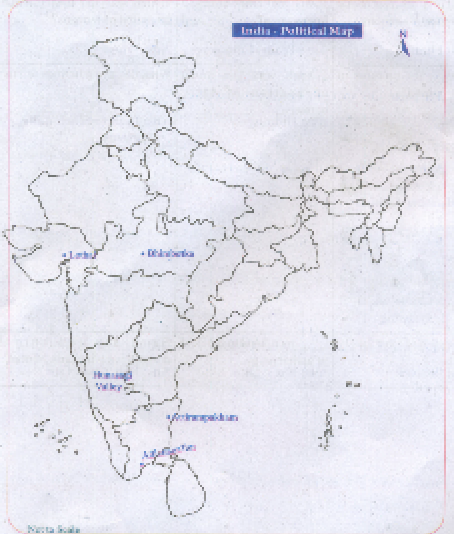
On the outline map of India, mark the following places:
1.Adichanallur
2.Attirampakkam
3.Bhimbetka
4.Hunasagi Valley
5.Lothal
43.
How are the industries classified on the basis of raw materials?
44.
Compare national and international resources.
45.
Jainism and Buddhism flourished in Sangam period. Give any two evidences for each.
46.
Why are the Red Sea, Dead Sea and Black Sea named so?
47.
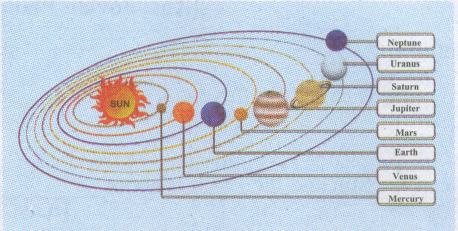
Study the picture and answer the given questions.
a. Which is the closest planet to the Sun?
b. Which is the largest planet?
c. Which is the fart~est planet from the Sun?
d. Which is the second smallest planet?
48.
Write any two types of discrimination?
49.
Various discrimination in India. Discuss.
50.
List out the various festivals celebrated in different states.
51.
Write about the accounts given by scholars about Kanchi.
52.
Explain the characteristics of the various spheres of the Earth.
53.
Distinguish between a Mountain and a Plateau
1.
(b)
1 and 3
2.
(b)
Nelson Mandela
3.
(c)
Andes
4.
(d)
Uranus and Neptune
5.
(d)
Silappathikaram
6.
(c)
Bhangra
7.
(d)
Ashoka
8.
(a)
sharp weapons
9.
(d)
All of these
10.
(d)
Confucianism
11.
(b)
The Atlantic Ocean
12.
(c)
Milky Way
13.
(d)
River Cauvery
14.
(d)
Many civilisations flourished on river valleys.
15.
(b)
Hunting
16.
()
back bone
17.
()
Constitution
18.
()
Pingali Venkayya
19.
()
Actual
20.
()
Jina Kanchi.
21.
()
lIavazhagi
22.
()
Madurai
23.
()
Australia
24.
()
Dr. B.R. Ambedkbar
25.
()
Rajasthan
26.
()
Chandrayaan-I
27.
()
A big trader
28.
()
Granaries
29.
()
hunting and gathering
30.
()
Dog
31.
1. The raw materials obtained from the primary acti~ities are converted into finished products through machinery on a large scale.
2. These activities are called secondary activities.
32.
(i) This anthem has to be sung at a duration of 52 seconds.
(ii) Everyone should stand erect while singing the national anthem.
(iii) One should understand the meaning while singing.
33.
| Naalangadi | Allangadi |
| Day Market of Sangam Age is called Naalangadi. | Evening Market of Sangam Age is called Allangadi |
34.
(i) Anthropology is the study of human and evolutionary history.
(ii) The word anthropology is derived from two Greek words
(iii) Anthropos meaning "man" or "human";
(iv) Logos, meaning "thought" or "reason.
35.
Evolution is the process through which the human kind changes and develops towards an advanced stage of life.
36.
(i) We should understand the life style of olden Age people with the help of museum.
(ii) Research students are get more information for museum
37.
(a)
38.
(a)
39.
(a)
40.
(a)
41.
(b)
42.
43.
On the basis of raw materials, industries are classified as
(i) Agro based industries - Cotton textiles, Sugar mills and Food processing.
(ii) Forest based industries - Paper mills, Furniture making, Building Materials.
(iii) Mineral based industries - Cement industry, Iron industry, and Aluminum Industries.
(iv) Marine based industries - Sea food processing.
44.
| S.No | National resources | International resources |
| 1. | National resources are resources within the political boundaries and oceanic area of a country. | International resources are all oceanic resources found in the open ocean. Resources found in this region can be utilized only after an international agreement. |
| 2. | (e.g.) Tropical forest regions of India. | (e.g.) Ambergris |
45.
Influence of Jainism [Samanam] in Tamil Nadu:
(i) In ancient Tamil literature, Jainism is referred to as Samanam.
(ii) There is a Samanar Hill or Samanar Malai in Keelakuyilkudi village, 15 km away from Madurai. The images of Tirthankaras created by Jain monks are found in the hill. It is a protected monument of Archaelogical Survey of India.
(iii) In Arittapatti, a small village 25 km from Madurai, on one side of Kalinjamalai hill there are Jain caves called Pandvar Padukka Pandavar Padukkai is the bed of Jain saints. This is the influence of Buddhism in Tamil Nadu.
(iv) Manimegalai, one of the epics of the post Sangam age is a Buddhist literature.
(v) Kanchipuram was a famous Buddhist Centre from where Dinnaga, the famous Buddhist logic logician, and Dharmapala, a great scholar of Nalanda University hailed.
46.
(i) Red Sea - It is named Red sea because it contains a Cyanobacteria which turns the normally blue-green water a reddish one. It gets connected to the ocean without even one river meeting the sea.
(ii) Black Sea - The Black Sea was first named by the ancient greeks as in hospitable sea. The sea got this reputation because it was different to navigate and hostile tribes inhabited its shores. After the successful development of the coast by the Greek colonists, the sea was named hospitable sea.
(iii) Dead Sea - The Dead Sea is roughly 8.6 times saltier than the ocean. This salinity makes for a harsh environment in which animals cannot flourish.
47.
a. Mercury
b. Jupiter
c. Uranus
d. Mars
48.
Types of discrimination:
(a) Caste discrimination
(b) Gender discrimination
(c) Religious discrimination
(a) Gaste discrimination:
(i) Caste system is the most dominant reason for inequality and discrimination in India.
(ii) Many people in India have fought against caste oppression.
(iii) The most prominent among them was Dr.B.R.Ambedkar.
(iv) He fought actively for equality among the citizens of India.
(b) Gender discrimination:
(i) Gender discrimination refers to health, education, economic and political inequalities between men and women in India.
(ii) For example a girl is not allowed to go to college after finishing her schooling.
(iii) Most of the girls are not allowed to select a career of their choice, rather they are forced into marriage.
(iv) In some families, girls are not allowed to wear modern dresses while boys in such families often wear modern dresses.
(c) Religious discrimination:
(i) Religions discrimination is unequal treatment of an individual or group based on their beliefs.
(ii) Religious discrimination has been around for a long time.
(iii) There have been problems between people of different religions for thousands of years.
(iv) Some people are not allowed to enter in public places; especially the places of worship, because they belong to another religion.
(v) Some religious people often end up in conflict with each other because of their rituals and way of life.
49.
(i) The different forms of inequalities such as caste inequality, religious inequality, race inequality or gender inequality give rise to discrimination.
(ii) Discrimination can happen on the basis of colour, class, religion gender etc.
(iii) Treating dark-skinned people differently from fair-skinned people, giving more importance to people of higher than to those of lower caste and thinking boys are smarter than girls are all thoughts of discrimination.
(iv) Article 15(1) of the constitution states that the State not to discriminate against any citizen on grounds only of religion, race, caste, sex, place of birth or any of them.
50.
1. Andhra Pradesh - Brahmotsavam
2. Arunachal Pradesh - Losar festival
3. Assam - Bohag Bihu
4. Bihar - Chhath Puja
5. Chhattisgarh - Bastar Dussehra
6. Goa - Carnival
7. Gujarat - Janmashtami, Diwali
8. Haryana - Baisaki
9. Himachal Pradesh - Maha Sivarathiri
10. Jammu and Kashmir - Eid-Ul-Fitr and Eid-ul-Azha
11. Jharkhand - Holi
12. Karnataka - Vgadi
13. Kerala - Onam
14. Madhya Predesh - Diwali
15. Maharastra - Ganesh Chaturthi
16. Manipur - Yaoshang
17. Meghalaya - Nongkrem Dance Festival
18. Mizoram - Chapachar kut Festival
19. Nagaland - Hombill Festival
20. Odisha - Raja Parba
21. Punjab - Lohri
22. Rajasthan - Gangaur Festival
23. Sikkim - Saga Dawa
24. Tamil Nadu - Pongal
25. Telangana - Bonalu
26. Tripura - Kashi puja
27. Uttra Pradesh - Navaratri
28. Uttarkhand - Ganga Dusshera
29. West Bengal - Durga Pooja
51.
(i) Scholars like Dharmabalar, Jothibalar, Sumathi and Bodhi Dharmar were born in Kanchi.
Bodhi Dharmar:
(i) Bodhi Dharmar is considered the found father of zen Buddhism
(ii) He taught martial arts to the Chinese and also how to control the breath to strengthen the blood and immune system energize the brain.
(iii) He passed away around 534 C.E.
Dharmapala:
(i) He lived in patatitta vihara near Kanchi.
(ii) He wrote pali commentaries for some of the Tripitakas.
(iii) He taught at Nalanda University but died young at the age of 32.
52.
(i) The earth is the most suitable planet to support life.
(ii) It has thrge major components that we call as the realms of the Earth lithosphere, hydrosphere and atmosphere.
Lithosphere:
(i) The lithosphere is the land on which we live.
(ii) It is the solid outer layer of the earth consisting of rocks and soils.
Hydrosphere:
(i) The hydrosphere consists of water bodies such as oceans, seas, rivers, lakes, ice caps.on mountains and water vapour in the atmosphere.
Atmosphere:
(i) Atmosphere is the envelope of air that surrounds the earth.
(ii) Different types of gases make up the atmosphere.
(iii) The major gases are Nitrogen 78% and Oxygen 21%.
(iv) The other gases like Carbon dioxide, Hydrogen, Helium, Argon and Ozone are present in meager amounts.
Biosphere:
(i) The narrow belt of interaction among the lithosphere, the hydrosphere and the atmosphere, where life exists is known as biosphere.
(ii) Bio means life in Greek.
(iii) It consists of distinct zones.
(iv) Each zone has its own climate, plant and animal life.
(iv) These zones are known as ecosystems.
53.
| S.No | Mountains | Plateaus |
| 1. | A landform that rises over 600 metre above its surroundings and has steep slopes is called a mountain. | Plateaus are the elevated portions of the Earth that have flat surfaces bounded by steep slopes. The elevation of plateaus may be a few hundred metre or several thousand metre. |
| 2. | Example: Himalayas | Example: Chotanagpur Plateau |

6th Standard Syllabus & Materials
6th Standard
TN 6th Social Science T3 - GEO - Understanding Disaster Sample Question Papers Study Material - QB365 Set A
NEW6th Standard
TN 6th Social Science T3 - GEO - Globe Sample Question Papers Study Material - QB365 Set A
NEW6th Standard
TN 6th Social Science T3 - GEO - Asia and Europe Sample Question Papers Study Material - QB365 Set A
NEW6th Standard
TN 6th Social Science T3 - HIS - South Indian Kingdoms Sample Question Papers Study Material - QB365 Set A



Tamilnadu Stateboard 6th Standard Subjects
Tamilnadu Stateboard Standards



