
 100% FREE ACCESS
6th Standard CBSE Syllabus & Materials
6th Standard CBSE
CBSE 6th Social Science The Value of Work - New Sample Question Papers Study Material - QB365 Set A
NEW6th Standard CBSE
CBSE 6th Social Science Family and Community - New Sample Question Papers Study Material - QB365 Set A
NEW6th Standard CBSE
CBSE 6th Social Science India's Cultural Roots - New Sample Question Papers Study Material - QB365 Set A
NEW6th Standard CBSE
CBSE 6th Social Science India,That is Bharat - New Sample Question Papers Study Material - QB365 Set A
NEW6th Standard CBSE
CBSE 6th Social Science Timeline and sources of history - New Sample Question Papers Study Material - QB365 Set A
NEW6th Standard CBSE
CBSE 6th Social Science Oceans and Continents - New Sample Question Papers Study Material - QB365 Set A

Published on: 03/12/2018
CBSE Class 6 is a crucial grade in your secondary school education. So learning with effective preparation is a must. Our study materials for CBSE Class 6 follow the latest CBSE syllabus and are prepared by subject experts who have much experience in the academic industry. By referring to our solutions, students get a clear understanding of each concept in detail. Students who have referred to our solutions have seen a significant increase in overall marks and ease in understanding the subjects. Our study materials are not only used by students but also by educational institutes in India.
In this post, we are going to provide you with the most important questions of Social Science exam from the chapter Rural Livelihoods. You should be knowing answers to these questions in all likelihood to score good marks in Class 6 Social Science exam.
In this question paper, the questions are cover from the social science chapter 9 Rural Livelihoods. Questions are prepared as per NCERT guidelines by the help of expert teachers.
The latest sample papers have been designed as per the latest blueprints, syllabus and examination trends. Sample papers should be practiced in examination condition at home or school and also show it to your teachers for checking or compare with the answers provided.
Download CBSE Class 6th Standard CBSE Social Science question papers, sample papers, important questions, and previous year solved papers in PDF format. Get free study materials, NCERT solutions, and exam preparation resources for Class 6th Standard CBSE Social Science
Questions + Answers key
Take MCQ Social Science Test
1.
What are the causes for the growth of agricultural labourers?
2.
Discuss the problems faced by fishermen during the monsoon season.
3.
Why do the rural people spend time on non-earning works?
4.
Why did Thulasi and Raman have to sell their cow?
5.
Why do both Sekar's and Aruna's families have to borrow? What similarities and differences do you find?
6.
Cultivation on a small piece of land to produce a variety of crops is called:
Subsistence agriculture
Marginal farming
Intensive subsistence agriculture
None of these
7.
What is the main crop of the village Kalpattu
Paddy
Wheat
Sweet corn
Sugarcane
8.
What is the main occupation of people living in the rural areas?
Working on farms
Working in banks
Working at shops
None of these
9.
Which of the following villages is a fishing village?
Pudupet
Kuppakulam
Nagaland
Kalpattu
10.
Which of the following shops is not in the main market?
Barber shops
Seed shops
Motorcycle repair shops
A tailor shop
11.
How many villages are there in our country?
12.
What is private debt?
13.
In your notebook draw some picture of work that you have seen people do in rural areas and write a few sentences that describe the work.
14.
Find the variety of small shops in the village's main street.
15.
Kalpattu village is located in which state?
16.
Rural people indifferent regions of the country grow ...........
17.
Paddy is the main crop that is grown in .............
18.
Collecting ..........., ............., and .............. to be sold to traders is an important source of additional income
19.
Soon the _________ becomes so large that no matter what they earn, they are unable to repay.
20.
Our _______ daughters are the joy of our lives.
21.
Give any five causes for the backwardness of Indian agriculture
22.
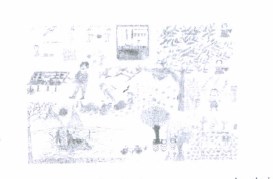
(i) Describe the works that you see people doing in the above picture.
(ii) Identify the different types of work that are related to farming and those that are not. List these in a table.
(iii) In your notebook draw some pictures of work that you have seen people do in rural areas and write a few sentences that describe the work.
1.
The causes for the growth of agricultural labourers are as follows :
(i) Increase in population.
(ii) Decline of cottage and handicraft industries.
(iii) Increased indebtedness.
(iv) Eviction of small farmers and tenants from the land.
2.
During the monsoon season, the fishermen cannot go to the sea because it is when the fish breed. These months are the most difficult ones. They survive by borrowing money from traders. Because of this, they face the problem of selling fish to traders the low prices and cannot do their own auctions
3.
The rural poor people do not earn much money to meet their both ends or to survive with the little money they earn. Therefore, they spend much time on collecting household things like firewood from forest, fetching water from distant borewell, grazing their cattle etc.
4.
Thulasi and Raman's one of the daughters fell ill and had to be taken to the hospital in town. They borrowed money from Ramalingam, so to pay back the money they had to sell their cow.
5.
Both Sekar's and Aruna's families have to borrow because Sekar's family owns about 2 acres of land and produces about 60 bags of paddy, which is not sufficient for his family. So, he has to borrow money. Aruna's family has to borrow money because four months in a year are the breeding season and men cannot go to the sea.
Similarities
(i) Both have to work very hard, from morning till evening to earn their living.
(ii) Both are under the clutches of the traders, from whom they have borrowed money.
Differences
(i) Sekar is a small farmer and Aruna is a fisherwoman.
(ii) Sekar has to do additional work, while Aruna does not need so.
6.
(b)
Marginal farming
7.
(a)
Paddy
8.
(a)
Working on farms
9.
(a)
Pudupet
10.
(c)
Motorcycle repair shops
11.
()
There are nearly 5,50,000 villages in our country.
12.
()
Private debt means loans which an individual takes for his/her personal consumption from other people or institutions.
13.
()
Students should do it themselves
14.
()
The variety of small shops in the village's main street are such as tea shops, grocery shops, barber shops, a cloth shop, a tailor shop, and two fertiliser and seed shops.
15.
()
Kalpattu village is located in Tamil Nadu.
16.
()
different crops
17.
()
irrigated lands
18.
()
mahuna, tendu, leaves honey
19.
()
loan
20.
()
school-going
21.
The main causes for the backwardness of the Indian agriculture are as follows:
(i) Small and fragmented land holdings.
(ii) Vicious circle of poverty.
(iii) Excessive dependence on monsoons.
(iv) No scientific method of cultivation.
(v) Floods and droughts
22.
(i)The works that people are doing:
(a) Hawker
(b) Fishing
(c) Labourers carrying goods
(d) Labourers working in the fields
(e) Plucking fruits and vegetables
(f) Shopkeeper
Works related to farming are:
(a) Labourers working in the fields
(b) Plucking fruits and vegetables
Works not related to farming are:
(a) Hawker
(b) Fishing
(c) Labourers carrying goods
(d) Mansions
(e) Shopkeeper

6th Standard CBSE Syllabus & Materials
6th Standard CBSE
CBSE 6th Social Science Locating Places on the Earth - New Sample Question Papers Study Material - QB365 Set A
NEW6th Standard CBSE
CBSE 6th Science A Journey Through States of Water - New Sample Question Papers Study Material - QB365 Set A
NEW6th Standard CBSE
CBSE 6th Science Temperature and its Measurement - New Sample Question Papers Study Material - QB365 Set A
NEW6th Standard CBSE
CBSE 6th Science Materials Around Us - New Sample Question Papers Study Material - QB365 Set A



CBSE 6th Standard CBSE Subjects
CBSE Standards




