
 100% FREE ACCESS
6th Standard Syllabus & Materials
6th Standard
TN 6th Tamil பருவம் 1 - இயல் 1 - மொழி -தமிழ்த்தேன் - இன்பத்தமிழ் Sample Question Papers Study Material - QB365 Set A
NEW6th Standard
TN 6th English T1 - Supplementary - The Apple Tree and The Farmer Sample Question Papers Study Material - QB365 Set A
NEW6th Standard
TN 6th English T1 - Prose - When The Trees Walked Sample Question Papers Study Material - QB365 Set A
NEW6th Standard
TN 6th Social Science T3 - CIV - Road Safety Sample Question Papers Study Material - QB365 Set A
NEW6th Standard
TN 6th Social Science T3 - CIV - Local Bodies - Rural and Urban Sample Question Papers Study Material - QB365 Set A
NEW6th Standard
TN 6th Social Science T3 - CIV - Democracy Sample Question Papers Study Material - QB365 Set A

Published on: 16/09/2019
Term 1 Five Mark
Download Tamil Nadu 6th Standard Social Science question papers, model tests, one-mark questions, important questions, and public exam papers in PDF format. Free study materials and answer keys for TN State Board students.
Questions + Answers key
Take MCQ Social Science Test
1.
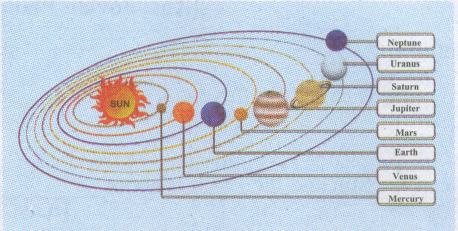
Study the picture and answer the given questions.
a. Which is the closest planet to the Sun?
b. Which is the largest planet?
c. Which is the fart~est planet from the Sun?
d. Which is the second smallest planet?
2.
Write any two types of discrimination?
3.
City of temples. Give short notes.
4.
“India is a land of diversity, yet we are all united”. Discuss.
5.
Distinguish between inner and outer planets.
6.
Distinguish between an ocean and a sea.
1.
a. Mercury
b. Jupiter
c. Uranus
d. Mars
2.
Types of discrimination:
(a) Caste discrimination
(b) Gender discrimination
(c) Religious discrimination
(a) Gaste discrimination:
(i) Caste system is the most dominant reason for inequality and discrimination in India.
(ii) Many people in India have fought against caste oppression.
(iii) The most prominent among them was Dr.B.R.Ambedkar.
(iv) He fought actively for equality among the citizens of India.
(b) Gender discrimination:
(i) Gender discrimination refers to health, education, economic and political inequalities between men and women in India.
(ii) For example a girl is not allowed to go to college after finishing her schooling.
(iii) Most of the girls are not allowed to select a career of their choice, rather they are forced into marriage.
(iv) In some families, girls are not allowed to wear modern dresses while boys in such families often wear modern dresses.
(c) Religious discrimination:
(i) Religions discrimination is unequal treatment of an individual or group based on their beliefs.
(ii) Religious discrimination has been around for a long time.
(iii) There have been problems between people of different religions for thousands of years.
(iv) Some people are not allowed to enter in public places; especially the places of worship, because they belong to another religion.
(v) Some religious people often end up in conflict with each other because of their rituals and way of life.
3.
(i) Kanchi is also known as the temple city.
(ii) The famous temple of great architectural beauty, Kailasanathar temple, was built by later pallava king Rajasimha II at Kanchi.
(iii) During the Pallava period, a large number of cave temples were built.
(iv) Some temples are situated at Kancheepuram like Ekambaranather Temple, Ulaganath Perumal Temple, Varatharaja Perumal Temple.
4.
(i) Diversities are seen in landscapes, climate, natural vegetation and soil.
(ii) Diversities are seen in languages, races, religion, customs and caste.
(iii) And also diversities are seen in habits and heritage, food and dress, art and architecture.
(iv) Irrespective of differences in all the above, we all take pride in calling ourselves as Indians.
(v) The feeling of oneness and unity among the people of various religious, castes of a country is called unity in diversity.
5.
| S.No | Inner planets | Outer planets |
| 1 | The four planets nearer to the sun are called Inner or Terrestrial planets. |
The last four plangts are called as Outer planets of Jovian planets. |
| 2 | Mercury, venus, earth and mars. | Jupiter, Saturn, Uranus and Neptune. |
| 3 | The inner planets are comparatively smaller in size and are compased of rocks |
They are also called Gaseous Giants. |
| 4 | The surface of inner planets has mountains, volcanoes and craters |
An asteriod belt is found between mars and jupiter. |
6.
| S.No | Ocean | Sea |
| 1. | Oceans are vast expanse of water. | Seas are water bodies partially or fully enclosed by land. |
| 2. | Eg. Pacific Ocean | Eg: Bay of Bengal, Arabian Sea. |

6th Standard Syllabus & Materials
6th Standard
TN 6th Social Science T3 - GEO - Understanding Disaster Sample Question Papers Study Material - QB365 Set A
NEW6th Standard
TN 6th Social Science T3 - GEO - Globe Sample Question Papers Study Material - QB365 Set A
NEW6th Standard
TN 6th Social Science T3 - GEO - Asia and Europe Sample Question Papers Study Material - QB365 Set A
NEW6th Standard
TN 6th Social Science T3 - HIS - South Indian Kingdoms Sample Question Papers Study Material - QB365 Set A



Tamilnadu Stateboard 6th Standard Subjects
Tamilnadu Stateboard Standards



