
 100% FREE ACCESS
6th Standard CBSE Syllabus & Materials
6th Standard CBSE
CBSE 6th Social Science The Value of Work - New Sample Question Papers Study Material - QB365 Set A
NEW6th Standard CBSE
CBSE 6th Social Science Family and Community - New Sample Question Papers Study Material - QB365 Set A
NEW6th Standard CBSE
CBSE 6th Social Science India's Cultural Roots - New Sample Question Papers Study Material - QB365 Set A
NEW6th Standard CBSE
CBSE 6th Social Science India,That is Bharat - New Sample Question Papers Study Material - QB365 Set A
NEW6th Standard CBSE
CBSE 6th Social Science Timeline and sources of history - New Sample Question Papers Study Material - QB365 Set A
NEW6th Standard CBSE
CBSE 6th Social Science Oceans and Continents - New Sample Question Papers Study Material - QB365 Set A

Published on: 19/01/2019
Basic Geometrical Ideas Full Material
Download CBSE Class 6th Standard CBSE Mathematics question papers, sample papers, important questions, and previous year solved papers in PDF format. Get free study materials, NCERT solutions, and exam preparation resources for Class 6th Standard CBSE Mathematics
Questions + Answers key
Take MCQ Mathematics Test
1.
PM also a chord?
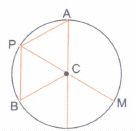
2.
Write down three angles involved in \(\triangle ABC\) of the given figure.
3.
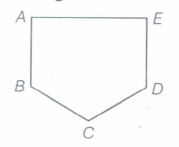
Name the line segments shown in given figure.
4.
How many chords can be drawn on the circle?
5.
What is the name of chord, which passes through the centre of the circle?
6.
How many diagonals, a quadrilateral have?
7.
How many sides, a quadrilateral have?
8.
How many vertices are there in a triangle?
9.
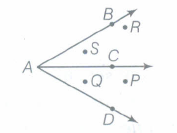
Write the points, which lie interior in the \(\angle CAD\).
10.
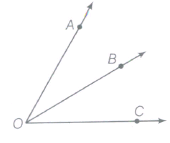
Write the name of angles in the given figure.
11.
Write the minimum number of point of intersection of three lines in a plane.
12.
A line contain how many points
(a) minimum?
(b) maximum?
13.
How many lines can be drawn through two given points?
14.
A star in the sky also gives us an idea of a point. Identify atleast five such situations in your daily life.
15.
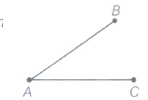
Name the line segments in the given figure. Is it A, the end point at each line segment?
16.
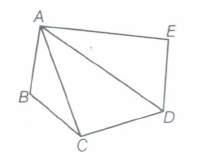
Name the vertices and the line segments in the given figure.
17.
Draw a rough sketch of a quadrilateral PQRS. Draw its diagonals, name them. Is the meeting point of the diagonals in the interior or exterior of the quadrilateral?
18.
How many angles does a polygon of five sides has?
19.
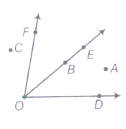
In the given diagram, name the point(s).
(a) In the interior of \(\angle DOE\).
(b) In the exterior of \(\angle EOF\).
(c) On \(\angle EOF\).
20.
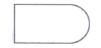
What is closed curve? Draw a closed curve.
21.
Draw rough diagram to illustrate the following:Closed curve.
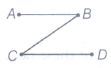
22.
Draw a figure to show that the points A, B, C and D are non-collinear.
23.
How many lines can pass through
(a) one given point?
(b) two given points?
24.
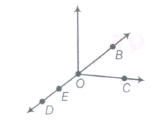
Use the figure to name
(a) five points.
(b) a line.
(c) four rays.
(d) five line segments.
25.
Take a sheet of paper. Make two folds (and crease them) to represent a pair of intersecting lines and discuss.
(a) Can two lines intersect in more than one point?
(b) Can more than two lines intersect in one point?
26.
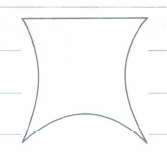
In the following figure, write the name of the figure, closed curve or polygon. Also give reason.
27.
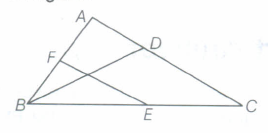
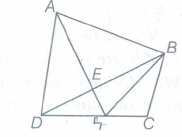
In the given figure, write the name of triangles.
28.
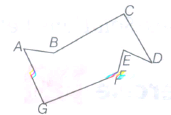
In the given figure, write the number of sides.
29.
Illustrate, if possible, each one of the following with a rough diagram:
(a) A closed curve that is not a polygon.
(b) An open curve made up entirely of line segments.
(c) A polygon with two sides.
30.
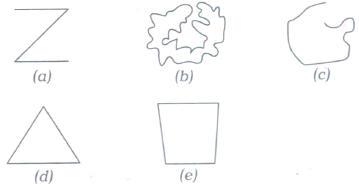
Classify the following curves as (i) open or (ii) closed.
31.
How many pairs of adjacent angles are there in a quadrilateral?
1
2
3
4
32.
How many pairs of opposite sides are there in a quadrilateral?
1
2
3
4
33.
How many pairs of opposite angles are there in a quadrilateral?
1
2
3
4
34.
How many angles are there in a quadrilateral?
1
2
3
4
35.
How many sides are there in a quadrilateral?
1
2
3
4
36.
How many vertices are there in a quadrilateral?
1
2
3
4
37.
How many angles are there in a triangle?
1
2
3
4
38.
How many sides are there in a triangle?
1
2
3
4
39.
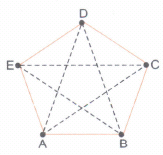
How many diagonals are there in the following figure?
4
5
2
3
40.
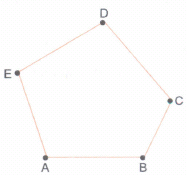
How many sides are there in the following figure?
5
4
2
3
41.
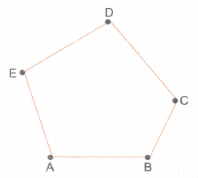
How many vertices are there in the following figure?
5
3
2
4
42.
Two intersecting lines intersect in
1 point
2 points
3 points
4 points.
43.
Which of the following is not a polygon?
Triangle
Rectangle
Pentagon
Circle
44.
The least number of line segment required to make a polygon is
1
2
3
5
45.
Which of the following are the diagonals of the given polygon?
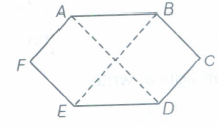
AD and BE
AFand FE
BC and ED
AB and ED
46.
Which of these is an example for a pair of these parallel lines?
Corner of a room
Railway track
Sides of a triangle
Surface of a ball
47.
Which of the following has two end points?
Ray
Line
Line segment
None of the above
48.
The number of circles that can be drawn with a given centre is
2
3
4
Infinite
49.
Number of lines passing through five points such that no three of them are collinear, is
10
5
20
8
50.
How many points are marked in the following figure?

1
2
3
4
1.
Yes
2.
The three angles in the above figure are \(\angle BAC,\angle ABC,\ and\ \angle ACB\).
3.
The line segments are \(\bar {AB},\bar {BC},\bar {CD},\bar {DE},\bar {AE}\).
4.
Infinite
5.
Diameter
6.
Two
7.
Four
8.
Three
9.
Q and P
10.
Here, angles are \(\angle AOB,\angle BOC\) and \(\angle AOC\).
11.
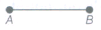
12.
(a) Two
(b) Infinite
13.
One line
14.
Five situations of a point in our daily life are as follow:
(i) Tip of an ice cone.
(ii) An edge of a table.
(iii) Corner of a room.
(iv) Corner of a desk.
(v) Corner of a paper.
15.
The line segments are\(\bar { AB}\) and \(\bar { AC}\).
Yes, A is the end point of each line segment.
16.
The vertices of the figure are A. B, C,D, E and the line segments are \(\bar {AB},\bar {BC},\bar {CD},\bar {DE},\bar {EA},\bar {AC},\bar {AD}\).
17.
The joins of the vertices, which are not adjacent i.e. opposite to each other, are called diagonals of quadrilateral. A rough sketch of a quadrilateral PQRS with its diagonals and their names are given below:
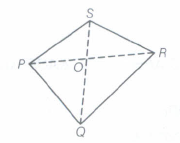
Here, PR and QS are its diagonals. They intersect each other at point O. So, point O is in the interior of the quadrilateral PQRS.
18.
Five
19.
(a) In given figure, point A lies between the sides OD and OE.
So, it is in the interior of\(\angle DOE\).
(b) In given figure, points C, A and D are in the exterior of \(\angle EOF\).
(c) In given figure, point E, B, O and F lie on the sides OE and OFof \(\angle EOF\), so these points are on \(\angle EOF\).
20.
A curve, which cut itself called closed curve.
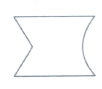
21.
The curve given below is a closed curve, since its ends are joined:
22.
23.
(a) Infinite number of lines can pass through one given point.
Let there be a point O on a surface.
Now, we can draw infinite lines through it.
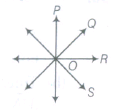
(b) Exactly one and only one line can pass through two given points (say A and B)

24.
From the given figure,
(a) Five points are B, C, D, E and O.
(b) A line is \(\vec {BD}\) (or \(\vec {OB}\)).
(c) Four rays are \(\vec {OB}\), \(\vec {OC}\), \(\vec {OE}\) and \(\vec {OD}\).
(d) Five line segments in the given figure are \(\overline { OB } ,\overline { OC } ,\overline { OE } ,\overline { OD } \) and \(\overline { DE } \).
25.
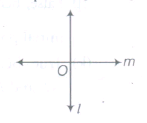
We know that, if two lines have one common point, then they are called intersecting lines. By making two folds of a sheet of paper and crease them, we get the following figures.
(a) From figure, it is clear that line l and m intersect at one point O (say) only. So, two lines cannot intersect in more than one point.
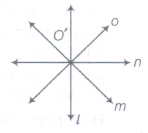
(b) Now, we again fold the paper diagonally (i.e. fold the paper three times) and crease them. We get the following figure.
In the figure, four lines l, m,n and o are intersecting at one point O' (say) only. So, it is clear from the above figure, that more than two lines intersect in one point.
26.
Closed curve, because a polygon is made by line segments only.
27.
\(\triangle EFB,\triangle AFB,\triangle DBC,\triangle FBC,\triangle ADE,\triangle ADB,\triangle DFE,\triangle AEB,\triangle AFD.\)
28.
Seven sides i.e AB, BC, CD, DE, EF, FG, AG.
29.
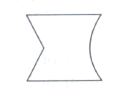
(a) The following figure shows a closed curve, but not a polygon, because a polygon is made by line segments only.
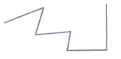
(b) The following figure shows an open curve made up entirely of line segments.
(c) It is not possible, because a polygon of two sides cannot be drawn.
30.
From the given figures, (a) and (c) are open curves and (b), (d) and (e) are closed curves.
31.
(d)
4
32.
(b)
2
33.
(b)
2
34.
(d)
4
35.
(d)
4
36.
(d)
4
37.
(c)
3
38.
(c)
3
39.
(b)
5
40.
(a)
5
41.
(a)
5
42.
(a)
1 point
43.
(d)
Circle
44.
(c)
3
45.
(a)
AD and BE
46.
(b)
Railway track
47.
(c)
Line segment
48.
(d)
Infinite
49.
(a)
10
50.
(d)
4

6th Standard CBSE Syllabus & Materials
6th Standard CBSE
CBSE 6th Social Science Locating Places on the Earth - New Sample Question Papers Study Material - QB365 Set A
NEW6th Standard CBSE
CBSE 6th Science A Journey Through States of Water - New Sample Question Papers Study Material - QB365 Set A
NEW6th Standard CBSE
CBSE 6th Science Temperature and its Measurement - New Sample Question Papers Study Material - QB365 Set A
NEW6th Standard CBSE
CBSE 6th Science Materials Around Us - New Sample Question Papers Study Material - QB365 Set A



CBSE 6th Standard CBSE Subjects
CBSE Standards




