
 100% FREE ACCESS
6th Standard CBSE Syllabus & Materials
6th Standard CBSE
CBSE 6th Social Science The Value of Work - New Sample Question Papers Study Material - QB365 Set A
NEW6th Standard CBSE
CBSE 6th Social Science Family and Community - New Sample Question Papers Study Material - QB365 Set A
NEW6th Standard CBSE
CBSE 6th Social Science India's Cultural Roots - New Sample Question Papers Study Material - QB365 Set A
NEW6th Standard CBSE
CBSE 6th Social Science India,That is Bharat - New Sample Question Papers Study Material - QB365 Set A
NEW6th Standard CBSE
CBSE 6th Social Science Timeline and sources of history - New Sample Question Papers Study Material - QB365 Set A
NEW6th Standard CBSE
CBSE 6th Social Science Oceans and Continents - New Sample Question Papers Study Material - QB365 Set A

Published on: 22/09/2018
Important Five Mark Question Paper
Download CBSE Class 6th Standard CBSE Mathematics question papers, sample papers, important questions, and previous year solved papers in PDF format. Get free study materials, NCERT solutions, and exam preparation resources for Class 6th Standard CBSE Mathematics
Questions + Answers key
Take MCQ Mathematics Test
1.
Draw a figure on the ground in the form of a horizontal number line as shown below. Frame questions as given in the above example and ask your friends.

Few questions framed are as follows:
1. Go 4 steps to the right of o.
2. Go 5 steps to the left of o.
3. Go 6 steps to the right of 0 and then go 4 steps further from there to the left.
4. Go 5 steps to the left of 0 and then go 1 step further from there to the left.
5. Go 8 steps to the right of 0 and then go 6 steps further from there to the left.
6. Go 4 steps to the left of 0 and then go 3 steps further from there to the right.
2.
Going up and down
In Mohan's house there are stairs for going up to the terrace and for going down to the godown.
Let us consider the number of stairs going up to the terrace as positive integer, the number of stairs going down to the godown as negative integer, and the number representing ground level as zero.
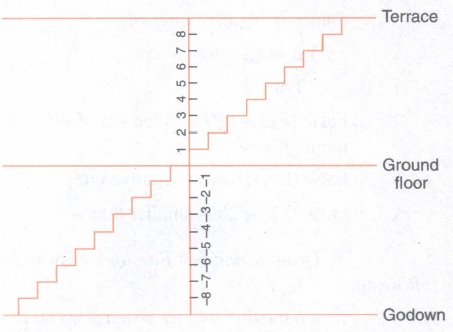
Do the following exercise and write down the answer as integer:
(a) Go 6 steps up from the ground floor.
(b) Go 4 steps down from the ground floor.
(c) Go 5 steps up from the ground floor and then go 3 steps up further from there.
(d) Go 6 steps down from the ground floor and then go down further 2 steps from there.
(e) Go down 5 steps from the ground floor and then move up 12·steps from there.
(f) Go 8 steps down from the ground floor and then go up 5 steps from there.
(g) Go 7 steps up from the ground floor and then 10 steps down from there.
Ameena wrote them as follows:
(a)+6
(b)-4
(c) (+ 5) + (+ 3) = + 8
(d) (-6) + (-2) =-4
(e)(-5)+(+12)=+7
(f)(-8) +(+5)=-3
(g) (+ 7) + (-10) = 17
She has made some mistakes. Can you check her answers and correct those that are wrong?
3.
A square is divided into certain number of equal parts. If 15 of the parts, so formed represent the fraction 1/5, find the number of parts in which the rectangle has been divided
4.
The perimeter of a regular hexagon is 72 cm How long is its each side?
5.
If it rained 40 cm in the last 8 days. How many centimetres of rain will fall in a month of 31 assuming that the rain continues to fall at the same, rate?
6.
Length of a rectangular field is 250 m and width is 150 m. Anuradha runs around this field 3 times. How far did she run? How many times she should run around the field to cover a distance of 4 km?
7.
The area of a rectangle is 40 cm2. If its length is (2k - 5) cm and its breadth is 8 cm. Then, find the value of k.
8.
The sale of cars of Maruti Udhyog in the city of Delhi from January to June in a year are as follows:
Take  = 50 cars.
| Months | January | February | March | April | May | June |
| Number of cars | 350 | 400 | 250 | 200 | 350 | 200 |
Represent them as a pictograph.
9.
There are 20 girls and 15 boys in a class.
(a) What is the ratio of number of girls to the number of boys?
(b) What is the ratio of number of girls to the total number of students in the class?
10.
The sale of electric bulbs on different days of a week is shown below
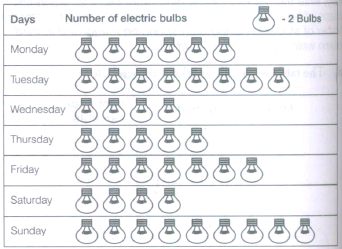
Observe the pictograph and answer the following questions.
(a) How many bulbs were sold on Friday?
(b) On which day, were the maximum number of bulbs sold?
(c) On which of the days, same number of bulbs were sold?
(d) On which of the days, minimum number of bulbs were sold?
(e) If one big carton can hold 9 bulbs. How many cartons were needed in the given week?
11.
Find the value of the following:
(i) 175 x 17 + 175 x 25
(ii) 207 x 80 + 207 x 20.
12.
Write the numbers given in the following place value table in decimal form.
| Hundreds (100) |
Tens (10) |
Ones (1) |
Tenths (1/10) |
Hundredths (1/100) |
Thousandths (1/1000) |
|
|---|---|---|---|---|---|---|
| (a) | 0 | 0 | 3 | 2 | 5 | 0 |
| (b) | 1 | 0 | 2 | 6 | 3 | 0 |
| (c) | 0 | 3 | 0 | 0 | 2 | 5 |
| (d) | 2 | 1 | 1 | 9 | 0 | 2 |
| (e) | 0 | 1 | 2 | 2 | 4 | 1 |
13.
The distance between the park and the house of a student is 2 km 260 m. Every day he walks both ways between the parks and his house. Find the total distance covered by him in a week's time.
14.
The monthly fee for a student in a school is Rs.480. If there are 620 students in the school. Then, find the total monthly collection of fees.
15.
Mark -3, 7, -4, -8, -1 and 3 on the number line.
16.
Medicine is packed in boxes, each weighing 4 kg 500 g. How many such boxes can be loaded in a van which cannot carry beyond 800 kg?
17.
Try to form a polygon with
(i) five matchsticks.
(ii) four matchsticks.
(iii) three matchsticks.
(iv) two matchsticks.
In which case was it not possible? Why?
18.
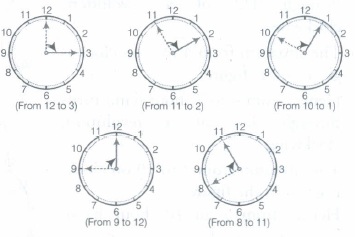
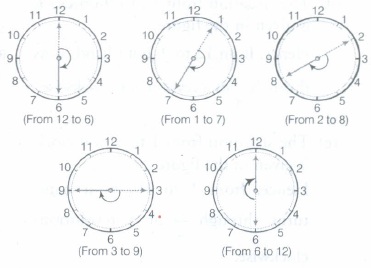
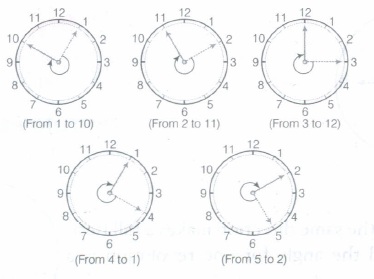
Draw five other situations of one-fourth, half and three-fourth revolution on a clock.
19.
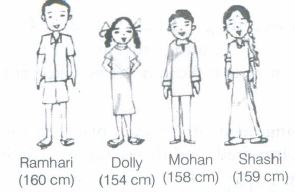
Who is the tallest? Who is the shortest?
(a) Can you arrange them in the increasing order of their heights?
(b) Can you arrange them in the decreasing order of their heights?
20.
Find the greatest and the smallest numbers. 6895, 23787, 24569, 24659.
1.
1. +4
2. -5
3. (+ 6) + (- 4) = + 2
4. (-5)+(-1)=-6
5. (+8)+(-6)=+2
6. (-4)+(+3)=-1
2.
(a) correct
(b)correct
(c)correct
(d)Incorrect; the correct is (- 6) + (- 2) = - 8
(e)correct
(f)correct
(g)ncorrect; the correct is (+ 7) + (- 10) = - 3
3.
We know that a part represents by fraction as 1/5.
Fraction of their parts = \(\frac { Number\ of\ parts }{ Total\ number\ of\ parts } \)
\(\frac { 1 }{ 5 } =\frac { 15 }{ Total\ number\ of\ parts } \)
⇒ Total number of parts = 5 x 15 = 75 [by cross-product]
Hence, the total number of parts are 75.
4.
12 cm
5.
155 cm
6.
Given, length of rectangular field (I) = 250 m and width is 150 m
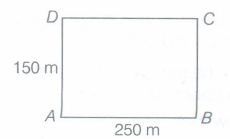
Perimeter of this field = 2 (I + b) = 2 (250 + 150) m
= 2 \(\times\) 400 m = 800 m
Distance covered in one round = Perimeter = 800 m
Distance covered in three rounds
= 3\(\times\) 800= 2400 m
Now, number of rounds to cover 4 km, i.e. 400 m.
=\(\frac{4000}{800}=5\) [∵1 km= 1000 m]
Hence, she should run 5 times around the field to cover the distance of 4 km
7.
k=5
8.
We draw the following table using given information
.png)
9.
Given, number of girls = 20 and number of boys = 15
\(\therefore\) Total number of students in the class = 20 +15 = 35
(a) Ratio of number of girls to the number of boys \(=\frac{Number\ of\ girls}{Number\ of\ boys}=\frac{20}{15}\)
\(=\frac{20\div5}{15\div5}=\frac{4}{3}=4:3\) [ \(\because\)HCFof 20 and 15=5]
(b) Ratio of number of girls to the total number of students in the class \(=\frac{Number\ of\ girls}{Total\ number\ of\ students}=\frac{20}{35}\)
\(=\frac{20\div5}{35\div5}=\frac{4}{7}\) [ \(\because\) HCF of 20 and 35 = 5]
10.
In the given pictograph, 1 picture = 2 bulbs
Now, number of bulbs sold on Monday = 6 pictures
= 6 x 2 = 12bulbs
Number of bulbs sold on Tuesday = 8 x 2 = 16 bulbs
Number of bulbs sold on Wednesday = 4 x 2 = 8 bulbs
Number of bulbs sold on Thursday = 5 x 2 = 10 bulbs
Number of bulbs sold on Friday = 7 x 2 = 14 bulbs
Number of bulbs sold on Saturday = 4 x 2 = 8 bulbs
Number of bulbs sold on Sunday = 9 x 2 = 18 bulbs
(a) Number of bulbs sold on Friday = 7 x 2 = 14 bulbs
(b) Maximum number of bulbs were sold on Sunday i.e. 18 bulbs.
(c) The same number of bulbs were sold on Wednesday and Saturday i.e. 8 bulbs.
(d) The minimum number of bulbs were sold on Wednesday and Saturday i.e. 8 bulbs.
(e) Total number of bulbs sold in a week
= 12 + 16 + 8 + 10 + 14 + 8 + 18 = 86
Now, number of cartons which can hold 9 bulbs = 1 and number of carton which can hold 1 bulb = \(\frac{1}{9}\)
\(\therefore\) Number of cartons which can hold 86 bulbs = \(\frac{1\times 86}{9}\)
= \(\frac{86}{9}=9\frac{5}{9}=10\)
Hence, 10 cartons were needed in the given week.
11.
(i) 7350
(ii) 20700.
12.
(a) Here,
\(0\times 100+0\times 10+3\times 1+2\times \frac { 1 }{ 10 } +5\times \frac { 1 }{ 100 } +0\times \frac { 1 }{ 1000 } \)
\(=0+0+3+\frac { 2 }{ 10 } +\frac { 5 }{ 100 }+0\)
\(=3+\frac { 2 }{ 10 } +\frac { 5 }{ 100 } \)=3+0.2+0.05=3.25
(b) Here,
\(1\times 100+0\times 10+2\times 1+6\times \frac { 1 }{ 10 } +3\times \frac { 1 }{ 100 } +0\times \frac { 1 }{ 1000 } \)
\(=100+0+2+\frac { 6 }{ 10 } +\frac { 3 }{ 100 } +0\)
\(=102+\frac { 6 }{ 10 } +\frac { 3 }{ 100 } \)
= 102 + 0.6 + 0.03 = 102.63
(c) Required decimal = 30.025
(d) Required decimal = 211.902
(e) Required decimal = 12.241
13.
31 km 640 m
14.
Rs.297600
15.
Draw a line and mark some points at equal distance on it as shown in the figure given below. Mark a point on it as zero. Points to the right of zero are positive integers and marked by +1, + 2, +3 erc., or simply 1, 2, 3 etc and points to the left of zero are negative integers and marked by -1, - 2, - 3 etc. Now, - 3 is a negative integer (since, - 3 has negative sign). So, move 3 points to the left of zero and represent it by point C. 7 is a positive integer (since + 7 has positive sign). So, move 7 points to the right of zero and represent it by point F. To mark - 4 on this line, move 4 points to the left of zero and represent it by point B. To mark - 8, on this line, move 8 points to the left of zero and represent it by point A. To mark - 1 on this line, move 1 point to the left of zero and represent it by point D. To mark 3 on this line, move 3 points to the right of zero and represent it by point E. Thus, we get the following representation of these integers on the number line:

16.
Given, van can carry a weight of 800 kg
= 800 \(\times\) 1000 g = 800000 g
According to the question,
Weight of one packet = 4 kg 500 g
= 4 \(\times\) 1000 + 500
= 4000 + 500
= 4500 g
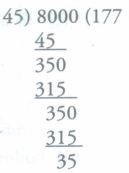
∴ Number of packets that can be loaded in the van\(=\frac { Total\quad weight\quad strength\quad of\quad the\quad van }{ Weight\quad of\quad one\quad packet } \)
\(=\frac { 800000 }{ 4500 } =\frac { 8000 }{ 45 } \)
Hence, only 177 boxes can be loaded in the van.
17.
We know that, if a closed simple figure is made up entirely of line segments, then it is called a polygon.
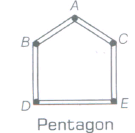
(i) Polygon with five matchsticks.
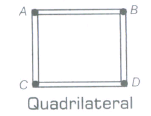
(ii) Polygon with four matchstick
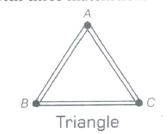
(iii) Polygon with three matchsticks
(iv) We know that, a polygon is a closed plane figure, bounded by line segments. So, with the help of two matchsticks, it is not possible to make a closed plane figure. Hence, no polygon is formed by two matchsticks.
18.
(i) One-fourth revolution For one-fourth revolution, the clock hand moves in many individual routes. Some of these situations on a clock are as follows:
(ii) Half revolution For half revolution, the clock hand moves in many individual routes. Some of these situations on a clock are as follows:
(iii) Three-fourth revolution For three-fourth revolution, the clock hand moves in many individual routes. Some of these situations on a clock are as follows:
19.
(i) From the given figure, it is clear that,
160> 159> 158> 154
∴ Ramhari is the tallest, because he has the height of 160 cm.
(ii) From the given figure, it is clear that,
154 < 158 < 159 < 160
∴ Dolly is the shortest, because she has the height of 154 cm.
We can arrange height from two types:
(a) Yes, we can arrange their heights in increasing order as follows: Dolly (154 cm) < Mohan (158 cm) < Shashi (159 cm) < Ramhari (160 cm).
(b) Yes, we can arrange their heights in decreasing order as follows: Ramhari (160 cm) > Shashi (159 cm) > Mohan (158 cm) > Dolly (154 cm).
20.
We have, 6895, 23787, 24569, 24659
Here, 6895 is a 4-digit number and other numbers are 5 digits, so it is clear that 6895 is the smallest number. Now, in remaining three numbers, the digit at ten thousands place is same in each number. So, we compare the thousands place digit.

∵ 4>3
Again, in two numbers, digit at thousands place is same. So, we compare the hundreds place digit.

∵ 6>5
∴ The greatest number is 24659 and smallest number is 6895.

6th Standard CBSE Syllabus & Materials
6th Standard CBSE
CBSE 6th Social Science Locating Places on the Earth - New Sample Question Papers Study Material - QB365 Set A
NEW6th Standard CBSE
CBSE 6th Science A Journey Through States of Water - New Sample Question Papers Study Material - QB365 Set A
NEW6th Standard CBSE
CBSE 6th Science Temperature and its Measurement - New Sample Question Papers Study Material - QB365 Set A
NEW6th Standard CBSE
CBSE 6th Science Materials Around Us - New Sample Question Papers Study Material - QB365 Set A



CBSE 6th Standard CBSE Subjects
CBSE Standards




