
 100% FREE ACCESS
6th Standard CBSE Syllabus & Materials
6th Standard CBSE
CBSE 6th Social Science The Value of Work - New Sample Question Papers Study Material - QB365 Set A
NEW6th Standard CBSE
CBSE 6th Social Science Family and Community - New Sample Question Papers Study Material - QB365 Set A
NEW6th Standard CBSE
CBSE 6th Social Science India's Cultural Roots - New Sample Question Papers Study Material - QB365 Set A
NEW6th Standard CBSE
CBSE 6th Social Science India,That is Bharat - New Sample Question Papers Study Material - QB365 Set A
NEW6th Standard CBSE
CBSE 6th Social Science Timeline and sources of history - New Sample Question Papers Study Material - QB365 Set A
NEW6th Standard CBSE
CBSE 6th Social Science Oceans and Continents - New Sample Question Papers Study Material - QB365 Set A

Published on: 15/09/2018
Model Question 2
Download CBSE Class 6th Standard CBSE Mathematics question papers, sample papers, important questions, and previous year solved papers in PDF format. Get free study materials, NCERT solutions, and exam preparation resources for Class 6th Standard CBSE Mathematics
Questions + Answers key
Take MCQ Mathematics Test
1.
What will be the next number in the sequence?
1, 5, 9, 13, 17, 21, .......
2.
How many lines of symmetry does an equilateral triangle have?
3.
Write the following using numbers, literal numbers and basic arithmetic operations.
4 less than number x.
4.
A car covers 1002 km in 16 h. At what speed per hour does the car move?
5.
The numbers 13 and 31 are prime numbers. Both these numbers have the same digits 1 and 3. Find such pairs of prime numbers upto 100.
6.
Find using distributive property 15 x 68.
7.
Going up and down
In Mohan's house there are stairs for going up to the terrace and for going down to the godown.
Let us consider the number of stairs going up to the terrace as positive integer, the number of stairs going down to the godown as negative integer, and the number representing ground level as zero.
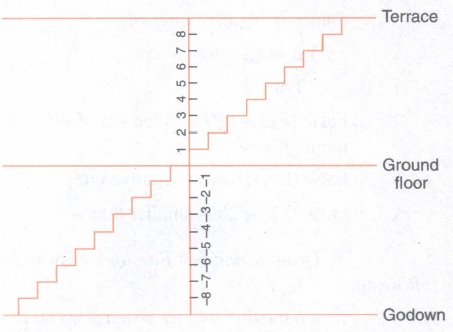
Do the following exercise and write down the answer as integer:
(a) Go 6 steps up from the ground floor.
(b) Go 4 steps down from the ground floor.
(c) Go 5 steps up from the ground floor and then go 3 steps up further from there.
(d) Go 6 steps down from the ground floor and then go down further 2 steps from there.
(e) Go down 5 steps from the ground floor and then move up 12·steps from there.
(f) Go 8 steps down from the ground floor and then go up 5 steps from there.
(g) Go 7 steps up from the ground floor and then 10 steps down from there.
Ameena wrote them as follows:
(a)+6
(b)-4
(c) (+ 5) + (+ 3) = + 8
(d) (-6) + (-2) =-4
(e)(-5)+(+12)=+7
(f)(-8) +(+5)=-3
(g) (+ 7) + (-10) = 17
She has made some mistakes. Can you check her answers and correct those that are wrong?
8.
Define the following. Like fractions
9.
Find the largest possible number of 5 digits, which exactly divisible by 32, 36 and 40.
10.
Draw any line segment \(\bar{AB}\). Mark any point Mon it. Through M, draw a perpendicular to \(\bar{AB}\) (use ruler and compasses).
11.
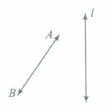
Draw the images of points A and B in line l of figure and name them as A' and B', respectively. Measures AB and A' B'. Are they equal?
12.
Form an equation for the given statements.
(a) When 14 is added to a number, the result is 70.
(b) The difference of a number with 3 is 10.
(c) Five times a number is 25.
(d) A number divided by 3 gives 15.
(e) Three is added to two times of a number given 13.
13.
During Maths lab activity, each student was given four broomsticks of length 8 cm, 8 cm, 5 cm, 5 cm to make different types of quadrilaterals.
(a) How many quadrilaterals can be formed using four broomsticks?
(b) Name the types of quadrilateral formed.
(c) While doing this activity, which value is depicted?
14.
There are 20 girls and 15 boys in a class.
(a) What is the ratio of number of girls to the number of boys?
(b) What is the ratio of number of girls to the total number of students in the class?
15.
The number of girl students in each class of a co-educational middle school is depicted by the pictograph.
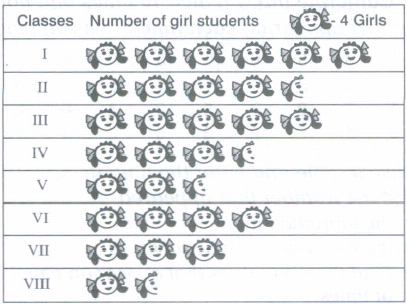
Observe this pictograph and answer the following questions.
(a) Which class has the minimum number of girl students?
(b) Is the number of girls in Class VI less than the number of girls in Class V?
(c) How many girls are there in Class VII?
16.
If a car covers 1262 km in 1 h. Then, find the distance will it cover in 26 h.
17.
An auto driver filled his CNG cylinder with 30 kg of CNG. If the cost of CNG is Rs 38/kg, find the amount spent by the auto driver.
18.
Ravi and Raju measured the length of their pencils.Ravi's pencil was 7 cm and 5 mm long and Raju'spencil was 8 cm and 3 mm long. Write the lengths of Ravi's and Raju's pencil (in cm) using decimals.
19.
How will you construct a 90° angle?
20.
There are two rectangles A and B. A has a length of 12 cm and breadth of 6 cm. B has a length of 11 cm and breadth of 9 cm. Find the ratio of their perimeter.
21.
Find the HCF of the following numbers using prime factorisation method 72,108,180
22.
Write all the capital letters of the English alphabets which have more than one lines of symmetry.
23.
Find the rule, which gives the number of matchsticks required to make the following matchstick patterns.
A pattern of letter V
24.
Solve the following using Brackets.
37 \(\times\) 108
25.
Write the predecessor of the following:
(a) 96
(b) 9998.
26.
Which of the following pairs of number are co-primes?
30,415
17,68
16,81
15,100.
27.
Observe the following pictograph and answer the related questions :
| Day | Number of students present |
|---|---|
| \(\Box\) = 10 students | |
| Monday | \(\Box\) \(\Box\) \(\Box\) \(\Box\) \(\Box\) \(\Box\) |
| Tuesday | \(\Box\) \(\Box\) \(\Box\) \(\Box\) \(\Box\) |
| Wednesday | \(\Box\) \(\Box\) \(\Box\) \(\Box\) |
| Thursday | \(\Box\) \(\Box\) \(\Box\) \(\Box\) \(\Box\) \(\Box\) \(\Box\) \(\Box\) |
| Friday | \(\Box\) |
| Saturday | \(\Box\) \(\Box\) |
On which day were the minimum number of students present?
Friday
Saturday
Thursday
Wednesday
28.
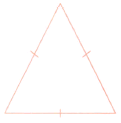
How many lines of symmetry does the figure have?
1
2
3
4
29.
Two lines are perpendicular, if they intersect each other at
acute angle
right angle
obtuse angle
None of these
30.
If each matchbox contains 50 matchsticks, the number of matchsticks required to fill n such boxes is
50+n
50n
50÷n
50-n
31.
The weight of 15 boxes is 60 kg. The weight of 12 boxes is ____________
32.
4.56 + 9.25 = _______________
1.
∵ 5-1=9-5=13-9
=17-13=21-17=4
∴ Next number in the sequence
= 21+4=25
2.
Three
3.
It can be written as (x-4).
4.
62 km 625 m per hour
5.
All prime numbers upto 100 are 2,3,5,7,11,13,17,19, 23,29,31,37,41,43,47,53,59,6.1,67,71,73,79,83, 89 and 97. Out of these prime numbers, pairs of prime numbers having same digits are
(i) 13,31 (ii) 17,71 (iii) 37,73 (iv) 79, 97
Hence, there are 4 pairs of such types.
6.
We have, 15 x 68 = 15 x (60 + 8) = 15 x 60 + 15 x 8 [by distributive property of multiplication over addition]
= 900 + 120 = 1020.
7.
(a) correct
(b)correct
(c)correct
(d)Incorrect; the correct is (- 6) + (- 2) = - 8
(e)correct
(f)correct
(g)ncorrect; the correct is (+ 7) + (- 10) = - 3
8.
Like fractions: Fractions having same denominators
9.
99360
10.
To draw a perpendicular to \(\bar{AB}\), we use the following steps:
Step I Firstly, draw a line segment \(\bar{AB}\) and take any point M on it.
.png)
Step II With Mas centre and a convenient radius, construct an arc intersecting the line \(\bar{AB}\) at two points X and Y.
.png)
Step III With X and Y as centres and a radius greater than \(\bar{XM}\) construct two arcs which cut each other at D.
.png)
Step IV Now, join MD. Then, \(\bar{MD}\) is perpendicular to \(\bar{AB}\) and we can write it as \(\bar{MD}\bot\bar{AB}\).
.png)
11.
Image of line segment AB is A'B' as shown below in figure.
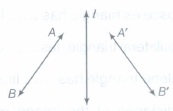
Now, it is clear that the length of line segment AB is equal to length of line segment A'B'.
12.
(a) Let the number be x.
Then, the required equation is x + 14 = 70
(b) Let the number be x.
Then, the required equation is x - 3 = 10
(c) Let the number be x.
Given, five times of x = 5x
∴ Required equation is 5x = 25
(d) Let the number be x.
One-third of x = \(\frac{x}{3}\)
Then, the equation is \(\frac{x}{3}\)=15
(e) Let the number be x.
Two times of this number = 2x
∴ The equation is 2x + 3 = 13
13.
Given, four broom sticks of length 8 cm, 8 cm, 5 cm and 5 cm.
(a) Three types of quadrilaterals can be formed.
(b) Name of the quadrilaterals are rectangle, parallelogram and kite.
(c) The value is scientific, temper and curiosity.
14.
Given, number of girls = 20 and number of boys = 15
\(\therefore\) Total number of students in the class = 20 +15 = 35
(a) Ratio of number of girls to the number of boys \(=\frac{Number\ of\ girls}{Number\ of\ boys}=\frac{20}{15}\)
\(=\frac{20\div5}{15\div5}=\frac{4}{3}=4:3\) [ \(\because\)HCFof 20 and 15=5]
(b) Ratio of number of girls to the total number of students in the class \(=\frac{Number\ of\ girls}{Total\ number\ of\ students}=\frac{20}{35}\)
\(=\frac{20\div5}{35\div5}=\frac{4}{7}\) [ \(\because\) HCF of 20 and 35 = 5]
15.
In the given pictograph, 1 picture = 4 girls, half picture = 2 girls
(a) Observing the pictograph, it is clear that the minimum number of girl students are in class VIII i.e. 4 + 2 = 6
(b) Observing the pictograph, it is clear that Number of girls in class VI = 4 x 4 = 16 and number of girls in class V = 2 x 4 + 1 x 2 = 8 + 2 = 10
\(\therefore\) 10 < 16
So, it is clear that number of girls in class VI is not Iess than the number of girls in class V.
(c) Observing the pictograph, number of girls in class VII = 3 x 4 = 12.
16.
32812 km
17.
Rs 1140
18.
Given, length of Ravi's pencil = 7 cm 5 mm
and length of Raju's pencil = 8 cm 3 mm
We know that, 10 mm = 1cm
\(\therefore\)1 mm = \(\frac { 1 }{ 10 } \) cm or one-tenth cm = 0.1 cm
Now, length of Ravi's pencil = 7 cm 5 mm
= 7 cm and 5 tenths cm
= 7cm + \(\frac { 5 }{ 10 } \) cm
= 7 crn+ 0.5 cm = 7.5 cm
and length of Raju's pencil = 8 cm 3 mm
= 8 cm and 3 tenths cm
=8 cm + \(\frac { 3 }{ 10 } \)cm=8 cm + 0.3 cm = 8.3 cm
19.
Construct a perpendicular to a line from a point on it.
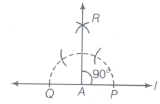
Here, \(\angle\)PAR = 90o.
20.
For rectangle A,
Length = 12 cm and breadth = 6 cm
Perimeter of rectangle A = 2 x (Length + Breadth)
=2(12+ 6)=36cm
For rectangle B, Length = 11 cm and breadth = 9 cm
Perimeter of rectangle B = 2 (11 + 9) = 40 cm
\(\therefore\) Required ratio \(=\frac{36}{40}=\frac{9}{10}=9:10\)
21.
HCF = 2 x 2 x 3 x 3 = 36
22.
The capital letters H, I, O and X have more than one line of symmetry.
23.
2n
24.
37\(\times\)108=37\(\times\)(100+8) =37\(\times\)100+37\(\times\)8
= 3700 + 296 = 3996
25.
We know that, predecessor is one less than the given whole number.
(a) Predecessor of 96 = 96 - 1 = 95
(b) Predecessor of 9998 = 9998 - 1 = 9997.
26.
(c)
16,81
27.
(a)
Friday
28.
(c)
3
29.
(b)
right angle
30.
(b)
50n
31.
()
48 Kg
32.
()
13.81

6th Standard CBSE Syllabus & Materials
6th Standard CBSE
CBSE 6th Social Science Locating Places on the Earth - New Sample Question Papers Study Material - QB365 Set A
NEW6th Standard CBSE
CBSE 6th Science A Journey Through States of Water - New Sample Question Papers Study Material - QB365 Set A
NEW6th Standard CBSE
CBSE 6th Science Temperature and its Measurement - New Sample Question Papers Study Material - QB365 Set A
NEW6th Standard CBSE
CBSE 6th Science Materials Around Us - New Sample Question Papers Study Material - QB365 Set A



CBSE 6th Standard CBSE Subjects
CBSE Standards




