
 100% FREE ACCESS
6th Standard CBSE Syllabus & Materials
6th Standard CBSE
CBSE 6th Social Science The Value of Work - New Sample Question Papers Study Material - QB365 Set A
NEW6th Standard CBSE
CBSE 6th Social Science Family and Community - New Sample Question Papers Study Material - QB365 Set A
NEW6th Standard CBSE
CBSE 6th Social Science India's Cultural Roots - New Sample Question Papers Study Material - QB365 Set A
NEW6th Standard CBSE
CBSE 6th Social Science India,That is Bharat - New Sample Question Papers Study Material - QB365 Set A
NEW6th Standard CBSE
CBSE 6th Social Science Timeline and sources of history - New Sample Question Papers Study Material - QB365 Set A
NEW6th Standard CBSE
CBSE 6th Social Science Oceans and Continents - New Sample Question Papers Study Material - QB365 Set A

Published on: 06/03/2020
6th Standard CBSE Mathematics Public Exam Important Question 2019-2020
Download CBSE Class 6th Standard CBSE Mathematics question papers, sample papers, important questions, and previous year solved papers in PDF format. Get free study materials, NCERT solutions, and exam preparation resources for Class 6th Standard CBSE Mathematics
Questions + Answers key
Take MCQ Mathematics Test
1.
Rahul's house is \(3\frac{4}{10}\)km away from his school. He walked some distance and then took a bus for \(1\frac{1}{7}\)km to reach the school. How far did he walk?
2.
Draw PO of length 7 cm and find its axis of symmetry.
3.
During three days of a week, a rickshaw puller earns Rs 40.20, rs 60.10 and Rs 55, respectively. What is his total earning during these days?
4.
There are two rectangles A and B. A has a length of 12 cm and breadth of 6 cm. B has a length of 11 cm and breadth of 9 cm. Find the ratio of their perimeter.
5.
Find the LCM of 112, 168, 266 by prime factorisation method.
6.
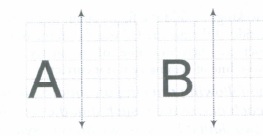
In each figure given below, a letter of the alphabet is shown along with a vertical line. Take the mirror image of the letter in the given line. Find which letters look the same after reflection (i.e. which letters look the same in the image) and which do not? Can you guess, why?
7.
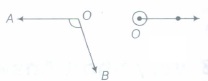
State the type of angle given below.
8.
This graph shows the number of boys, who have different types of hobbies.
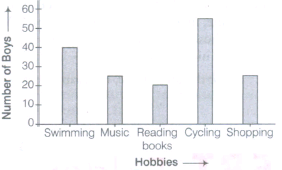
Use the graph to answer the following questions.
(a) Which is the most popular hobby among the boys?
(b) Which is the least popular hobby among the boys?
(c) What is the total number of boys, who participated in the survey?
(d) Which two hobbies ae equally popular among the boys?
9.
A rectangular piece of land measures 0.7 km by 0.5 km. Each side is to be fenced with 4 rows of wires. What is the length of the wire needed?
10.
Oranges are to be transferred from larger boxes into smaller boxes. When a large box is emptied,the oranges from it fill two smaller boxes and still 10 oranges remain outside. If the number of oranges in a small box are taken to be x, what is the number of oranges in the larger box?
11.
Write the integer which is its own additive inverse?
12.
Find the value of 968 x 73 + 968 x 27?
13.
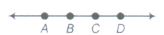
Name the line given in all possible (twelve) ways, choosing only two letters at a time from the four given letters.
14.
Find the greatest and the smallest numbers. 4536, 4892, 4370, 4452.
15.
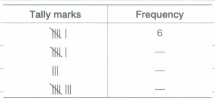
Complete the following table
16.
Given, two different lengths as 8.1 cm and 3.4 cm. Construct a length equal to the difference of these two lengths. Measure the new length.
17.
Write the following ratios in the simplest form.
600 g to 1 kg
18.
Find the area of a rectangle whose perimeter is 120 m and length is 40 m.
19.
Express as cm using decimals
60 mm
20.
Identify the shapes given below. Check whether, they are symmetric or not. Draw the line of symmetry as well.

21.
Identify the operations (addition, subtraction, division, multiplication) in forming the following expressions and tell how the expressions have been formed.
2y+17,2y-17
22.
Find the common factors of 35 and 50
23.
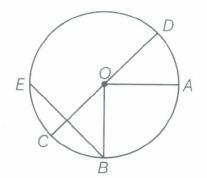
Give the name of all chords in the given figure.
24.
There are two set-squares in your box. What are the measures of the angles that are formed at their corners? Do they have any angle measure that is common?
25.
Draw a number line and answer the following:
Which number will we reach, if we move 5 numbers to the left of 1?
26.
Find the face value of 7 in 942756.
27.
Write the numerator of \(\frac { 7 }{ 10 } \)
28.
Find using the number line 3 x 3.
29.
Find 15 x 68, 17 x 23, 69 x 78 + 22 x 69 Using distributive property
30.
How will you construct a 150° angle?
31.
Complete the following table.
| Shape | Rough figure | Number of lines of symmetry | |
|---|---|---|---|
| (i) | Equilateral triangle | 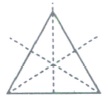 |
3 |
| (ii) | Square | ||
| (iii) | Rectangle | ||
| (iv) | Isosceles triangle | ||
| (v) | Rhombus | ||
| (vi) | Circle |
32.
Namita travels 20 km 50 m everyday. Out of this she travels 10 km 200 m by bus and the rest by auto. How much distance does she travel by auto?
33.
A room 9.68 m long and 6.2 m wide. Its floor is to be covered with glazed tiles of 22 cm by 10 cm each. If rate of tiles is Rs.25 per tile. Find the total cost of tiles.
34.
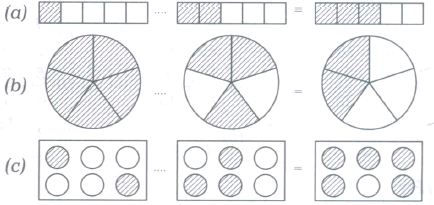
Write these fractions appropriately as additions or subtractions
35.
Determine, if the following ratios form a proportion.Also, write the middle term and extreme terms, where the ratios form a proportion.
(a) 25 cm : 1 m and Rs.40 : Rs.160
(b) 39 L : 65 L and 6 bottles: 10 bottles
(e) 2 kg: 80 kg and 25 g: 625 g
(d) 200mL : 2.5 L and Rs.4 : Rs.50
36.
Anil is x years old. Express the following in algebraic form.
(a) Anil's age after a period of 15 yr.
(b) 5 times Anil's age, 5 yr ago.
(c) What is his father's age, if he is 15 yr more than double of Anil's age?
(d) The present age of Anil's cousin, if his cousin is three years less than one-third Anil's age five years ago.
(e) Find the age of Anil's grandfather, if his age is double his son's age and the age of Anil's father is 20 yr more than Anil's age.
37.
The number of scouts in a school is depicted by the following pictograph.
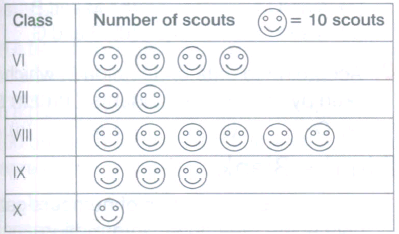
Observe the pictograph and answer the following questions.
(a) Which class has the minimum number of scouts?
(b) Which class has the maximum number of scouts?
(c) How many scouts are there in class VI?
(d) Which class has exactly four times the scouts as that of class X?
(e) What is the total number of scouts in the classes VI to X?
38.
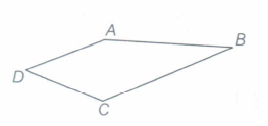
Draw a rough sketch of a quadrilateral ABCD Write
(i) two pairs of opposite sides.
(ii) two pairs of adjacent angles.
39.
Complete each of the following:
(a) 30 + (-50) + (-20)
(b) 40 + (-10) + (-15)
(c) 45 - (-5) + 10
(d) 60 - 10 + 5 = 5 - (-5)
(e)16 + (-13) + (-10)
(f) 0 + 5 - (-6) + (-7)
40.
Write a digit in the blank space of the following number, so that the number formed is divisible by 11. 8___9484
41.
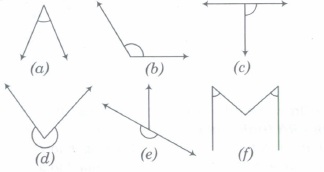
Classify each one of the following angles as right, straight, acute, obtuse or refles.
42.
| Raman's shop | The sales during the last year | |
| Things | Price | Apples 2457 kg |
| Apples | Rs.40 per kg | Oranges 3004 kg |
| Oranges | Rs.30 per kg | Combs 22760 |
| Combs | Rs.3 for one | Toothbrushes 25367 |
| Toothbrushes | Rs.10 for one | Pencils 38530 |
| Pencils | Rs.1 for one | Notebooks 40002 |
| Notebooks | Rs.6 for one | Soapcakes 20005 |
| Soapcakes | Rs.8 for one | |
(a) Can you find the total weight of apples and oranges Raman sold last year?
Weight of apples = ________kg
Weight of oranges = _______kg
Therefore, total weight = __ kg +__ kg = __ kg
(b) Can you find the total money Raman got by selling apples?
(c) Can you find the total money Raman got by selling apples and oranges together?
(d) Make a table showing how much money Raman received from selling each item? Arrange the entries of amount of money received in descending order. Find the item which brought him the highest amount. How much is this amount?
43.
The prime number which is even is
2
3
5
13
44.
\(\cfrac { 12 }{ 10 } =\)
0.12
1.2
1.02
1.002.
45.
Observe the following bar graph and answer the related questions:
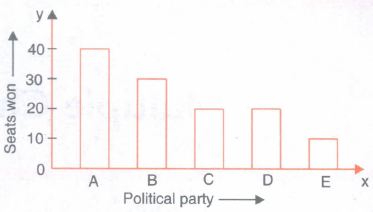
Which political party won the minimum number of seats?
A
B
D
E
46.
Which of the following letters has no line of symmetry?
O
X
I
Q
47.
The perimeter of an equilateral triangle is 9 m. Find the length of the side.
1 m
2 m
3 m
9 m
48.
\(\frac { 1 }{ 4 } +\frac { 1 }{ 4 } +\frac { 1 }{ 4 } +\frac { 1 }{ 4 } \)=
1
2
4
8
49.
Arrange the following numbers in ascending order: 132, 2000, 7500, 525.
7500, 2000, 525,132
132, 525, 2000, 7500
132, 525, 7500,2000
7500, 2000, 132, 525
50.
The shape
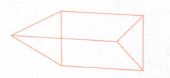
is of
triangular prism
pyramid
cuboid
cylinder.
51.
First triangular number is
3
6
10
15
52.
In a school library, the ratio of Mathematics books to Science books is same as the ratio of Science books to Hindi books. If there are 450 books of Science and 300 books of Hindi, then find the number of books in Mathematics
720
675
300
450
53.
The instrument to draw a circle is
ruler
protractor
divider
compasses
54.
Given, expression for P divided by 15 is
P-15
P+15
P÷15
\(p\times 15\)
55.
The successor of the predecessor of -20 is
-20
-10
-19
-21
56.
The number of circles that can be drawn with a given centre is
2
3
4
Infinite
1.
\(2\frac{9}{35}\)Km
2.
We know that, perpendicular bisector of a line segment is its axis of symmetry.
Step I Draw a line segment \(\bar{PQ}\) = 7 cm.
Step II With P and 0 as centres and radius more than half of \(\bar{PQ}\), draw two arcs which intersect each other at A and B.
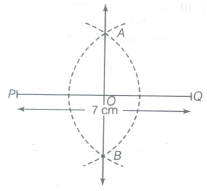
Step III Join A and B.
Thus, AB is the axis of symmetry of \(\bar{PQ}\).
3.
| Earning om 1st day | = | Rs 40.20 |
| Earning om 2 nd day | = | Rs 60.10 |
| Earning on 3rd day | = | +Rs 55.00 |
| \(\therefore\) Total earning | = | Rs 155.30 |
4.
For rectangle A,
Length = 12 cm and breadth = 6 cm
Perimeter of rectangle A = 2 x (Length + Breadth)
=2(12+ 6)=36cm
For rectangle B, Length = 11 cm and breadth = 9 cm
Perimeter of rectangle B = 2 (11 + 9) = 40 cm
\(\therefore\) Required ratio \(=\frac{36}{40}=\frac{9}{10}=9:10\)
5.
For the LCM of 112, 168 and 266
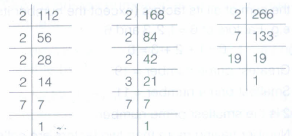
112 = 2 x 2 x 2 x 2 x 7 = 24 x 7
168 = 2 x 2 x 2 x 3 x 7 = 233 x 3 x 7
266 = 2 x 7 x19
\(\therefore\)LCM = 24 x 3 x 7 x 19 = 6384
6.
Taking the mirror image of the letters A and B from the given line. These will look as shown below:
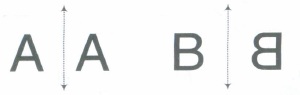
It is clear that, A look the same after reflection and B do not look the same because A has reflection symmetry but B does not have.
Now, the mirror image of other letters are shown below
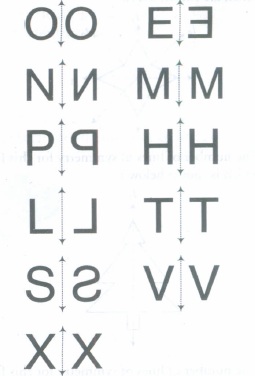
From the above, we can say that A, O, M, H, T, V and X look the same after reflection because these letters are
symmetrical.
Also, we see that B, E, N, P, L and S do not look the same after reflection because these letters are not symmetrical.
7.
In the given figures, we have,
\(\angle AOB\) is an obtuse angle.
8.
(a) Cycling
(b) Reading books
(c) 160
(d) Music and shopping.
9.
Given, length of piece ofland = 0.7 km
and breadth of piece of land = 0.5 km
∴ Perimeter of the rectangular piece of land
= 2 \(\times\) (Length + Breadth) = 2 \(\times\) (0.7 +05) km
= 2\(\times\)1.2 km = 2.4 km
Then, length of wire fencing for 1 row
= Perimeter of rectangular piece ofland = 2.4 km
∴ Length of wire fencing for 4 rows = 4 \(\times\) 2.4 km = 9.6 km
Hence, the wire of length 9.6 km is needed.
10.
Given, the number of oranges in a smaller box = x
Since, one larger box is emptied to fill two smaller boxes. So, the number of oranges in two smaller boxes = 2 \(\times\) Th( number of oranges in one box = 2 \(\times\) x = 2x
Also, 10 oranges remain outside, when large box isemptied to fill two smaller boxes. So, number of oranges in the larger box = Numberr oranges in two smaller boxes + Oranges left over = 2x +1 Hence, the number of oranges in the larger box is(2x + 10)
11.
Zero (0) is its own additive inverse.
12.
We have, 968 x 73 + 968 x 27
= 968 (73 + 27) [taking 968 as common term]
= 968 x 100 = 96800.
13.
We know that, a line is a line segment which can extend indefinitely in both directions. Name oflines in all possible ways are as follow:
(i) By taking A, all possible ways are \(\overleftrightarrow { AB } ,\overleftrightarrow { AC } and\overleftrightarrow { AD } \).
(ii) By taking B, all possible ways are \(\overleftrightarrow { BC } ,\overleftrightarrow { BD } and\overleftrightarrow {BA } \).
(iii) By taking C, all possible ways are \(\overleftrightarrow { CD } ,\overleftrightarrow { CA } and\overleftrightarrow {CB } \).
(iv) By taking D, all possible ways are \(\overleftrightarrow { DA } ,\overleftrightarrow { DB } and\overleftrightarrow {DC } \).
14.
We have, 4536, 4892, 4370, 4452
Here, each of the given numbers is containing 4-digits and their digits at thousand places are also same. So, we compare the hundreds place digit.
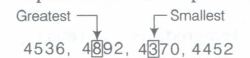
∵ 8>5>4>3
∴ The greatest number is 4892 and the smallest number is 4370.
15.

16.
4.7 cm.
17.
Ratio of 600 g to 1 kg \(=\frac{600}{1000}[\because\ 1\ kg=1000g]\)
\(=\frac{3}{5}=3:5\)
18.
800 m2
19.
We know that, 1 mm \(={1\over10}\) cm
\(\therefore\) 60 mm \(=60\times{1\over 10}\)cm = \({60\over10}\) cm = 6.0 cm
20.
The given. figure is symmetric and Its line of symmetry is shown alongside.

21.
(i) 2y+17, Here,' operation is multiplication and addition and to form an expression, firstly 2 is multiplied by y and then 17 is added to 2y.
(ii) 2y-17, Here, operation is multiplication and subtraction and to form an expression, firstly,y is
multiplied by 2 and then 17 is subtracted from 2y.
22.
Factors of 35 and 50 are as follows:
35 = 1 x 35 ; 35 = 5 x 7 and 50 = 1 x 50; 50 = 2 x 25 ; 50 = 5 x 10
Now, all factors of 35 =1, 5, 7, 35 and all factors of 50 = 1, 2, 5, 10, 25, 50
\(\therefore\) Common factors = 1, 5
Hence, common factors of 35 and 50 are 1 and 5.
23.
The chords of the above circle are BE and CD.
24.
We have, two set-squares in our box. In one of them, angles are of 30°, 60°, 90° and in the other, angles are of 45°, 45°, 90°.
(i)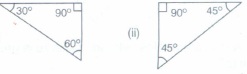
Clearly, they have one angle measure in common, which is 90°.
25.

On the number line, starting from 1 and moving 5 points towards left (each step being equal to 1 unit), we will reach at - 4.
26.
7
27.
7
28.
To find 3 x 3
We have to multiply 3 by 3 i.e. 3 units x 3 (or 3 units 3 times). Let us start from 0, move 3 units to the right of 0.
.png)
After making 3 such moves, we reach at 9.
\(\therefore\) 3 x 3 = 9.
29.
15 x 68 = 15 x (60 + 8)
= 15 x 60 + 15 x 8
(distributivity of multiplication over addition)
= 900 + 120 = 1020
17 x 23 = 17 x (20 + 3)
= 17 x 20 + 17 x 3
(distributivity of multiplication over addition)
=340+51=391
69 x 78 + 22 x 69
= 69 x 78 + 69 x 22
(commutativity of multiplication)
= 69 x (78 + 22)
(distributivity of multiplication over addition)
= 69 x 100 = 6900.
30.
To construct an angle of 150o, steps of construction are given below:
Step I Draw a line and mark point 0 and A on it such that A is in the right of O.
Step II With O as centre and with any convenient radius draw a semi-circle, cutting the line I at P and S.
Step III Now, take P as centre and radius same as in Step II, draw an arc which intersects the semi-circle at Q.
Step IV Now, take Qas centre and (same as step II) draw an arc which intersects the semi-circle at R.
Step V Now, bisect this angle. For this, take distance more than half of length RS as radius and with R and S as centre draw arcs such that both intersect each other at T.
Step VI Join OT and produce it up to point B.
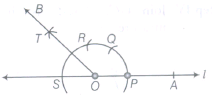
Thus, \(\angle\)AOB = 150o.
31.
First, we draw rough figure of each shape.
(ii) A rough figure of a square is given below:
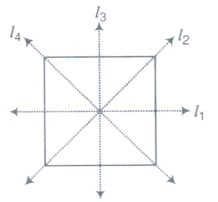
In square, l1,l2,l3 and l4 are four lines of symmetry.
(iii) A rough figure of a rectangle is given below:
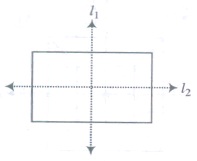
In rectangle,l1 and l2 are two lines of symmetry.
(iv)A rough figure of an isosceles triangle is given below:
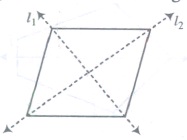
In rhombus, l1 and l2 are two lines of symmetry.
(vi) A rough figure of a circle is given below:
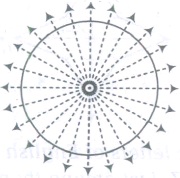
In circle, there are infinite lines of symmetry.
32.
\(\because\) Total distance travelled by Namita
= 20 km 50 m = 20 km + 50 m
\(=20\quad km+50\times \frac { 1 }{ 1000 } km\) \(\left[ \because 1\quad m=\frac { 1 }{ 1000 } km \right] \)
\(=20\quad km+\frac { 50 }{ 1000 } km\) = (20+0.050) km = 20.050 km
and distance travelled by Namita by bus
= 10 km 200 m = 10 km + 200 m
= 10 km + 200 \(\times \frac { 1 }{ 1000 } km\left[ \because \quad 1m=\frac { 1 }{ 1000 } km \right] \)
\(=10\quad km+\frac { 200 }{ 1000 } km=10\quad km+0.200\quad km\)
= ( 10 + 0.200) km = 10.200 km
\(\therefore\) Distance travelled by auto
= 20.050 km - 10.200 km
= (20.050 - 10.200) km = 9.850 km
Hence, she travels 9.850 km by auto.
33.
Given, length of floor of the room (l)= 9.68 m
and width of floor ofthe room (b)= 6.2 m
Area of the room = 9.68\(\times\) 6.2 sq m . ... (i)
Also, given that length of each tile = 22 cm
and width of each tile = 10 cm
Now, area of each tile = 22 \(\times\) 10 sq cm ... (ii)
Number of tiles required to cover the floor of the room
\(=\frac { 9.68\times 6.2\times 100\times 100 }{ 22\times 10 } \left[ \because 1m=100cm \right] \)
\(=\frac { 968\times 62\times 10 }{ 22\times 10 } =\frac { 968\times 62 }{ 22 } =2728\)
Total cost = Rs. 2728 \(\times\) 25 = Rs. 68200
34.
(a) In first figure, fraction for shaded portion = \(\frac { 1 }{ 5 } \)
In second figure, fraction for shaded portion = \(\frac { 2 }{ 5 } \)
and in third figure, fraction for shaded portion = \(\frac { 3 }{ 5 } \)
Here, third figure represents more shaded portion than first and second figures.
So, \(\frac { 1 }{ 5 } +\frac { 2 }{ 5 } =\frac { 1+2 }{ 5 } =\frac { 3 }{ 5 } \)
∴ The given figure will be as follows:

(b) In first figure, fraction for shaded portion = 1or \(\frac { 5 }{ 5 } \)
In second figure, fraction for shaded portion = \(\frac { 3 }{ 5 } \)
and in third figure, fraction for shaded portion =\(\frac { 2 }{ 5 } \)
Here, third figure represents less shaded portion than first and second figure
So, \(1-\frac { 3 }{ 5 } =\frac { 5-3 }{ 5 } =\frac { 2 }{ 5 } \)
∴ The given figure is represented as follows:
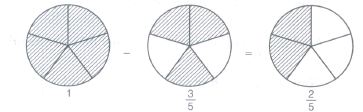
(c) ∴ The given figure is represented as:
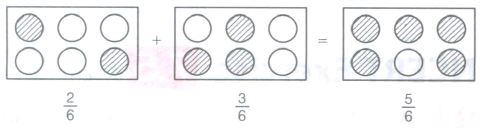
35.
(a) Here, 25 cm : 1 m = 25 cm : 1 x 100 cm [\(\because\)1 m=100em]
= 25 cm: 100 cm
\(=25:100=\frac{25}{100}=\frac{25\div25}{100\div25}=\frac{1}{4}=1:4\)
[dividing numerator and denominator both by 25]
and Rs.40:Rs.160=40:160=\(\frac{40}{160}=\frac{4}{16}=\frac{1}{4}=1:4\)
[dividing numerator and denominator both by 10]
Here, 1: 4 = 1: 4 i.e. 25 cm : 1 m = Rs.40 : Rs.160
So, the ratios of 25 cm : 1 m and Rs.40 : Rs.160 are in proportion.
i.e. 25 cm : 1 m: : Rs.40 : Rs.160
Now, middle terms are 1 m and Rs.40 and extreme terms are 25 cm and Rs.160.
(b) Here,39L:65L=39:65=\(\frac{39}{65}\)
\(=\frac{39\div13}{65\div13}\) [\(\because\) HCF of 39 and 65 = 13]
\(=\frac{3}{5}=3:5\)
and 6 bottles: 10 bottles = 6 :10 \(=\frac{6}{10}\)
\(=\frac{6\div2}{10\div2}=\frac{3}{5}=3:5\)
[dividing numerator and denominator both by 2]
Here, 3 : 5 = 3 :5 i.e. 39 L : 65 L = 6 bottles: 10 bottles.
So, the ratio of 39 L : 65 Land 6 bottles: 10 bottles are in proportion.
i.e. 39 L : 65 L : : 6 bottles: 10 bottles
Now, middle terms of ratios are 65 Land 6 bottles and extreme terms of ratios are 39 Land 10 bottles.
(c) Here, 2kg:80kg=2:80=\(=\frac{2}{80}=\frac{2\div2}{80\div2}=\frac{1}{40}=1:40\)
[dividing numerator and denominator both by 2]
and 25 g : 625 g = 25 :625 \(=\frac{25}{625}=\frac{25\div25}{625\div25}=\frac{1}{25}=1:25\)
[\(\because\)HCF of 25 and 625 = 5 X 5 = 25]
Since, both ratios are not equal.
\(\therefore\) 2 kg : 80 kg \(\ne\) 25 g : 625 g
Hence, the given ratios are not in proportion.
(d) Here, 200mL:2.5L=200 \(\times\frac{1}{1000}L:2.5\ L\)
\([\because\ 1\ mL=\frac{1}{1000}L]\)
\(=\frac{200}{1000}L:2.5L=0.200L:2.5L\)
\(=0.200:2.5=\frac{0.200}{2.5}=\frac{2}{25}=2:25\)
[multiplying numerator and denominator both by 10]
and Rs.4:Rs.50=4:50=\(\frac{4}{50}=\frac{4\div2}{50\div2}=\frac{2}{25}=2:25\)
[dividing numerator and denominator both by 2]
Here, 2 : 25 = 2 : 25 i.e. 200 mL : 2.5 L = Rs. 4 : Rs.50
So, the ratios of 200 mL : 2.5 L and Rs. 4 : Rs. 50 are in proportion.
i.e. 200 mL : 2.5 L: : Rs.4 : Rs. 50
Now, middle terms of ratios are 2.5 L and Rs.4 and extreme terms of ratios are 200 mL and Rs.50.
36.
(a) Given, Anil's present age = x yr
Anil's age after 15 yr = (x + 15) yr
(b) 5 yr ago Anil's age = (x - 5) yr
5 times Anil's age, 5 yr ago = 5(x - 5) yr
(c) Given, Anil's age = x yr
Father's age = (2x + 15) yr
(d) 5 yr ago Anil's age = (x - 5) yr
Now, cousin's age = \([\frac{1}{3}(x-5)-3]\)yr
(e) Given, Anil's age = x yr
Anil's father age = (x + 20) yr
Anil's grandfather age = 2(x + 20) yr
37.
(a) Class X has minimum number of scouts i.e. 10.
(b) Class VIII has maximum number of scouts i.e. 60.
(c) Number of scouts in class VI = 40
(d) Number of scouts in class X =10
Hence. class VI has exactly four times the scouts as that of class X.
(e) Total number of scouts in classes VI to X
= 40 + 20 + 60 + 30 + 10 = 160.
38.
(i) AB and CD, BC and AD,
(ii) \(\angle A\ and\ \angle B,\angle B\ and\ \angle C,\angle C\ and\ \angle D,\angle D\ and\ \angle A\)
39.
According to the rules of addition and subtraction of integers,
(a) 30 + (-50) + (-20) = 30 -(50 + 20) = 30 -70 = -40
(b) 40 + (-10) + (-15) = 40 -(10 + 15) = 40 - 25 = 15
(c) 45 - (-5) + 10 = 45 + 5 + 10 = 60
(d) 60 - 10 + 5 - (-5 ) = 60 + 5 + 5 - 10 = 70 -10 = 60
(e) 16 + (-13) + (-10) =16 -(13 + 10) =16 - 23 = -7
(f) 0 + 5 - (-6) + (-7) = 0 + 5 + 6 - 7 ⇒ 11 - 7 = 4
40.
Let the required unknown digit be x.
Then, the number becomes
\(\begin{matrix} 8 \\ \downarrow \\ E \end{matrix}\begin{matrix} x \\ \downarrow \\ O \end{matrix}\begin{matrix} 9 \\ \downarrow \\ E \end{matrix}\begin{matrix} 4 \\ \downarrow \\ O \end{matrix}\begin{matrix} 8 \\ \downarrow \\ E \end{matrix}\begin{matrix} 4 \\ \downarrow \\ O \end{matrix}\)
Sum of digits at odd places from right = 4 + 4 + x = 8+x
Sum of digits at even places from right = 8 + 9 + 8= 25
\(\because\) Number is divisible by 11.
\(\therefore\) Difference of digits will be 0 or 11.
\(\Rightarrow\)25 - (8 + x) = 0 or 11
\(\Rightarrow\)25 - 8 - x = 0 or 11 \(\Rightarrow\) 17 - x = 0 or 11
Taking difference 0, 17-x=0 \(\Rightarrow\) x=17+0 \(\Rightarrow\) x=17 [but 17 is not a single digit number, so it is not possible]
Taking difference 11, 17 - x = 11 \(\Rightarrow\) x = 17 - 11= 6
So, required digit to write in the blank space is 6.
41.
We know that,
An angle which is smaller than a right angle is called an acute angle.
An angle with measure 90° is called a right angle.
An angle which is greater than a right angle but smaller than a straight angle is called an obtuse angle.
An angle with measure 180° is called a straight angle.
An angle which is greater than a straight angle but smaller than a complete angle is called a reflex angle.
Now, from these results
(a) Given angle is smaller than a right angle, so it is an acute angle.
(b) Given angle is more than a right angle, so it is an obtuse angle.
(c) Given angle is a right angle.
(d) Given angle is more than a straight angle, so it is a reflex angle.
(e) Given angle is a straight angle.
(f) Both angles are smaller than a right angle, so both these are acute angles.
42.
(a) Weight of apples sold during the last year = 2457 kg
Weight of oranges sold during the last year = 3004 kg
∴ Total weight of apples and oranges Raman sold, during the last year = 2457 + 3004= 5461 kg
(b) Total money Raman got by selling apples
=Total number of apples \(\times\) Cost per kg
= 2457 \(\times\) 40 = Rs. 98280
(c) Total money Raman got by selling oranges
=Total number of oranges \(\times\) Cost per kg
=3004 \(\times\) 30 = Rs. 90120
∴ Total money Raman got by selling apples and oranges together =98280 + 90120 = Rs. 188400
(d) Following table shows the money received from selling items:
| Items | Sales | Rate | Money received |
| Apples | 2457 | Rs.40 per kg | 2457 \(\times\) 40 =Rs. 98280 |
| Oranges | 3004 | Rs.30 per kg | 3004 \(\times\) 30 = Rs. 90120 |
| Combs | 22760 | Rs.3 for one | 22760 \(\times\) 3 = Rs. 68280 |
| Toothbrushes | 25367 | Rs.10 for one | 25367\(\times\) 10 =Rs. 253670 |
| Pencils | 38350 | Rs.1 for one | 38350 \(\times\) 1= Rs. 38350 |
| Notebooks | 40002 | Rs.6 for one | 40002 \(\times\) 6 = Rs. 240012 |
| Soapcakes | 20005 | Rs.8 for one | 20005 \(\times\) 8 = Rs. 160040 |
The entries of amount of money received in descending order are as follows:
Rs. 253670 >Rs. 240012 >Rs. 160040 > Rs. 98280 > Rs. 90120 >Rs. 68280 > Rs. 38350
The item, which brought him the highest amount is tooth brushes. This amount is Rs. 253670.
43.
(a)
2
44.
(b)
1.2
45.
(d)
E
46.
(d)
Q
47.
Length of side = \(\frac{9}{3}\)=3 m
48.
(a)
1
49.
(b)
132, 525, 2000, 7500
50.
(a)
triangular prism
51.
(a)
3
52.
(b)
675
53.
(d)
compasses
54.
(c)
P÷15
55.
Given, integer is -20
Precedessor of -20 = -20 - 1 = -21
Successor of -21 = -21 + 1 = -20
56.
(d)
Infinite

6th Standard CBSE Syllabus & Materials
6th Standard CBSE
CBSE 6th Social Science Locating Places on the Earth - New Sample Question Papers Study Material - QB365 Set A
NEW6th Standard CBSE
CBSE 6th Science A Journey Through States of Water - New Sample Question Papers Study Material - QB365 Set A
NEW6th Standard CBSE
CBSE 6th Science Temperature and its Measurement - New Sample Question Papers Study Material - QB365 Set A
NEW6th Standard CBSE
CBSE 6th Science Materials Around Us - New Sample Question Papers Study Material - QB365 Set A



CBSE 6th Standard CBSE Subjects
CBSE Standards




