
 100% FREE ACCESS
6th Standard CBSE Syllabus & Materials
6th Standard CBSE
CBSE 6th Social Science The Value of Work - New Sample Question Papers Study Material - QB365 Set A
NEW6th Standard CBSE
CBSE 6th Social Science Family and Community - New Sample Question Papers Study Material - QB365 Set A
NEW6th Standard CBSE
CBSE 6th Social Science India's Cultural Roots - New Sample Question Papers Study Material - QB365 Set A
NEW6th Standard CBSE
CBSE 6th Social Science India,That is Bharat - New Sample Question Papers Study Material - QB365 Set A
NEW6th Standard CBSE
CBSE 6th Social Science Timeline and sources of history - New Sample Question Papers Study Material - QB365 Set A
NEW6th Standard CBSE
CBSE 6th Social Science Oceans and Continents - New Sample Question Papers Study Material - QB365 Set A

Published on: 06/03/2020
6th Standard CBSE Mathematics Public Exam Sample Question 2020
Download CBSE Class 6th Standard CBSE Mathematics question papers, sample papers, important questions, and previous year solved papers in PDF format. Get free study materials, NCERT solutions, and exam preparation resources for Class 6th Standard CBSE Mathematics
Questions + Answers key
Take MCQ Mathematics Test
1.
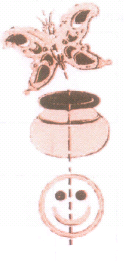
How do you name the dotted line in the figure?
2.
A triangular prism looks like the shape of a Kaleidoscope. It has triangles as its bases.
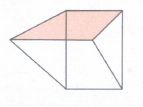
Faces:____________.
Edges: ___________.
Corners:___________.
3.
In any quadrilateral ABCD, \(\bar {AB}\ and\ \bar {BC}\) are adjacent sides. Can you write other pairs of adjacent sides?
4.
Write the first two common multiples of 5 and 15.
5.
Are the ratio 10 g : 40 g and 25 kg : 100 kg in proportion?
6.
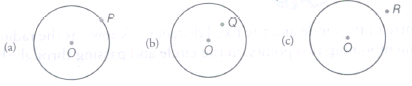
Draw a circle of radius 5.2 cm and mark point P, Q and R such that
(a) P is on the circle
(b) Q is in the interior of the circle
(c) R is in the exterior of the circle.
7.
What are pictographs?
8.
Saumya is at the step x. Shruti is 5 steps behind saumya . Where is Shruti?
9.
A piece of wire is 12 cm long. What will be the length of each side, if the wire is used to form a regular hexagon?
10.
In each of the following pairs, which number is to the right of the other on the number line?
2, 9
11.
How many milligrams make one kilogram?
12.
Write each of the following as decimals. \(\frac { 2 }{ 5 } \)
13.
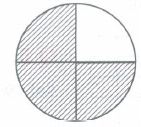
Write the fraction representing the shaded portion
14.
Find the sum, using the number line 2 + 6.
15.
A boy was asked to find the LCM of 3, 5, 12 and another number. But while calculating he wrote 21 instead of 12 and yet came with the correct answer. What could be the fourth number?
16.
Add the following 270.24 + 12.52 + 1.5
17.
Compare \(4\frac{2}{3} and 5\frac{3}{7}\)
18.
In the word 'PICTURE', mention the letter with no line of symmetry.
19.
If 14: x:: 7 : 25, then find the value of x.
20.
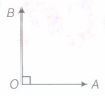
State the type of angle given below.
21.
Find the rule, which gives the number of matchsticks required to make the following matchstick patterns.
A pattern of letter U
22.
Find the perimeter of the following figures.
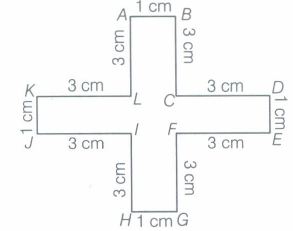
Perimeter = AB+ BC +CD + DE + EF + FG +GH +HI + IJ + JK + KL + LA
=__+__+__+__+__+__+__+__+__+__+__+__=__
23.
Following is the choice of sports for 20 students of class VI. Cricket, Football, Cricket, Tennis, Cricket, Badminton, Football, Cricket, Football, Tennis, Cricket, Badminton, Basketball, Football, Golf, Football, Hockey, Football Hockey, Cricket
Arrange the names of sports in a table using tally marks.
24.
Represent the following using integers with proper sign:
35 km above sea level
25.
Draw a rough sketch of a quadrilateral PQRS. Draw its diagonals, name them. Is the meeting point of the diagonals in the interior or exterior of the quadrilateral?
26.
Using divisibility tests, determine the following number is divisible by 6? 297144
27.
Some numbers can be shown by two rectangles.
e.g. .png)
Give at least five other such examples.
28.
Make the greatest and the smallest 4-digit numbers using any four different digits with conditions given below:
Digit 4 is always at tens place
29.
The number of cars sold over a period of six months is represented in a pictograph given below
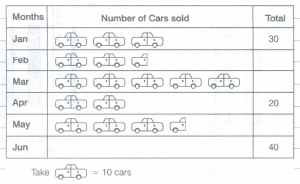
(b) Which month has the highest number of cars being sold?
(c) Find the ratio of the number of cars sold in April to the number of cars being sold in June.
30.
On an average,\(\frac{1}{10}\)of the food eaten is turned into organism's own body and is available for the next level of consumer in a food chain. What fraction of the food eaten is not available for the next level?
31.
The cost of 21 chairs is Rs 42000.
(a) Find the number of chairs that can be purchased for Rs 36000.
(b) Find the cost of 15 such chairs.
32.
Draw any angle with vertex O. Take a point A on one of its arms and B on another such that OA = OB. Draw the perpendicular bisectors of \(\bar{OA}\) and \(\bar{OB}\). Let them meet at P. Is PA = PB?
33.
Reshma went to the market with Rs 5000 cash. Out of this money she purchased one frock, one toy and one bag costing Rs 1150.48, Rs 540.52 and Rs 2160.70, respectively. How much money is left with her?
34.
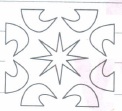
How many lines of symmetry does the given figure have?
35.
Fatima wants to mail three parcels to three village schools. She finds that the postal charges are Rs 20, Rs 28 and Rs 36, respectively. If she wants to buy stamps only of one denomination, what is the greatest denomination of stamps she must buy to mail the three parcels?
36.
Sunita is half the age of her mother Geeta. Find their ages
(i) after 4 yr?
(ii) before 3 yr?
37.
Avneet buys 9 square paving slabs, each with a side of \(\frac{1}{2}\) m. He lays them in the form of a square.
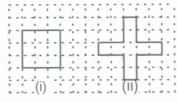
(a) What is the perimeter of his arrangement in the figure(i)?
(b) Shari does not like his arrangement. She gets him to lay them out like a cross. What is the perimeter of her arrangement in the figure (ii)?
(c) Which has greater perimeter?
(d) Avneet wonders, if there is a way of getting an even greater perimeter. Can you find a way of doing this? (The paving slabs must meet along complete edges i.e. they cannot be broken.)
38.
In a five-digit number, digit at ten's place is 4, digit at unit's place is one fourth of ten's place digit, digit at hundred's place is 0, digit at thousand's place is 5 times of the digit at unit's place and ten thousand's place digit is double the digit at ten's place. Find the number
39.
In a city, polio drops were given to 212583 children on Sunday in March 2013 and to 216813 children in next month.
(a) Find the difference of the number of children getting polio drops in the two months.
(b) What is the value of vaccinating children for polio in India?
40.
One of the equal angles of an isosceles triangle is 40°. Find its other angle.
41.
Mark -3, 7, -4, -8, -1 and 3 on the number line.
42.
Illustrate, if possible, each one of the following with a rough diagram:
(a) A closed curve that is not a polygon.
(b) An open curve made up entirely of line segments.
(c) A polygon with two sides.
43.
The speed of Shubham is 6 km per hour. The speed of Yash is 2 km per hour. The ratio of the speed of Shubham to the speed ofYash is
2:3
3:1
1:3
3:2
44.
Which of the following number is not a multiple of 9?
18
36
81
75
45.
\(\cfrac { 12 }{ 10 } =\)
0.12
1.2
1.02
1.002.
46.
The expression for 'p divided by 2' is
\(\frac { p }{ 2 } \)
2p
p+2
p-2
47.
Observe the following table and answer the related questions:
| Blood groups | Number of students |
|---|---|
| A | 9 |
| B | 6 |
| O | 12 |
| AB | 3 |
| Total | 30 |
The ratio of the frequencies of blood groups B and O is
1 : 3
2 : 3
3 : 4
1 : 2
48.
How many lines of symmetry does the figure have?
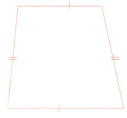
1
2
3
no line of symmetry
49.
The perimeter of the figure
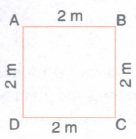 is
is
8 m
16 m
4 m
none of these.
50.
Which of the following pairs of fractions are like fractions?
\(\frac { 1 }{ 5 } ,\frac { 4 }{ 5 } \)
\(\frac { 2 }{ 3 } ,\frac { 3 }{ 4 } \)
\(\frac { 4 }{ 5 } ,\frac { 5 }{ 6 } \)
\(\frac { 5 }{ 6 } ,\frac { 6 }{ 7 } \)
51.
Which of the following statements is true?
Every positive integer is larger than every negative integer.
Zero is greater than every positive integer.
Zero is smaller than every negative integer.
Farther a number from zero to the right, smaller is its value.
52.
Take two digits, 0 and 1. Make the smallest 4-digit number using both the digits equal number of times
1001
1010
1100
None of these
53.
What part of a revolution have you turned through if you stand facing east and turn clockwise to face west?
\(\frac{1}{4}\)
\(\frac{1}{2}\)
\(\frac{3}{4}\)
none of these
54.
Find 27 \(\div\) (9 \(\div\) 3 ).
3
6
9
27.
55.
In the given figure, point B lies
.png)
interior
exterior
both (a) and (b)
None of these
56.
The least number of line segment required to make a polygon is
1
2
3
5
1.
We name the dotted line in the figure as the line of symmetry.
2.
A triangular prism looks like the shape of a Kaleidoscope. It has triangles as its bases.
Faces: 5.
Edges: 9.
Corners: 6.
3.
Yes! Other pairs of adjacent sides are:
\(\bar {BC},\bar{CD};\bar{CD},\bar{DA};\bar{DA},\bar{AB}\)
4.
Multiples of 5 = 5, 10, 15, 20, 25, 30, ...
Multiples of 15 = 15, 30, ...
First two common multiples = 15, 30
5.
We have,10 g:40 g \(=\frac{10}{40}=1:4\)
and 25 kg: 100 kg \(=\frac{25}{100}=1:4\)
So, they are in proportion.
6.
Now, mark the points P, Q and R on it according to question.
7.
The pictorial representation of the numerical data using pictures or symbols is called the pictograph of the data.
8.
Shurti is at the step x - 5.
9.
2 cm
10.

Here, 2 and 9 both are on the right of zero, bur 9 is farther from zero in comparison of 2. So, number 9 is right of number 2.
11.
We know that, 1 kg = 1000 g = (1000 X 1000) mg [∵ 1 g = 1000 mg]
= 1000000 mg
∴ 1000000 milligrams make one kilogram
12.
We have, \(\frac { 2 }{ 5 } \)
To make this fraction in tenths, we have to multiply by 2 in its numerator and denominator both.
\(\therefore \quad \frac { 2 }{ 5 } =\frac { 2\times 2 }{ 5\times 2 } =\frac { 4 }{ 10 } \)
Here, it has 4 tenths.
i.e. \(\frac { 4 }{ 10 } =0.4\)
13.
Here, the given figure is divided into 4 equal parts and 3 parts out of 4 parts are shaded.
∴ The required fraction = \(\frac { 3 }{ 4 } \)
14.
To find 2 + 6
Let us start from 2. Since, we have to add 6 to this number, we make 6 jumps to the right of 2. Each jump being equal to 1 unit. After six jumps, we reach at 8.
.png)
\(\therefore\) 2 + 6 = 8.
15.
Let the fourth number be x.
Case I. Taking the correct number 12
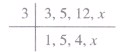
∴ LCM=3 \(\times\) 5 \(\times\) 7 \(\times\) x
Case II. Taking 21 instead of 12
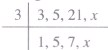
∴ LCM = 3 \(\times\) 5 \(\times\) 7 \(\times\) x
According to the question,
LCM is the same in both the cases.
∴ Fourth number = 4 x 7 = 28.
16.
Here, 270.24 + 12.52+ 1.5 can be written as
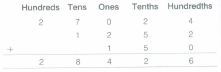
270.24 + 12.52 + 1.50 = 284.26
17.
We have, \(4\frac{2}{3} \) and \(5\frac{3}{7}\)
Now, \(4\frac{2}{3}=\frac{4\times3+2}{3}=\frac{14}{3}\)
and \(5\frac{3}{7}=\frac{5\times7+3}{3}=\frac{38}{7}\)
Now, let us compare \(\frac{14}{3} and \frac{38}{7}\) by
cross - multiplication.
we have,

14 x 7 = 98 and 38 x 3 = 114
∵ 114>98
∴ \(\frac{38}{7}>\frac{14}{3}\)
So, \(5\frac{3}{7}>4\frac{2}{3}\)
18.
P and R
19.
50
20.
In the given figures, we have,
\(\angle AOB\) is a right angle.
21.
3n
22.
The perimeter of the given figure is 28 cm
23.
| Sports | Tally marks | Number of students |
| Cricket | I I I I I | 6 |
| Football | I I I I I | 6 |
| Tennis | I I | 2 |
| Badminton | I I | 2 |
| Basketball | I | 1 |
| Golf | I | 1 |
| Hockey | I I | 2 |
| Total | 20 |
24.
Given, statements can be represented using integer +35
25.
The joins of the vertices, which are not adjacent i.e. opposite to each other, are called diagonals of quadrilateral. A rough sketch of a quadrilateral PQRS with its diagonals and their names are given below:
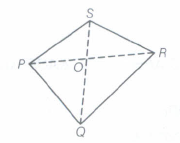
Here, PR and QS are its diagonals. They intersect each other at point O. So, point O is in the interior of the quadrilateral PQRS.
26.
We have, 297144
(i) Divisibility by 2
\(\because\)Unit digit of number = 4, so 297144 is divisible by2.
(ii) Divisibility by 3
Sum of digits of given number = 2 + 9 + 7 + 1+ 4 + 4 = 27
\(\because\) 27 is divisible by 3, so 297144 is also divisible by 3.
Now, we see that 297144 is divisible by 2 and 3 both.
Hence, it is divisible by 6.
27.
There are many examples of such type. Five of them are as follows:
(i).png)
(ii).png)
28.
Digits in ascending order are 0,1,2,3,4,5,6,7,8,9 and digits in descending order are 9,8,7,6,5,4,3,2,1, 0. Also, we know that 0 can never be taken at the leftmost place.
Keeping the digit 4 at tens place, we can fill other places thousands, hundreds and ones place by remaining number.
Greatest number
| 9 | 8 | 4 | 7 |
[Keeping the greatest digits i.e. 9, 8 and 7 at thousands, hundreds and tens place]
Smallest number
| 1 | 0 | 4 | 2 |
[Keeping the smallest digits i.e. 9, 8 and 7 at thousands, hundreds and tens place].
29.
(b) March (c) 1:2
30.
Quantity of food eaten which turned into organism's own body = \(\frac{1}{10}\)of the total food Now, the quantity of food eaten which is not available for the next level =1-\(\frac{1}{10}\)
\(=\frac { 10-1 }{ 10 } =\frac { 9 }{ 10 } \)
Hence, the required fraction =\(\frac { 9 }{ 10 } \)
31.
(a) 18
(b) Rs 30000
32.
Here, we will use the following steps of construction:
Step I Draw any angle XOY with vertex O.
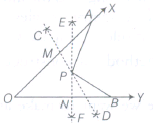
Step II Take a point A on OX and a point B on OY, such that OA = OB.
Step III Now, with O as centre, using compasses, draw an arc radius more than half of the length of \(\bar{OA}\).
Step IV With the same radius and with A as centre, draw another arcs using compasses, which cut the previous arc at C and D respectively.
Step V join \(\bar{CD}\) . It curs \(\bar{OA}\) at M therefore, CD is the perpendicular bisector of OA.
Step VI Now, with 0 as centre and radius equal to more than half of the length of OB, draw arcs.
Step VII With same radius and with B as centre, draw another arcswhich cut the previousarcsat E and F.
Step VIII join \(\bar{EF}\). It curs \(\bar{OB}\) at N. Therefore, EF is the perpendicular of \(\bar{OA}\).
Also, both perpendicular bisectors meet at A.
On measuring, we get PA = PB.
33.
Reshma has cash in hand = Rs 5000
Cost of one frock = Rs 1150.48
Cost of one toy = Rs 540.52
Cost of one bag = Rs 2160.70
_____________
\(\therefore\) Total cost = Rs 3851.70
_____________
Total cash in hand = Rs 5000.00
Total money spent = -Rs 3851.70
____________
\(\therefore\) Balance = 1148.30
____________
Hence, the money left with Reshma is Rs 1148.30.
34.
4
35.
The given postal charges for three parcels are Rs20, Rs28, Rs 36.
The greatest denomination of stamps is the HCF of 20, 28 and 36.
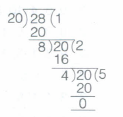

HCF of 20 and 28 is 4.
Now, we.find the HCF of 4 and 36.
HCF of 4 and 36 is 4.
Hence, HCF of 20, 28 and 36 is 4.
\(\therefore\) Fatima would by stamp of denomination of Rs4.
36.
Let the age of Sunita's mother = 2x yr
Then, according to the question,
Sunita's age = \(\frac{2x}{2}\) = x [half of her mother's age
(i) After 4 yr, present age is added in given years.
Sunita's age = (x + 4) yr
∴ Her mother's age = (2x + 4) yr
(ii) Before 3 yr, given year is subtracted from present age.
∴ Sun ita's age = (x - 3) yr
and her mother's age = (2x - 3) yr
37.
(a) Avneet lays 9 squares in the form of a square as shown in the figure, then side of the square
\(=\left( \frac { 1 }{ 2 } +\frac { 1 }{ 2 } +\frac { 1 }{ 2 } \right) m=\frac { 1+1+1 }{ 2 } =\frac { 3 }{ 2 } m\)
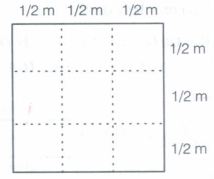 \(=\left( \frac { 1 }{ 2 } +1+1+\frac { 1 }{ 2 } +1+1+\frac { 1 }{ 2 } +1+1+\frac { 1 }{ 2 } +1+1 \right) m\)
∴ Perimeter of Avneet's arrangement
= 4 \(\times\) Length of a side = 4 \(\times\) \(\frac{3}{2}\) = 6 m
Hence, the perimeter of Avneet's arrangement is 6 m.
(b) Shari lays 9 squares in the form of a cross as shown in figure, then
Perimeter of Shari's arrangement = Sum of all sides
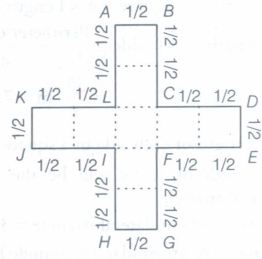
= AB + BC + CD + DE + EF + FG + GH + HI + IJ + JK + KL+ LA
\(=\frac { 1 }{ 2 } +\left( \frac { 1 }{ 2 } +\frac { 1 }{ 2 } \right) +\left( \frac { 1 }{ 2 } +\frac { 1 }{ 2 } \right) +\frac { 1 }{ 2 } +\left( \frac { 1 }{ 2 } +\frac { 1 }{ 2 } \right) +\left( \frac { 1 }{ 2 } +\frac { 1 }{ 2 } \right) +\frac { 1 }{ 2 } +\left( \frac { 1 }{ 2 } +\frac { 1 }{ 2 } \right) +\left( \frac { 1 }{ 2 } +\frac { 1 }{ 2 } \right) +\frac { 1 }{ 2 } +\left( \frac { 1 }{ 2 } +\frac { 1 }{ 2 } \right) +\left( \frac { 1 }{ 2 } +\frac { 1 }{ 2 } \right) \)
\(=\left( \frac { 1 }{ 2 } +1+1+\frac { 1 }{ 2 } +1+1+\frac { 1 }{ 2 } +1+1+\frac { 1 }{ 2 } +1+1 \right) m\)
\(=\left( \frac { 1 }{ 2 } +\frac { 1 }{ 2 } +\frac { 1 }{ 2 } +\frac { 1 }{ 2 } +8 \right) m=(1+1+8)m=10m\)
Hence, the perimeter of Shari's arrangement is 10m
(c) From above, it is clear that Shari's arrangement i.e, a cross has greater perimeter.
(d) Yes, there is a way shown alongside in which we get a greater perimeter.
Here, we have arrange the 9 squares in the form of a rectangle
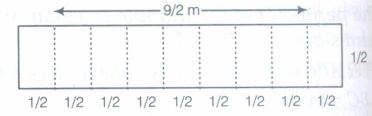
Now, length of rectangle
\(=\left( \frac { 1 }{ 2 } +\frac { 1 }{ 2 } +\frac { 1 }{ 2 } +\frac { 1 }{ 2 } +\frac { 1 }{ 2 } +\frac { 1 }{ 2 } +\frac { 1 }{ 2 } +\frac { 1 }{ 2 } +\frac { 1 }{ 2 } \right) m=\frac { 9 }{ 2 } m\)
and breadth of rectangle = 1/ 2 m
∴ Perimeter of this rectangle = 2 \(\times\)(Length + Breadth
\(=2\times \left( \frac { 9 }{ 2 } +\frac { 1 }{ 2 } \right) =2\times \left( \frac { 9+1 }{ 2 } \right) \)
\(=2\times \frac { 10 }{ 2 } =10m\)
It is clear that, it has the perimeter equal to cross. So, we can say that cross has greater perimeter comparison to square.
38.
According to the question,
Digit at ten's place = 4
Digit at unit's place = \(\frac{1}{4}\) of ten's place digit =\(\frac{1}{4}\times4=1\)
Digit at hundred's place = 0
Digit at thousand's place = 5 x Digit of unit's place
=5\(\times\)1=5
Digit at ten thousand's place = 2 x Digit of ten's place
=2\(\times\)4=8
∴ Required number = 85041
39.
(a) Given, number of children, who got polio drops in March 2013 = 212583
Number of children, who got polio drops in next month = 216813
\(\therefore\) Difference of the number of children getting polio drops in two months
= 216813 - 212583 = 4230 children.
(b) Importance of pulse polio drops
The children are vaccinated for their protectior against deadly polio virus. All the babies below 5 yrs of age are given oral polio vaccine simultaneously, it helps to eradicate the virus.
40.
100°
41.
Draw a line and mark some points at equal distance on it as shown in the figure given below. Mark a point on it as zero. Points to the right of zero are positive integers and marked by +1, + 2, +3 erc., or simply 1, 2, 3 etc and points to the left of zero are negative integers and marked by -1, - 2, - 3 etc. Now, - 3 is a negative integer (since, - 3 has negative sign). So, move 3 points to the left of zero and represent it by point C. 7 is a positive integer (since + 7 has positive sign). So, move 7 points to the right of zero and represent it by point F. To mark - 4 on this line, move 4 points to the left of zero and represent it by point B. To mark - 8, on this line, move 8 points to the left of zero and represent it by point A. To mark - 1 on this line, move 1 point to the left of zero and represent it by point D. To mark 3 on this line, move 3 points to the right of zero and represent it by point E. Thus, we get the following representation of these integers on the number line:

42.
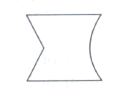
(a) The following figure shows a closed curve, but not a polygon, because a polygon is made by line segments only.
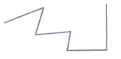
(b) The following figure shows an open curve made up entirely of line segments.
(c) It is not possible, because a polygon of two sides cannot be drawn.
43.
\(\frac { 6 }{ 2 } =\frac { 3 }{ 1 } \)=3:1
44.
(d)
75
45.
(b)
1.2
46.
(a)
\(\frac { p }{ 2 } \)
47.
(d)
1 : 2
48.
(d)
no line of symmetry
49.
Perimeter = 4 x 2 = 8 m
50.
(a)
\(\frac { 1 }{ 5 } ,\frac { 4 }{ 5 } \)
51.
(a)
Every positive integer is larger than every negative integer.
52.
(a)
1001
53.
(b)
\(\frac{1}{2}\)
54.
(c)
9
55.
(a)
interior
56.
(c)
3

6th Standard CBSE Syllabus & Materials
6th Standard CBSE
CBSE 6th Social Science Locating Places on the Earth - New Sample Question Papers Study Material - QB365 Set A
NEW6th Standard CBSE
CBSE 6th Science A Journey Through States of Water - New Sample Question Papers Study Material - QB365 Set A
NEW6th Standard CBSE
CBSE 6th Science Temperature and its Measurement - New Sample Question Papers Study Material - QB365 Set A
NEW6th Standard CBSE
CBSE 6th Science Materials Around Us - New Sample Question Papers Study Material - QB365 Set A



CBSE 6th Standard CBSE Subjects
CBSE Standards




