
 100% FREE ACCESS
6th Standard CBSE Syllabus & Materials
6th Standard CBSE
CBSE 6th Social Science The Value of Work - New Sample Question Papers Study Material - QB365 Set A
NEW6th Standard CBSE
CBSE 6th Social Science Family and Community - New Sample Question Papers Study Material - QB365 Set A
NEW6th Standard CBSE
CBSE 6th Social Science India's Cultural Roots - New Sample Question Papers Study Material - QB365 Set A
NEW6th Standard CBSE
CBSE 6th Social Science India,That is Bharat - New Sample Question Papers Study Material - QB365 Set A
NEW6th Standard CBSE
CBSE 6th Social Science Timeline and sources of history - New Sample Question Papers Study Material - QB365 Set A
NEW6th Standard CBSE
CBSE 6th Social Science Oceans and Continents - New Sample Question Papers Study Material - QB365 Set A

Published on: 26/09/2019
Symmetry
Download CBSE Class 6th Standard CBSE Mathematics question papers, sample papers, important questions, and previous year solved papers in PDF format. Get free study materials, NCERT solutions, and exam preparation resources for Class 6th Standard CBSE Mathematics
Questions + Answers key
Take MCQ Mathematics Test
1.
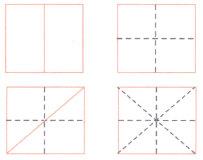
Take a square piece of paper. Fold it into half vertically, fold it again into half horizontally. (i. e., you have folded it twice J. Now open out the folds and again fold the square into half (for a third time now), but this time along a diagonal, as shown in the figure. Again open it and fold it into half(for the fourth time J, but this time along the other diagonal, as shown in the figure. Open out the fold. How many lines of symmetry does the shape have?
2.
Take a piece of paper. Fold it in half. Spill a few drops of ink on one half side. Now press the halves together. What do you see? Is the resulting figure symmetric? If yes, where is the line of symmetry? Is there any other line along which it can be folded to produce two identical parts? Try more such patterns.
3.
How many lines of symmetry do the following figures have?

4.
How many lines of symmetry do the following figures have?

5.
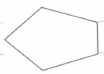
In the given figure, line of symmetry is
6.
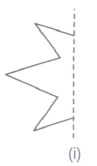
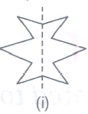
Complete the figure, given its line of symmetry.
7.
How many lines of symmetry does a regular pentagon have?
8.
In the word 'PICTURE', mention the letter with no line of symmetry.
9.
State the line of symmetry of letters E and B.
10.
Complete the figure along the line of symmetry.
11.
Write the letters of the word' MATHEMATICS' which have no line of symmetry.
12.
Write all the capital letters of the English alphabets which have more than one lines of symmetry.
13.
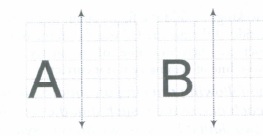
In each figure given below, a letter of the alphabet is shown along with a vertical line. Take the mirror image of the letter in the given line. Find which letters look the same after reflection (i.e. which letters look the same in the image) and which do not? Can you guess, why?
14.
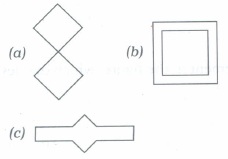
Draw two lines of symmetry in the following figures.
15.
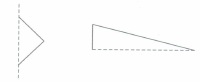
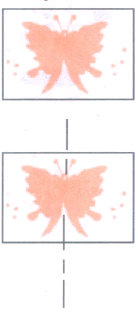
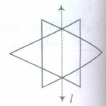
In the figure given alongside, l is the line of symmetry. Draw the image of the triangle and complete the diagram, so that it becomes symmetric.

1.
There are 4 lines of symmetry in the shape.
2.
We see that the resulting figure is symmetric about the line of fold which is the line of symmetry. There is no other line along which it can be folded to produce two identical parts.
3.
1
4.
6
5.
Horozontal
6.
7.
One
8.
P and R
9.
Horizontal
10.
The complete figures are
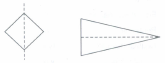
11.
Here, the letter S has no line of symmetry.
12.
The capital letters H, I, O and X have more than one line of symmetry.
13.
Taking the mirror image of the letters A and B from the given line. These will look as shown below:
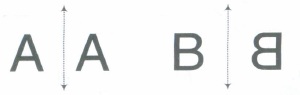
It is clear that, A look the same after reflection and B do not look the same because A has reflection symmetry but B does not have.
Now, the mirror image of other letters are shown below
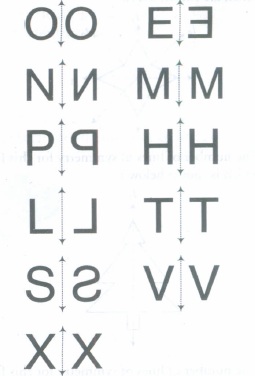
From the above, we can say that A, O, M, H, T, V and X look the same after reflection because these letters are
symmetrical.
Also, we see that B, E, N, P, L and S do not look the same after reflection because these letters are not symmetrical.
14.
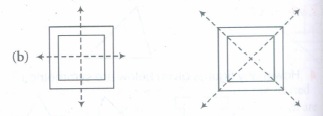
In figures (a) and (c), there ate only two lines of symmetry i. e. horizontal line of symmetry and vertical line of symmetry.
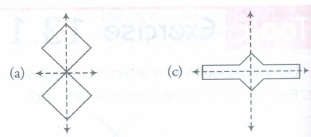
But for figure (b), we can draw more than two lines of symmetry as shown below.
15.
On drawing the image of the triangle and completing the diagram, we get the adjoining figure which is symmetrical about the line of symmetry l.

6th Standard CBSE Syllabus & Materials
6th Standard CBSE
CBSE 6th Social Science Locating Places on the Earth - New Sample Question Papers Study Material - QB365 Set A
NEW6th Standard CBSE
CBSE 6th Science A Journey Through States of Water - New Sample Question Papers Study Material - QB365 Set A
NEW6th Standard CBSE
CBSE 6th Science Temperature and its Measurement - New Sample Question Papers Study Material - QB365 Set A
NEW6th Standard CBSE
CBSE 6th Science Materials Around Us - New Sample Question Papers Study Material - QB365 Set A



CBSE 6th Standard CBSE Subjects
CBSE Standards




