
 100% FREE ACCESS
6th Standard CBSE Syllabus & Materials
6th Standard CBSE
CBSE 6th Social Science The Value of Work - New Sample Question Papers Study Material - QB365 Set A
NEW6th Standard CBSE
CBSE 6th Social Science Family and Community - New Sample Question Papers Study Material - QB365 Set A
NEW6th Standard CBSE
CBSE 6th Social Science India's Cultural Roots - New Sample Question Papers Study Material - QB365 Set A
NEW6th Standard CBSE
CBSE 6th Social Science India,That is Bharat - New Sample Question Papers Study Material - QB365 Set A
NEW6th Standard CBSE
CBSE 6th Social Science Timeline and sources of history - New Sample Question Papers Study Material - QB365 Set A
NEW6th Standard CBSE
CBSE 6th Social Science Oceans and Continents - New Sample Question Papers Study Material - QB365 Set A

Published on: 03/08/2019
Integers
Download CBSE Class 6th Standard CBSE Mathematics question papers, sample papers, important questions, and previous year solved papers in PDF format. Get free study materials, NCERT solutions, and exam preparation resources for Class 6th Standard CBSE Mathematics
Questions + Answers key
Take MCQ Mathematics Test
1.
Use number line and add the following integers:
(- 2) + 8 + (- 4)
2.
Use number line and add the following integers:
(- 1) + (- 2) + (- 3)
3.
Find the solution of (-10) + (+ 8) without using number line.
4.
Write all the integers between -15 and -5.
5.
Represent -6 and +4(4) on the number line.
6.
Following is the account of a shopkeeper which shows profit and loss from the sale of certain items. Using proper sign in the above account, fill up the blanks.
| Name of items | Profit | Loss | Representation with proper sign |
| Mustard oil Rice Black pepper Wheat Groundnut oil |
Rs.150 Rs.225 Rs.200 |
|
________ ________ ________ ________ ________ |
7.
Write all the integers between the given pair (write them in the increasing order).
- 30 and - 23.
8.
Write the following numbers (integers) in increasing order with inequality '<'.
8,7, -3, 2, 0, 4
9.
By using '+' or '-' sign indicate the following.
A train late by 30 min.
10.
Write the succeeding number of the following.
| Number | Successor |
|---|---|
| 10 | |
| 8 | |
| -5 | |
| -3 | |
| 0 |
11.
Temperature of a place at 7 : 00 am was 6°C. Temperature increased by 4°C in first hour and decreased by 1°C in the second hour. What was the temperature at 9 : 00 am?
12.
Compare the following pairs of numbers using > or <.
(i) \(0\ \Box -8\)
(ii) \(-1\ \Box\ -15\)
(iii) \(5\ \Box\ -5\)
(iv) \(11\ \Box\ 15\)
(v) \(0\ \Box\ 6\)
(vi) \(-20\ \Box\ 2\)
From the above exercise, Rohini arrived at the following conclusions:
(a) Every positive integer is larger than every negative integer.
(b) Zero is less than every positive integer.
(c) Zero is larger than every negative integer.
(d) Zero is neither a negative integer nor a positive integer.
(e) Farther a number from zero on the right, larger is its value.
(f) Farther a number from zero on the left, smaller is its value. Do you agree with her? Give examples.
13.
_______ + (-11) + 100 = 200
14.
(-11) + (-3) + (-1) = ________
15.
( ... ) -(-7) = 10
16.
(-4)+ _________ =12
17.
12+ (-12)= _________
18.
|29-9|=|29|+|-9|
19.
|-17-9|=|-17|+|-9|
20.
|8+5|=|8|+|5|
21.
In number system, there is smallest Integer but there is no largest integer
22.
9+(-6)-(-4)=9-(-6)-8
23.
Which of the following is true?
0<-8
0>-8
4<-4
0>6
24.
The preceding number of the number 6 is
2
3
4
5
25.
The preceding number of the number 0 is
1
-1
0
none of these.
26.
Number of whole numbers lying between -7 and 6 is
2
4
5
6
27.
Number of integers lying between -2 and 2 is
3
4
2
1
1.
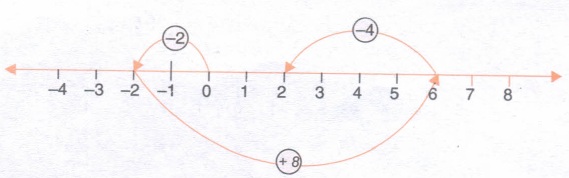
(- 2) + 8 + (- 4)
First we move 2 steps to the left of 0 reaching - 2, then from this point we move 8 steps to the right to
reach + 6 and finally from + 6 we move 4 steps to the left. We reach the point 2.
Thus, (- 2) + 8 + (- 4) = + 2 = 2.
2.
(- 1) + (- 2) + (- 3)
First we move 1 step to the left of 0 reaching - 1, then from this point we move 2 steps to the left to reach - 3 and finally from - 3, we move 3 steps to the left. We reach the point - 6.
Thus, (- 1) + (- 2) + (- 3) = - 6.

3.
(-10) + (+ 8)
=(-2)+(-8)+(+8)
=(-2)+0=-2
4.
Integers between -15 and -5 are -14, -13:-12, -11, -10, - 9, - 8, - 7, - 6.
5.
To represent -6 on the number line, we move 6 points to the left of zero.

6.
| Name of items | Profit | Loss | Representation with proper sign |
| Mustard oil Rice Black pepper Wheat Groundnut oil |
Rs.150 Rs.225 Rs.200 |
|
+Rs.150 -Rs.250 +Rs.225 +Rs.200 -Rs.330 |
7.
Increasing order of these integers is - 29 < - 28 < - 27 < - 26 < - 25 < - 24, because we are moving to the right from -30 to -23.
8.
-3<0<2<4<7<8
9.
-30 min
10.
We know that, one more than given number gives a successor. So, the succeeding numbers of given numbers are given as below:
| Number | Successor |
|---|---|
| 10 | 10 + 1 = 11 |
| 8 | 8 + 1 = 9 |
| -5 | -5 + 1 = -4 |
| -3 | -3 + 1 = -2 |
| 0 | 0 + 1 = 1 |
11.
Temperature at 7 : 00 am = + 6° C
It is given that, temperature increased by 4°C in first hour.
So, temperature at 8 : 00 am = +6°C + 4°C = 10°C
Temperature decreased in second hour by 1°C.
So, the temperature at 9 : 00 am = 10°C - 1°C = 9°C
12.
(i) We have, \(0\ \Box -8\)
Since, 0 is to the right of - 8. ∴ 0 > -8
(ii) We have, \(-1\ \Box\ -15\)
Since, - 1 is to the right of - 15. ∴ -1 > -15
(iii) We have, \(5\ \Box\ -5\)
Since, 5 is to the right of - 5. ∴ 5> -5
(iv)We have, \(11\ \Box\ 15\)
Since, 11 is to the left of 15. ∴ 11 < 15
(v) We have, \(0\ \Box\ 6\)
Since, 0 is to the left of 6. \(\therefore\) 0 < 6
(vi) We have, \(-20\ \Box\ 2\)
Since, - 20 is to the left of 2. \(\therefore\) -20 < 2
Yes, I agree with Rohini. Some examples are as follow:
(a) Every positive integer is larger than every negative integer. e. g. 5 > - 2.
(b) Zero is less than every positive integer. e. g. 0 < 3.
(c) Zero is larger than every negative integer. e. g. 0 > - 4.
(d) Zero is neither a negative integer nor a positive integer, because 0 has neither '+' sign nor '-' sign.
(e) Farther a number from zero, on the right side, larger is its value, because on number line, every integer on the right from zero is greater than zero. e. g. 5 > 0.
(f) Farther a number from zero, on the left side, smaller is its value because on number line, every integer on the left from zero is smaller than zero. e. g. - 8
13.
x + (-11) + 100 = 200
\(\Rightarrow\) x + 89 = 200
\(\Rightarrow\) x = 200 - 89
= 111
14.
(-11) + (-3) + (-1) = - (11 + 3 + 1) = -15
15.
()
3
16.
We have, (-4) + ______ = -12
Here, sum of two integers is not zero, so have we cannot write additive inverse of -4.
-4 + ______ = -12
\(\Rightarrow\) -4 + ______ = - (4 + 8)
\(\Rightarrow\) -4 + ______ = (-4) + (-8)
So, on comparing both sides, we get -8 to fill the blank space.
Thus (-4) + (-8) = - 12
17.
We have, 12 + (-12) = ______ 12 + (-12) = 0
[ \(\because\) 12 and -12 are additive inverse of each other ]
18.
(b)
19.
(a)
20.
(a)
21.
(b)
22.
(a)
23.
(b)
0>-8
24.
(d)
5
25.
(b)
-1
26.
The integers lying between -7 and 6 are -6, -5, -4, -3, -2, -1, 0, 1, 2, 3, 4, 5. Whole number are 0, 1, 2, 3, 4 and 5.
\(\therefore\) The number of whole numbers = 6
27.
The integers lying between -2 and 2 are -1, 0 and 1. So, there are 3 integers.

6th Standard CBSE Syllabus & Materials
6th Standard CBSE
CBSE 6th Social Science Locating Places on the Earth - New Sample Question Papers Study Material - QB365 Set A
NEW6th Standard CBSE
CBSE 6th Science A Journey Through States of Water - New Sample Question Papers Study Material - QB365 Set A
NEW6th Standard CBSE
CBSE 6th Science Temperature and its Measurement - New Sample Question Papers Study Material - QB365 Set A
NEW6th Standard CBSE
CBSE 6th Science Materials Around Us - New Sample Question Papers Study Material - QB365 Set A



CBSE 6th Standard CBSE Subjects
CBSE Standards




