
 100% FREE ACCESS
6th Standard CBSE Syllabus & Materials
6th Standard CBSE
CBSE 6th Social Science The Value of Work - New Sample Question Papers Study Material - QB365 Set A
NEW6th Standard CBSE
CBSE 6th Social Science Family and Community - New Sample Question Papers Study Material - QB365 Set A
NEW6th Standard CBSE
CBSE 6th Social Science India's Cultural Roots - New Sample Question Papers Study Material - QB365 Set A
NEW6th Standard CBSE
CBSE 6th Social Science India,That is Bharat - New Sample Question Papers Study Material - QB365 Set A
NEW6th Standard CBSE
CBSE 6th Social Science Timeline and sources of history - New Sample Question Papers Study Material - QB365 Set A
NEW6th Standard CBSE
CBSE 6th Social Science Oceans and Continents - New Sample Question Papers Study Material - QB365 Set A

Published on: 12/08/2019
Fractions
Download CBSE Class 6th Standard CBSE Mathematics question papers, sample papers, important questions, and previous year solved papers in PDF format. Get free study materials, NCERT solutions, and exam preparation resources for Class 6th Standard CBSE Mathematics
Questions + Answers key
Take MCQ Mathematics Test
1.
put appropriate sign \(\frac { 3 }{ 7 } \Box { } \frac { 5 }{ 7 } \)
2.
Which is the larger fraction? \(\frac { 6 }{ 10 } or\frac { 7 }{ 10 } \)
3.
Write the numerator of \(\frac { 7 }{ 10 } \)
4.
What fraction of an hour is 40 minutes?
5.
Color the part according to the given fraction
 \(\frac { 1 }{ 3 } \)
6.
Write the fraction representing the shaded portion.
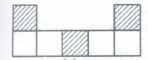
7.
Write the fraction representing the shaded portion.
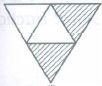
8.
Write the fraction representing the shaded portion
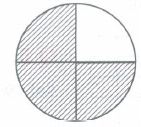
9.
\(2\frac{5}{7}\)is equal to the improper fraction _______.
10.
\(\frac{7}{9}\)and \(\frac{5}{9}\) are _______ proper fractions
11.
A fraction with numerator greater than the denominator is called an ______ fraction.
12.
Fill up using one of these: '>','<' or '='\(\frac { 2005 }{ 2005 } \) ☐1
13.
Fill up using one of these: '>','<' or '=' \(\frac { 3 }{ 5 } \)☐1
14.
Fill in the boxes \(\Box{ } -\frac { 5 }{ 8 } =\frac { 1 }{ 4 } \)
15.
Replace ☐ in each of the following by the correct number. \(\frac { 3 }{ 5 } =\frac { \Box { } }{ 20 } \)
16.
Write the simplest form of \(\frac { 16 }{ 72 } \)
17.
Draw number lines and locate the points on them. \(\frac { 1 }{ 8 } ,\frac { 2 }{ 8 } ,\frac { 3 }{ 8 } ,\frac { 7 }{ 8 } \)
18.
A rectangle is divided into certain number of equal parts. If 16 of the parts so formed represent the fraction \(\frac{1}{4}\) find the number of parts in which the rectangle has been divided.
19.
Add\(\frac { 1 }{ 12 } +\frac { 1 }{ 12 } \) .How will we show this pictorially? Using paper folding?
20.
Write the fractions. Are all these fractions equivalent?
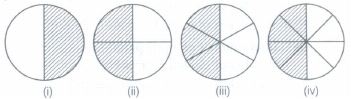
21.
If \(\frac{7}{9}=\frac{28}{p}\) then value of p is
23
2
36
16
22.
The two consecutive integers between which the fraction \(\frac{5}{7}\) lies are
5 and 6
0 and 1
5 and 7
6 and 7
23.
When \(\frac{1}{4}\) is written with denominator as 12, its numerator is
3
8
24
12
24.
Which of the following fraction is smallest?
\(\frac{16}{23}\)
\(\frac{17}{23}\)
\(\frac{9}{23}\)
\(\frac{11}{23}\)
25.
The fraction which is not equal to \(\frac{4}{5}\) is
\(\frac{40}{50}\)
\(\frac{12}{15}\)
\(\frac{16}{20}\)
\(\frac{9}{15}\)
26.
Ali divided one fruit cake equally among six persons. The part of the cake he gave to each person is \(\frac{1}{6}\)
27.
The value of \(\frac{19}{23}-\frac{7}{23} \) is \(\frac{12}{23}\)
28.
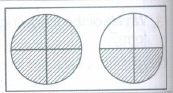
The fraction represented by the shaded portion in the following figure is \(\frac{3}{8}\)

29.
The result obtained by subtracting a fraction from another fraction is necessarily a fraction.
30.
Fractions \(\frac{7}{9}\) and \(\frac{42}{54}\) are equr.va Ient fractions.
31.
\(\frac{6}{7}\)
32.
\(\frac{6}{16}\)
33.
\(\frac{7}{7}\)
34.
\(\frac{6}{10}\)
35.
\(\frac{6}{4}\)
1.
After putting the appropriate signs, we have \(\frac { 3 }{ 7 } \boxed { < } \frac { 5 }{ 7 } \)
2.
We have \(\frac { 6 }{ 10 } ,\frac { 7 }{ 10 } \)
Here, denominators of both fractions are same and 7 > 6.
So, \(\frac { 7 }{ 10 } >\frac { 6 }{ 10 } \)
3.
7
4.
We know that, total minutes in an hour = 60 min
∴ Required field fraction = \(\frac { 40\quad min }{ 60\quad min } =\frac { 40 }{ 60 } =\frac { 2 }{ 3 } \)
5.
Here, fraction \(\frac { 1 }{ 3 } \) shows that out of 3 equal parts, 1 part is shaded. So, the required figure is shown alongside.

6.
Total number of equal parts = 7; Shaded parts = 3
∴ Fraction representing the shaded portion = \(\frac { 3 }{ 7 } \)
7.
Total number of equal parts = 4; Shared parts = 2
∴ Fraction representing the shaded portion
= \(\frac { Number\ of\ shaded\ parts }{ Total\ number\ of\ equal\ parts } =\frac { 2 }{ 4 } \)
8.
Here, the given figure is divided into 4 equal parts and 3 parts out of 4 parts are shaded.
∴ The required fraction = \(\frac { 3 }{ 4 } \)
9.
()
\(2\frac{5}{7}=\frac{2\times7+5}{7}=\frac{14+5}{7}=\frac{19}{7}\)
10.
()
Here,\(\frac{7}{9}\) and \(\frac{5}{9}\) have same denominators, so they are like proper fractions.
11.
()
A fraction which has denominator greater than numerator is called an improper fraction.
12.
()
'\(\frac { 2005 }{ 2005 } \) \(\boxed { = } \) 1
13.
()
\(\frac { 3 }{ 5 } \)\(\boxed { < } \)1
14.
We have \(\Box{ } -\frac { 5 }{ 8 } =\frac { 1 }{ 4 } \)
Here\(\frac { 5 }{ 8 } \) is subtracted from missing fraction to get\(\frac { 1 }{ 4 } .\) This means addition of \(\frac { 5 }{ 8 } \) and \(\frac { 1 }{ 4 } \) gives the missing fraction.
∴ Missing fraction = \(\frac { 1 }{ 4 } +\frac { 5 }{ 8 } \)
⇒ \(\frac { 1 }{ 4 } =\frac { 1\times 2 }{ 4\times 2 } =\frac { 2 }{ 8 } \)
Now, \(\frac { 1 }{ 4 } +\frac { 5 }{ 8 } =\frac { 2 }{ 8 } +\frac { 5 }{ 8 } =\frac { 2+5 }{ 8 } =\frac { 7 }{ 8 } \)
Hence \(\boxed { \frac { 7 }{ 8 } } -\frac { 5 }{ 8 } =\frac { 1 }{ 4 } \)
15.
\(\frac { 3 }{ 5 } =\frac { \boxed { 12 } }{ 20 } \)
16.
We have \(\frac { 16 }{ 72 } \)
Now, factors of 16 = 2\(\times\)2\(\times\)2\(\times\)2 and factor of 72 = 2\(\times\)2\(\times\)2\(\times\)2\(\times\)3
Common factors = 2,2 and 2
∴ HCF of 16 and 72 = 2\(\times\) 2\(\times\)2 = 8
Then, \(\frac { 16 }{ 72 } =\frac { 16\div 8 }{ 16\div 8 } =\frac { 2 }{ 9 } \)
Hence ,fraction \(\frac { 2 }{ 9 } \)is the simplest form of given fraction.
17.
Here, fractions are \(\frac { 1 }{ 8 } ,\frac { 2 }{ 8 } ,\frac { 3 }{ 8 } and\frac { 7 }{ 8 } \)
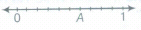
Now, draw a number line, mark two points 0 and Ion it. Divide the gap between 0 and 1 into eight equal parts because denominator is 8, then each part will show.\(\frac { 1 }{ 8 } \)Also 2 parts show\(\frac { 2 }{ 8 } \), 3 parts show\(\frac { 3 }{ 8 } \) and 7 parts show \(\frac { 7 }{ 8 } \)

Hence, A, B, C and D represent \(\frac { 1 }{ 8 } ,\frac { 2 }{ 8 } ,\frac { 3 }{ 8 } and\frac { 7 }{ 8 } \) respectively.
18.
Let a rectangle be divided into x equal parts.
Now, 16 of the parts represent =\(\frac{1}{4}\)
\(\therefore \frac { 16 }{ x } =\frac { 1 }{ 4 } \Rightarrow x=16\times 4\Rightarrow \) x = 64 parts
Hence, rectangle is divided into 64 equal parts.
19.
We have,
Pictorially, it can be shown as
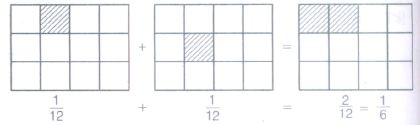
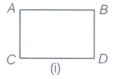
By folding paper, it can be shown in the following way Take a square piece of paper say ABCD [figure (i)].
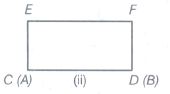
Fold it by overlapping its edge AB and CD to get figure (ii).
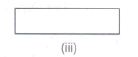
Again, refold it by taking EF over C(A) D(B) to get figure (iii).
Now,reopen it, then we get the following figure (iv)

Now,fold it vertically at two places to obtain three equal vertical portion as shown in figure (v)
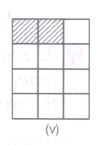
Shaded \(\frac { 1 }{ 12 } \)portion twice,
We see that, \(\frac { 1 }{ 12 } +\frac { 1 }{ 12 } =\frac { 1+1 }{ 12 } =\frac { 2 }{ 12 } =\frac { 1 }{ 6 } \)
20.
(i) Total number of equal parts = 2;
Number of shaded parts = 1
∴ Fraction of shaded portion = \(\frac { Number\ of\ shaded\ parts\ }{ Total\ number\ of\ equal\ parts } =\frac { 1 }{ 2 } \)
(ii) Total number of equal parts = 4;
Number of shaded parts = 2
∴ Fraction of shaded portion = 2/4
(iii) Total number of equal parts = 6;
Number of shaded parts = 3
∴ Fraction of shaded portion = 3/6
(iv) Total number of equal parts = 8;
Number of shaded parts = 4
∴ Fraction of shaded portion = 4/8
Now, \(\frac { 2 }{ 4 } =\frac { 2\div 2 }{ 4\div 2 } =\frac { 1 }{ 2 } \) [∵ HCF of 2 and 4 is 2]
\(\frac { 3 }{ 6 } =\frac { 3\div 3 }{ 6\div 3 } =\frac { 1 }{ 2 } \) [∵ HCF of 3 and 6 is 3]
\(\frac { 4 }{ 8 } =\frac { 4\div 4 }{ 8\div 4 } =\frac { 1 }{ 2 } \) [∵ HCF of 4 and 8 is 4]
Since all fraction in simple form are same.
∴ \(\frac { 1 }{ 2 } =\frac { 2 }{ 4 } =\frac { 3 }{ 6 } =\frac { 4 }{ 8 } \) i.e the fractions are equivalent.
21.
(c)
36
22.
(b)
0 and 1
23.
(a)
3
24.
(c)
\(\frac{9}{23}\)
25.
(d)
\(\frac{9}{15}\)
26.
(a)
27.
(a)
28.
(a)
29.
(b)
30.
(a)
31.
()

32.
()

33.
()

34.
()
35.
()

6th Standard CBSE Syllabus & Materials
6th Standard CBSE
CBSE 6th Social Science Locating Places on the Earth - New Sample Question Papers Study Material - QB365 Set A
NEW6th Standard CBSE
CBSE 6th Science A Journey Through States of Water - New Sample Question Papers Study Material - QB365 Set A
NEW6th Standard CBSE
CBSE 6th Science Temperature and its Measurement - New Sample Question Papers Study Material - QB365 Set A
NEW6th Standard CBSE
CBSE 6th Science Materials Around Us - New Sample Question Papers Study Material - QB365 Set A



CBSE 6th Standard CBSE Subjects
CBSE Standards




