
 100% FREE ACCESS
6th Standard CBSE Syllabus & Materials
6th Standard CBSE
CBSE 6th Social Science The Value of Work - New Sample Question Papers Study Material - QB365 Set A
NEW6th Standard CBSE
CBSE 6th Social Science Family and Community - New Sample Question Papers Study Material - QB365 Set A
NEW6th Standard CBSE
CBSE 6th Social Science India's Cultural Roots - New Sample Question Papers Study Material - QB365 Set A
NEW6th Standard CBSE
CBSE 6th Social Science India,That is Bharat - New Sample Question Papers Study Material - QB365 Set A
NEW6th Standard CBSE
CBSE 6th Social Science Timeline and sources of history - New Sample Question Papers Study Material - QB365 Set A
NEW6th Standard CBSE
CBSE 6th Social Science Oceans and Continents - New Sample Question Papers Study Material - QB365 Set A

Published on: 19/01/2019
Class 6 Whole Numbers Full Chapter Solutions
Download CBSE Class 6th Standard CBSE Mathematics question papers, sample papers, important questions, and previous year solved papers in PDF format. Get free study materials, NCERT solutions, and exam preparation resources for Class 6th Standard CBSE Mathematics
Questions + Answers key
Take MCQ Mathematics Test
1.
Study the following patterns.
1 =12, 1 + 3 = 22, 1 + 3 + 5 = 32, 1 + 3 + 5 + 7 = 42
Hence, find the sum of
(a) First 19 odd numbers.
(b) First 21 odd numbers.
2.
Write the natual number and the whole number which has no predecessor.
3.
Find 4 x 3, 5 - 3 using the number line.
4.
In a school, there are four sections of class VI. Each section has 50 students. Money collected for picnic from each student is Rs 125. Find the r total amount collected.
5.
A dairy supplies 40 L of milk in morning and 50 L of milk in the evening. If the cost of milk is Rs 24 per litre, find the total sell in rupees.
6.
Find the value of 968 x 73 + 968 x 27?
7.
Find the whole number n.when 2n - 6 = 0?
8.
Write the following numbers as directed using dots.
(a) 16 as a square
(b) 26 as a rectangle.
9.
There are two whole numbers, which when multiplied by itself gives the same number. What are they?
10.
Find the product of the largest three-digit number with the smallest four-digit number.
11.
Find 5 x 4 on the number line.
12.
Find 10 - 3 on the number line.
13.
Find 5 + 2 on the number line.
14.
In each of the following pairs of numbers, state which whole number is to the left of the other on the number line. Use appropriate symbol (> or <).
(a) 497, 495
(b) 3059, 3096.
15.
Write the successor of the following:
(a) 299
(b) 2923.
16.
Determine the sum of the four numbers as given below:
(a) Successor of 32
(b) Predecessor of 49
(c) Predecessor of the predecessor of 56
(d) Successor of the successor of 67.
17.
Write the predecessor of the following:
(a) 96
(b) 9998.
18.
If the product of two whole numbers is zero, can we say that one or both of them will be zero? Justify through examples.
19.
Some numbers can be shown by two rectangles.
e.g. .png)
Give at least five other such examples.
20.
How many whole numbers are there between 32 and 53?
21.
Find 15 x 68, 17 x 23, 69 x 78 + 22 x 69 Using distributive property
22.
If \(\Delta\) is an operation such that a \(\Delta\) b = 2a + b + 3, then find the value of 5 \(\Delta\) 3.
23.
Find the product of the smallest whole number with the largest three-digit whole number.
24.
An auto driver filled his CNG cylinder with 30 kg of CNG. If the cost of CNG is Rs 38/kg, find the amount spent by the auto driver.
25.
Mohan has Rs 10000 in his account. He spent Rs 5945 on his birthday. How much money left in his account?
26.
Find the value of the following:
(i) 175 x 17 + 175 x 25
(ii) 207 x 80 + 207 x 20.
27.
Find the value of 3 x (7 + 3), 5 x (9 + 1) using distributive property.
28.
Study the following patterns.
1 = 12
1 + 3 = 22
1 + 3 + 5 = 32
1 + 3 + 5 + 7 = 42
Hence, find the sum of
(a) first 12 odd numbers
(b) first 50 odd numbers.
29.
In a city, polio drops were given to 212583 children on Sunday in March 2013 and to 216813 children in next month.
(a) Find the difference of the number of children getting polio drops in the two months.
(b) What is the value of vaccinating children for polio in India?
30.
Mr. Rajesh withdraws Rs 100000 from his bank account. He purchased a TV set for Rs 38650, a refrigerator for Rs 23880 and jewellery worth Rs 35560. How much money was left with him?
1.
(a) 361
(b) 441.
2.
1, 0
3.
4 x 3 = 12, 5 - 3 = 2
4.
25000
5.
Rs 2160
6.
We have, 968 x 73 + 968 x 27
= 968 (73 + 27) [taking 968 as common term]
= 968 x 100 = 96800.
7.
We have, 2n - 6 = 0
2n = 6 \(\Rightarrow n=\frac{6}{2}=3\)
8.
According to the patterns of whole number,
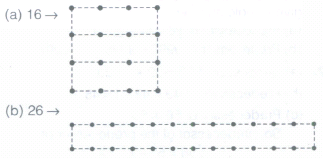
9.
If we multiply 0 by itself, it gives same number
i.e. 0 x 0 = 0, and similarly, 1 x 1 = 1.
\(\therefore\) The required whole numbers are 0 and 1.
10.
Largest 3-digit number = 999 and smallest 4-digit number = 1000
\(\therefore\) Product = 999 x 1000 = 999000.
11.
We start from 0, move 5 units at a time to the right, make 4 such moves. We reach at 20
.png)
So, 5 x 4 = 20.
12.
We start from 10, make 3 jumps to the left, we reach at 7.
.png)
So, 10 - 3 = 7.
13.
We start from 5, make 2 jumps to the right, we reach at 7.
.png)
So, 5 + 2 = 7.
14.
We know that, the number which lies to the right of other is a greater number.
(a) 497 lies to the right of 495, so, 497 > 495
(b) 3059 lies left to the 3096, so, 3059 < 3096.
15.
We know that, successor is one more than tbe given whole number.
(a) Successor of 299 = 299 + 1 = 300
(b) Successor of 2923 = 2923 + 1 = 2924.
16.
(a) Successor of 32 = 32 + 1 = 33
(b) Predecessor of 49 = 49 - 1 = 48
(c) Predecessor of 56 is 55
So, predecessor of the predecessor of 56 = 55 - 1 = 54
(d) Successor of 67 is 68
So, successor of the sucessor of 67 = 68 + 1 = 69
Hence, the sum of four numbers = 33 + 48 + 54 + 69 = 204.
17.
We know that, predecessor is one less than the given whole number.
(a) Predecessor of 96 = 96 - 1 = 95
(b) Predecessor of 9998 = 9998 - 1 = 9997.
18.
Yes, if the product of two whole numbers is zero, then one or both of them will be zero. Since, we know that the product of any whole number with zero is always zero i.e. a x 0 = 0, where a is any whole number and 0 x 0 = 0. Some examples are as follows:
| Whole number | Product | Is the product zero? | |
| (a x 0) | (0 x a) | ||
| 5 | 5 x 0 = 0 | 0 x 5 = 0 | Yes |
| 3 | 3 x 0 = 0 | 0 x 3 = 0 | Yes |
| 0 | 0 x 0 = 0 | 0 x 0 = 0 | Yes |
| 4 | 4 x 0 = 0 | 0 x 4 = 0 | Yes |
| 25 | 25 x 0 = 0 | 0 x 25 = 0 | Yes |
19.
There are many examples of such type. Five of them are as follows:
(i).png)
(ii).png)
20.
Whole numbers between 32 and 53 are as follows:
33, 34, 35, 36, 37, 38, 39, 40, 41, 42, 43, 44, 45, 46, 47, 48, 49, 50, 51 and 52.
Hence, total number of whole numbers between 32 and 53 is 20.
Alternate Method
We can find the total numbers by using (b - a) - 1.
Where, a = First number and b = Last number
Here, a = 32, b = 53
Whole numbers between 32 and 53 = (b - a) - 1
= (53 - 32) -1 [putting the values of a and b)
= 21 - 1 = 20.
21.
15 x 68 = 15 x (60 + 8)
= 15 x 60 + 15 x 8
(distributivity of multiplication over addition)
= 900 + 120 = 1020
17 x 23 = 17 x (20 + 3)
= 17 x 20 + 17 x 3
(distributivity of multiplication over addition)
=340+51=391
69 x 78 + 22 x 69
= 69 x 78 + 69 x 22
(commutativity of multiplication)
= 69 x (78 + 22)
(distributivity of multiplication over addition)
= 69 x 100 = 6900.
22.
16
23.
0
24.
Rs 1140
25.
Rs 4055.
26.
(i) 7350
(ii) 20700.
27.
30, 50
28.
The given pattern is
1 = 12
1 + 3 = 22
1+ 3 + 5 = 32
1+ 3 + 5 + 7 = 42
(a) Sum of first 12 odd numbers
1+ 3 + 5 + 7 + 9 + 11 + 13 + 15 + 19 + 21 + 23 + 25 = 122 = 1
(b) Similarly, sum of first 50 odd numbers = 502 = 2500.
29.
(a) Given, number of children, who got polio drops in March 2013 = 212583
Number of children, who got polio drops in next month = 216813
\(\therefore\) Difference of the number of children getting polio drops in two months
= 216813 - 212583 = 4230 children.
(b) Importance of pulse polio drops
The children are vaccinated for their protectior against deadly polio virus. All the babies below 5 yrs of age are given oral polio vaccine simultaneously, it helps to eradicate the virus.
30.
Given, money withdraws from bank = Rs 100000
Money spent on TV = Rs 38650
Money spent on refrigerator = Rs 23880
Money spent on jewellery = Rs 35560
Total amount spent
= 38650 + 23880 + 35560
= Rs 98090
Left money
= Rs 100000 - Rs 98090 = Rs 1910.

6th Standard CBSE Syllabus & Materials
6th Standard CBSE
CBSE 6th Social Science Locating Places on the Earth - New Sample Question Papers Study Material - QB365 Set A
NEW6th Standard CBSE
CBSE 6th Science A Journey Through States of Water - New Sample Question Papers Study Material - QB365 Set A
NEW6th Standard CBSE
CBSE 6th Science Temperature and its Measurement - New Sample Question Papers Study Material - QB365 Set A
NEW6th Standard CBSE
CBSE 6th Science Materials Around Us - New Sample Question Papers Study Material - QB365 Set A



CBSE 6th Standard CBSE Subjects
CBSE Standards




