
 100% FREE ACCESS
6th Standard CBSE Syllabus & Materials
6th Standard CBSE
CBSE 6th Social Science The Value of Work - New Sample Question Papers Study Material - QB365 Set A
NEW6th Standard CBSE
CBSE 6th Social Science Family and Community - New Sample Question Papers Study Material - QB365 Set A
NEW6th Standard CBSE
CBSE 6th Social Science India's Cultural Roots - New Sample Question Papers Study Material - QB365 Set A
NEW6th Standard CBSE
CBSE 6th Social Science India,That is Bharat - New Sample Question Papers Study Material - QB365 Set A
NEW6th Standard CBSE
CBSE 6th Social Science Timeline and sources of history - New Sample Question Papers Study Material - QB365 Set A
NEW6th Standard CBSE
CBSE 6th Social Science Oceans and Continents - New Sample Question Papers Study Material - QB365 Set A

Published on: 19/01/2019
Decimals HOTS Questions
Download CBSE Class 6th Standard CBSE Mathematics question papers, sample papers, important questions, and previous year solved papers in PDF format. Get free study materials, NCERT solutions, and exam preparation resources for Class 6th Standard CBSE Mathematics
Questions + Answers key
Take MCQ Mathematics Test
1.
Make three more examples similar to the one given in question 1 and solve them.
Three more examples similar to the one given in question 1 are as follows:
Can you write the following numbers as decimals?
| S.No. | Hundreds(100) | Tens(10) | Ones(1) | Tenths\(\left( \cfrac { 1 }{ 10 } \right) \) |
| 1 | 6 | 4 | 9 | 2 |
| 2 | 3 | 8 | 4 | 5 |
| 3 | 4 | 6 | 5 | 7 |
2.
Neha's mom bought 4 kgs 700 g of carrots, 7 kg 45 g of tomatoes, 6 kg 85 g of potatoes. While coming back from market vegetable of weight 2 kg 460 g fall from the packet. What quantity of vegetables are left with her?
3.
Alok purchased 1 kg 200 g potatoes, 250 g dhania, 5 kg 300 g onion, 500 g palak and 2 kg 600 g tomatoes. Find the total weight of his purchases in kilograms.
4.
Round off 20.83 to nearest tenths.
5.
Arrange 12.142, 12.124, 12.104, 12.401 and 12.214 in ascending order
6.
The place value of a digit at the tenths place is 10times the same digit at the ones place. State whether the statement is true or false?
7.
Rajesh covers journey by car in 3 h. He covers a distance 60 km 320 m during first hour, 54 km 70 m during the second hour and 65 krn 9 m during the third hour. What is the total distance covered in his journey?
8.
Sunita travelled 15 km 268 m by bus, 7 km 7 m by car and 500 m on foot in order to reach her school. How far is her school from her residence?
9.
Namita travels 20 km 50 m everyday. Out of this she travels 10 km 200 m by bus and the rest by auto. How much distance does she travel by auto?
10.
Write 20 rupees 27 paise in decimal.
11.
What part of the whole square is the shaded portion, if we shade 8 squares, 15 squares, 50 squares, 92 squares of the whole square?
12.
Write the decimal number represented by the points A, B, C and D on the given number line.

13.
Write the following decimals in the place value table.
(a) 19.4 (b) 0.3
14.
Write \(\frac { 3 }{ 2 } ,\frac { 4 }{ 5 } and\frac { 8 }{ 5 } \) in decimal notation.
15.
Ravi and Raju measured the length of their pencils.Ravi's pencil was 7 cm and 5 mm long and Raju'spencil was 8 cm and 3 mm long. Write the lengths of Ravi's and Raju's pencil (in cm) using decimals.
1.
1.Required number
=600+40+9+ \(\cfrac { 2 }{ 10 } \) =649.2
2.Required number
= 300 + 80 + 4 + \(\cfrac { 5 }{ 10 } \) = 384.5
3.Required number
=400+60+5+ \(\cfrac { 7 }{ 10 } \) =465.7
2.
15.37 kg
3.
Firstly, we convert all the weight in the same unit i.e. gram into kilogram and then find the total weight.
Given, weight of potatoes = 1 kg + 200 g
= 1 kg + 200 g
= 1 kg + \(\frac { 200 }{ 1000 } \)kg
= 1 kg + 0.200 kg = 1.200 kg \(\left[ \because \quad 1g=\frac { 1 }{ 1000 } kg \right] \)
Weight of dhania = 250 g = \(\frac { 250 }{ 1000 } \)kg= 0.250 kg
Weight of onion = 5 kg 300 g = 5 kg + 300 g
\(=5\quad kg+\frac { 300 }{ 1000 } kg\)
= 5 kg + 0.300 kg
= 5.300 kg
Weight of palak = 500 g = \(\frac { 500 }{ 1000 } kg=0.500\quad kg\)
Weight of tomatoes = 2 kg 600 g = 2 kg + 600 g
\(=2\quad kg+\frac { 600 }{ 1000 } kg\) \(\left[ \because 1\quad g=\frac { 1 }{ 1000 } kg \right] \)
= 2 kg + 0.600 kg = 2.600 kg
\(\therefore\) Total weight of his purchases in kilograms = Weight of potatoes + Weight of dhania + Weight of onion + Weight of palak + Weight of tomatoes
= 1.200 kg + 0.250 kg + 5.300 kg + 0.500 kg + 2.600 kg
= [1.200 + 0.250 + 5.300 + 0.500 + 2.600] kg
\(\quad1.200\\\quad0.250\\\quad5.300\\\quad0.500\\+2.600\\\_\_\_\_\_\_\_\_\\\quad9.850\\\_\_\_\_\_\_\_\_\)
Hence, the total weight is 9.850 kg.
4.
For rounding off to tenths place, we look at the hundredths place.
Here, the digit is 3.
So, the digit at the tenths place (8) will not be increased by 1.
\(\therefore\) 3 will be written as equal to zero.
Hence, rounding off 20.83 to nearest tenths, we get 20.80.
5.
Given numbers are 12.142, 12.124, 12.104, 12.401 and 12..214.
\(\therefore\) \(12.142=10+2+\frac { 1 }{ 10 } +\frac { 4 }{ 100 } +\frac { 2 }{ 1000 } \)
\(12.124=10+2+\frac { 1 }{ 10 } +\frac { 2 }{ 100 } +\frac { 4 }{ 1000 } \)
\(12.104=10+2+\frac { 1 }{ 10 } +\frac { 0 }{ 100 } +\frac { 4 }{ 1000 } \)
\(12.401=10+2+\frac { 4 }{ 10 } +\frac { 0 }{ 100 } +\frac { 1 }{ 1000 } \)
\(12.214=10+2+\frac { 2 }{ 10 } +\frac { 1 }{ 100 } +\frac { 4 }{ 1000 } \)
Here, whole part of all numbers are same and tenths part of 12.142, 12.124 and 12.104 are same.
Now, tenths part of 12.401 = \(\frac { 4 }{ 10 } \)
and tenths part of 12.214 = \(\frac { 2 }{ 10 } \)
\(\because \quad \frac { 4 }{ 10 } >\frac { 2 }{ 10 } \)
\(\therefore\) 12.401 > 12.214
Again, hundredths part of 12.142 = \(\frac { 4 }{ 100 } \)
\(\therefore\) Hundredths part of 12.104 = \(\frac { 0 }{ 100 } \)
\(\therefore \quad \frac { 4 }{ 100 } >\frac { 2 }{ 100 } >\frac { 0 }{ 100 } \)
\(\therefore\) 12.142 > 12.124 > 12.104
Hence, the ascending order of given number are 12.104 < 12.124 < 12.142 < 12.214 < 12.401.
6.
False, because the place value of a digit at the tenths place is 1/10 times the same digit at the ones place,
e.g. Let a number be 23.37.
Here, place value of 3 at ones place = 3
and place value of 3 at tenths place
\(=\frac { 3 }{ 10 } =3\times \frac { 1 }{ 10 } =\frac { 1 }{ 10 } \times \) Place value of 3 at ones place
7.
We know that = 1000 m = 1 km
\(\therefore \quad 1m=\frac { 1 }{ 1000 } km\)
Now, distance covered during the first hour = 60.320 km
Distance covered during the second hour = 54.070 km
Distance covered during the third hour = 65.009 km
______________
\(\therefore\) Total distance = 179.399 km
______________
Hence, total length of journey is 179.399 km.
8.
Distance travelled by bus
= 15 km 268 m = 15 km + 268 m
\(= 15\ km+ 268\times{1\over 1000}km\) \(\begin{bmatrix} \because 1\ m={1\over1000}km \end{bmatrix}\)
\(=15\ km+{268\over1000}km\)
= (15 + 0.268) km = 15.268 km
Distance travelled by car = 7 km 7 m = 7 km + 7 m
\(= 7 km + 7\times{1\over 1000}km\) \(\begin{bmatrix} \because 1\ m={1\over1000}km \end{bmatrix}\)
\(=7\ km+{7\over 1000}km=7\ km+0.007\ km\)
= (7 + 0.007) km = 7.007 km
Distance travelled by foot
\(= 500 m = 500\times{1\over 1000}km\) \(\begin{bmatrix} \because 1\ m={1\over1000}km \end{bmatrix}\)
\(={500\over1000}km=0.500\ km\)
\(\therefore\) Total distance travelled by Sunita
\(\quad15.268\\\quad7.007\\+0.500\\\_\_\_\_\_\_\_\\\ 22.775\\\_\_\_\_\_\_\_\)
Hence, total distance travelled by Sunira is 22.775 km.
9.
\(\because\) Total distance travelled by Namita
= 20 km 50 m = 20 km + 50 m
\(=20\quad km+50\times \frac { 1 }{ 1000 } km\) \(\left[ \because 1\quad m=\frac { 1 }{ 1000 } km \right] \)
\(=20\quad km+\frac { 50 }{ 1000 } km\) = (20+0.050) km = 20.050 km
and distance travelled by Namita by bus
= 10 km 200 m = 10 km + 200 m
= 10 km + 200 \(\times \frac { 1 }{ 1000 } km\left[ \because \quad 1m=\frac { 1 }{ 1000 } km \right] \)
\(=10\quad km+\frac { 200 }{ 1000 } km=10\quad km+0.200\quad km\)
= ( 10 + 0.200) km = 10.200 km
\(\therefore\) Distance travelled by auto
= 20.050 km - 10.200 km
= (20.050 - 10.200) km = 9.850 km
Hence, she travels 9.850 km by auto.
10.
We have, Rs 20 + 27 paise = Rs 20 + 27 paise = Rs 20 + \(\left( 2\times \frac { 1 }{ 10 } +\frac { 7 }{ 100 } \right) \)paise = Rs (20 + 0.27) = Rs 20.27
Length
We know that, 100 cm = 1 m \(\therefore\) 1 cm=\(\frac { 1 }{ 100 } m=0.01\quad m\)
So, to convert cm into m, multiply cm by \(\frac { 1 }{ 100 } \).
Also, 1000 m = 1 km \(\therefore \quad 1m=\frac { 1 }{ 1000 } km\)
So, to convert m into km, multiply m by 1/1000 and 10 mm = 1 cm
\(\therefore \quad 1\quad mm=\frac { 1 }{ 10 } cm\)
So, to convert mm into cm, multiply mm by 1/10.
\(e.g.\quad 65\quad cm=\frac { 65 }{ 100 } m=0.64\quad m\)
125 cm = (100 + 25) cm = \(\left( \frac { 100 }{ 100 } +\frac { 25 }{ 100 } \right) \) m = 1.25 m
11.
(i) If we shade 8 squares, then whole square with shaded portion is given.
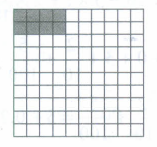
Here, total number of squares = 100 and number of shaded squares = 8
\(\therefore
\) Ordinary fraction = \(\frac { Shaded\quad squares }{ Total\quad squares } =\frac { 8 }{ 100 } \)
and decimal number = \(\frac { 8 }{ 100 } =0.08\)
(ii) If we shade 15 squares, then whole square with shaded portion is given
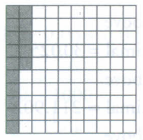
Here, total number of squares = 100 and number of shaded squares = 15
\(\therefore
\) Ordinary fraction=\(\frac { Shaded\quad squares }{ Total\quad squares } =\frac { 15 }{ 100 } \)
and decimal number = \(\frac { 15 }{ 100 } =0.15\)
(iii) If we shade 50 squares, then whole square with shaded portion is given
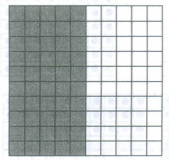
Here, total number of squares = 100 and number of shaded squares = 50
\(\therefore \quad Ordinary\quad fraction=\frac { Shaded\quad squares }{ Total\quad squares } =\frac { 50 }{ 100 } \)
and decimal number = \(\frac { 50 }{ 100 } =0.50\)
(iv) If we shade 92 squares, then whole square with shaded portion is given.
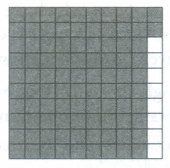
Here, total number of squares = 100 and number of shaded squares = 92
\(\therefore \quad Ordinary\quad fraction=\frac { Shaded\quad squares }{ Total\quad squares } =\frac { 92 }{ 100 } \)
\(and\quad decimal\quad number=\frac { 92 }{ 100 } \)
= 0.92
Now, we can write it in the form of table as shown below:
| Shaded portions | Ordinary fraction | Decimal number |
|---|---|---|
| 8 squares | \(\frac { 8 }{ 100 } \) | 0.08 |
| 15 squares | \(\frac { 15 }{ 100 } \) | 0.15 |
| 50 squares | \(\frac { 50 }{ 100 } \) | 0.50 |
| 92 squares | \(\frac { 92 }{ 100 } \) | 0.92 |
12.
Given number line is a follows:

(i) From the figure, it is clear that A = 0.8 as the unit length between 0 and 1 has been divided into 10 equal parts and 8 parts from 0 have been taken.
(ii) From the figure, it is clear that B = 1.3 as the unit length between 1 and 2 has been divided into 10 equal parts and unit length between 0 to 1 and then 3 parts have been taken.
(iii) From the figure, it is clear that C = 2.2 as the unit length between 2 and 3 has been divided into 10 equal parts and unit length between 0 to 1, 1 to 2 and then 2 parts have been taken.
(iv) From the figure, it is clear that D = 2.9 as the unit length between 2 and 3 has been divided into 10 equal parts and unit length between 0 to 1, 1 to 2 and then 9 parts have been taken.
13.
We can write the given decimals as follows:
(a) We have, 19.4 = 1 \(\times\)10 + 9 \(\times\) 1 + 4 \(\times\) \(\frac { 1 }{ 10 } \)
Now, putting these values in place value table, we get
| Hundreds (100) |
Tens (10) |
Ones (1) |
Tenths (1/10) |
|---|---|---|---|
| 0 | 1 | 9 | 4 |
(b) We have, 0.3 = 0 \(\times\) 10 + 0 \(\times\) 1 + 3 \(\times\)\(\frac{1}{10}\)
Now, putting these values in place value table, we get
| Hundreds (100) |
Tens (10) |
Ones (1) |
Tenths (1/10) |
|---|---|---|---|
| 0 | 0 | 0 | 3 |
14.
(i) \(\frac { 3 }{ 2 } =\frac { 3\times 5 }{ 2\times 5 } \)
[multiplying numerator and denominator by 5 to make denominator 10]
\(=\frac { 15 }{ 10 } =1\frac { 5 }{ 10 } =1+\frac { 5 }{ 10 } =1+0.5=1.5\)
Therefore, \(\frac { 3 }{ 2 } \) is 1.5 in decimal notation.
(ii) \(\frac { 4 }{ 5 } =\frac { 4\times 2 }{ 5\times 2 } \)
[multiplying numerator and denominator by 2 to make denominator 10]
\(=\frac { 8 }{ 10 } =0.8\)
Therefore, \(\frac { 4 }{ 5 } \) is 0.8 in decimal notation.
(iii) \(\frac { 8 }{ 5 } =\frac { 8\times 2 }{ 5\times 2 } \)
[multiplying numerator and denominator by 2 to make denominator 10]
\(=\frac { 16 }{ 10 } =1\frac { 6 }{ 10 } =1+\frac { 6 }{ 10 } =1+0.6=1.6\)
Therefore, \(\frac { 8 }{ 5 } \) is 1.6 in decimal notation.
15.
Given, length of Ravi's pencil = 7 cm 5 mm
and length of Raju's pencil = 8 cm 3 mm
We know that, 10 mm = 1cm
\(\therefore\)1 mm = \(\frac { 1 }{ 10 } \) cm or one-tenth cm = 0.1 cm
Now, length of Ravi's pencil = 7 cm 5 mm
= 7 cm and 5 tenths cm
= 7cm + \(\frac { 5 }{ 10 } \) cm
= 7 crn+ 0.5 cm = 7.5 cm
and length of Raju's pencil = 8 cm 3 mm
= 8 cm and 3 tenths cm
=8 cm + \(\frac { 3 }{ 10 } \)cm=8 cm + 0.3 cm = 8.3 cm

6th Standard CBSE Syllabus & Materials
6th Standard CBSE
CBSE 6th Social Science Locating Places on the Earth - New Sample Question Papers Study Material - QB365 Set A
NEW6th Standard CBSE
CBSE 6th Science A Journey Through States of Water - New Sample Question Papers Study Material - QB365 Set A
NEW6th Standard CBSE
CBSE 6th Science Temperature and its Measurement - New Sample Question Papers Study Material - QB365 Set A
NEW6th Standard CBSE
CBSE 6th Science Materials Around Us - New Sample Question Papers Study Material - QB365 Set A



CBSE 6th Standard CBSE Subjects
CBSE Standards




