
 100% FREE ACCESS
6th Standard CBSE Syllabus & Materials
6th Standard CBSE
CBSE 6th Social Science The Value of Work - New Sample Question Papers Study Material - QB365 Set A
NEW6th Standard CBSE
CBSE 6th Social Science Family and Community - New Sample Question Papers Study Material - QB365 Set A
NEW6th Standard CBSE
CBSE 6th Social Science India's Cultural Roots - New Sample Question Papers Study Material - QB365 Set A
NEW6th Standard CBSE
CBSE 6th Social Science India,That is Bharat - New Sample Question Papers Study Material - QB365 Set A
NEW6th Standard CBSE
CBSE 6th Social Science Timeline and sources of history - New Sample Question Papers Study Material - QB365 Set A
NEW6th Standard CBSE
CBSE 6th Social Science Oceans and Continents - New Sample Question Papers Study Material - QB365 Set A

Published on: 19/01/2019
Fun with Magnets Chapter Full Material
Download CBSE Class 6th Standard CBSE Science question papers, sample papers, important questions, and previous year solved papers in PDF format. Get free study materials, NCERT solutions, and exam preparation resources for Class 6th Standard CBSE Science
Questions + Answers key
Take MCQ Science Test
1.
State the ways through which a magnet can be demagnetised.
2.
Suggest an arrangement to store a U-shaped magnet. How is this different from storing a pair of bar magnets?
3.
You are given an iron strip. How will you make it into a magnet?
4.
Where are poles of a bar magnet located?
5.
A magnet was broken into five pieces. How many north poles will be present in the broken pieces?
6.
How do magnetic trains run without touching the ground?
7.
Riya's mother is stitching buttons on a shirt. The needle has slipped from her hand onto the floor. Can Riya help her mother to find the needle?
8.
Define attractive and directive properties of a magnet.
9.
Name two magnetic and two non-magnetic materials
10.
Insert a magnetised needle through a paper cork. Let the cork float in the water placed ina tub in such a way that the cork does not touch the water. Does the needle always point in the same direction when the cork stops rotating?
11.
A tailor was stitching buttons on his shirt. The needle has slipped from his hand onto the floor. How can you help the tailor to find the needle?
12.
When South pole of a magnet comes in contact with South pole of other magnet, than what happens?
13.
Mention what types of forces act between the two unlike poles of the magnet, if both of them are put together.
14.
Paheli and her friends were decorating the class bulletin board. She dropped the box of stainless steel pins by mistake. She tried to collect the pins using a magnet. She could not succeed. What could be the reason for this?
15.
Where are the poles of a bar magnet located? Suggest a method to locate them.
16.
A bar magnet is cut into two pieces A and B from the middle as shown in figure.

Will the two pieces act as individual magnets? Mark the poles of these two pieces. Suggest an activity to verify your answer.
17.
You are provided with two identical metal bars. Out of the two, one is a magnet. Suggest two ways to identify the magnet.
18.
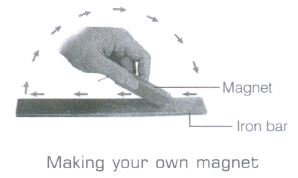
Describe the steps involved in the magnetising of an iron strip with the help of a magnet.
19.
Materials that get attracted to a magnet are called ___________ materials.
20.
_________is a tool used by sailors and travellers to find direction.
21.
Refrigerator doors use the _________property of magnet.
22.
In a bar magnet, magnetic attraction is _____________near its ends.
23.
When a bar magnet is broken, each of broken part will have ...... pole/poles.
24.
Magnets are used in
refrigerator doors
credit cards
door bells
All of these
25.
When the south poles of two magnets are kept close, they will__________
attract
repel
rotate
remain unaffected
26.
Observe the pictures A and B given in Fig, carefully.
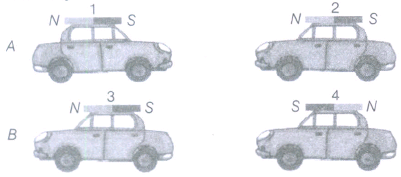
Which of the following statements is correct for the above given pictures?
In A, cars 1 and 2 will come closer and in B, cars 3 and 4 will come closer
In A, cars 1 and 2 will move away from each other and in B, cars 3 and 4 will move away
In A, cars 1 and 2 will move away and in B,cars 3 and 4 will come closer to each other
In A, cars 1 and 2 will come closer to each other and in B, cars 3 and 4 will move away from each other.
27.
A horse shoe magnet has:
No poles
One pole
Two'poles
Infinite poles
28.
Which of the following is a confirmatory evidence of a pure magnet?
Attraction
Repulsion
None of these
Both of these
29.
Three magnets A, B and C were dipped one by one in a heap of iron filings. Figure shows the amount of the iron filings sticking to them. The strength of these magnets will be
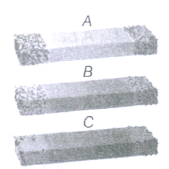
A > B> C
A < B < C
A = B = C
A < B > C
30.
A freely suspended magnet always points in the
upside down
East-West direction
North-South direction
Any direction by chance
31.
Magnets have a shape of
cylindrical
horse-shoe
ball-ended magnet
All of these
32.
North pole of a magnet can be identified by
another magnet having its poles marked as North Pole and South pole
another magnet no matter whether the poles are marked or not
using an iron bar
using iron filings
33.
A bar magnet is immersed in a heap of iron filings and pulled out. The amount of iron filings Clinging to the
North pole is almost equal to the South pole
North pole is much less than the South pole
North pole is much less than the South pole
magnet will be same all along its length
34.
How will you test that 'tea dust' is not adulterated with iron powder?
35.
What is a magnet
36.
If we gently break a bar magnet from its centre, will two poles get free?
37.
In which country was the magnet use discovered
38.
What is magnetite?
1.
There are following two ways to demagnetise a magnet
(i) by heating
(ii) by hammering
2.
It is a suggested way shown in figure below
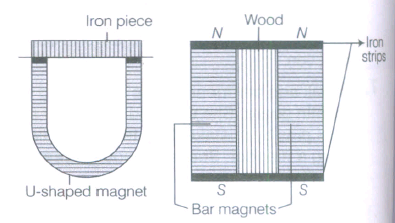
U-shaped magnet is kept along with an iron piece while bar magnets are kept along with iron strips and magnets separated by wood along their length.
3.
We can convert an iron strip into a bar magnet by the following method
(i) Take an iron strip
(ii) Place it on the table.
(iii) Now, take a bar magnet and place one of its poles near one edge of the bar of iron.
(iv) Without lifting the bar magnet, move it along the length of iron strip,tiII we reach the other end.
(v) Now, lift the magnet and bring the pole (the same pole we started with) to the same point of the iron strip from which we began.
(vi) Now, move the magnet again along the iron bar in the same direction as we did before.
(vii) Repeat this process about 30-40 times.
(viii) Bring a pin or some iron fillings near the iron strip to check whether it has become a magnet. If not, continue the process for some more time.
4.
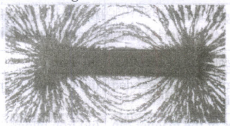
The poles of a bar magnet are located at the two ends of a bar magnet as shown below:
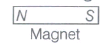
These two poles are North pole (N) and South pole (S).
5.
On breaking a magnet into five pieces, each piece will behave as a magnet because each piece of magnet consists of both north poles and south poles. So, five north poles will be present in the broken pieces.
6.
Avery strong magnetic field is created by electrified coils in the guideway wails, which propels the trains.
7.
Yes, Riya can help her mother to find the needle by using a magnet. Since needle is made of iron so it will easily stick to the magnet.
8.
(i) Attractive property: A magnet has the property to attract some substance like iron, cobalt and nickel when brought near it. This property of magnet is called the attractive property.
(ii) Directive property: If we suspend a magnet freely with a thread, then it always aligns itself in the geographic north-south direction when it comes to rest. This is called the directive property of a magnet.
9.
The two magnetic materials are :
(i) Iron (ii) Cobalt.
The two non-magnetic materials are :
(i) Leather (ii) Plastic
10.
Yes, the needle always points in the same direction when the cork stops rotating.
11.
With the help of a bar magnet, we can find the needle.
12.
When South pole of a magnet comes in contact with South pole of the other magnet, then it repels each other because like poles always repel each other.
13.
If the two unlike poles of a magnet is put together, then a force of attraction develops between them.
14.
She could not succeed because the stainless steel pins are not made of iron, so they are not attracted towards magnet.
15.
The poles of the bar magnet are located at its two end points. Place a magnet on paper and sprinkle some iron filings on it. It is observed that the iron filings get attracted more strongly towards the two ends of the magnet as compared to its central portion indicating that the poles are located at these two ends of the magnet
16.
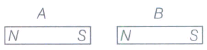
Yes, two pieces will work as an individual magnet because a monopole (single pole) of magnet never exists
17.
The two ways to identify the magnet are
(i) Hang the metal bars with a thread and having its level horizontal one by one and let it stop in any direction. Now, if we move it by"pushing it slowly and it returns to the same direction, it means that it is a magnet otherwise it is an iron bar simply.
(ii) Take some iron filings and move the iron bars over these iron filings one by one. If iron filings are attracted very strongly at poles, then it is a magnet and if it is not attracted, then it is simply an iron bar.
18.
Steps involved in the magnetising of an iron strip are
(i) Take an iron strip which is to be magnetised.
(ii) Keep it in a wooden table.
(iii) Hold one end of bar magnet in your hand and keep the other end of bar magnet at one end of iron bar.
(iv) Without lifting, move the lower end of bar magnet to the end of iron bar.
(v) After reaching end of iron bar, lift the bar magnet and bring it to the same position and repeat the process again and again.
19.
()
magnetic
20.
()
Magnetic compass
21.
()
attracting
22.
()
strong
23.
()
North and South
24.
(d)
All of these
25.
(b)
repel
26.
27.
(c)
Two'poles
28.
(b)
Repulsion
29.
(a)
A > B> C
30.
(c)
North-South direction
31.
(d)
All of these
32.
(a)
another magnet having its poles marked as North Pole and South pole
33.
(a)
North pole is almost equal to the South pole
34.
()
It will be tested by using a magnet. If 'tea dust' is adulterated with iron powder, it will stick onto the magnet
35.
()
A material which shows an attraction for magnetic materials such as iron, cobalt and nickel is called a magnet. When it is suspended freely, it points in the geographical north-south direction
36.
()
No, the two pieces will act as individual magnets.
37.
()
Magnet use was first discovered in Greece.
38.
()
Magnetite is one of the natural ores of iron and also known as natural magnet.

6th Standard CBSE Syllabus & Materials
6th Standard CBSE
CBSE 6th Social Science Locating Places on the Earth - New Sample Question Papers Study Material - QB365 Set A
NEW6th Standard CBSE
CBSE 6th Science A Journey Through States of Water - New Sample Question Papers Study Material - QB365 Set A
NEW6th Standard CBSE
CBSE 6th Science Temperature and its Measurement - New Sample Question Papers Study Material - QB365 Set A
NEW6th Standard CBSE
CBSE 6th Science Materials Around Us - New Sample Question Papers Study Material - QB365 Set A



CBSE 6th Standard CBSE Subjects
CBSE Standards




