
 100% FREE ACCESS
6th Standard CBSE Syllabus & Materials
6th Standard CBSE
CBSE 6th Social Science The Value of Work - New Sample Question Papers Study Material - QB365 Set A
NEW6th Standard CBSE
CBSE 6th Social Science Family and Community - New Sample Question Papers Study Material - QB365 Set A
NEW6th Standard CBSE
CBSE 6th Social Science India's Cultural Roots - New Sample Question Papers Study Material - QB365 Set A
NEW6th Standard CBSE
CBSE 6th Social Science India,That is Bharat - New Sample Question Papers Study Material - QB365 Set A
NEW6th Standard CBSE
CBSE 6th Social Science Timeline and sources of history - New Sample Question Papers Study Material - QB365 Set A
NEW6th Standard CBSE
CBSE 6th Social Science Oceans and Continents - New Sample Question Papers Study Material - QB365 Set A

Published on: 19/01/2019
Integers Complete Study Material
Download CBSE Class 6th Standard CBSE Mathematics question papers, sample papers, important questions, and previous year solved papers in PDF format. Get free study materials, NCERT solutions, and exam preparation resources for Class 6th Standard CBSE Mathematics
Questions + Answers key
Take MCQ Mathematics Test
1.
Find the solution of (-10) + (+ 8) without using number line.
2.
Find the solution of( + 6) + (- 10) without using number line.
3.
Represent the following numbers on a number line:
-1
4.
Write five integers, which are less than -120, but greater than -160.
5.
Find the answers of the following additions.
(+10) + (+4)
6.
Depict the following numbers on the number line.
5
7.
Draw a number line and answer the following:
If we are at -8 on the number line, in which direction should we move to reach -13 ?
8.
In each of the following pairs, which number is to the right of the other on the number line?
-3,-8
9.
Following is the list of temperatures of five places in India on a particular day at the year:
| Place | Temperature | |
|---|---|---|
| Siachin | 10°C below 0°C | ...... |
| Shimla | 2°C below 0°C | ...... |
| Ahmedabad | 30°C above 0°C | ...... |
| Delhi | 20°C above 0°C | ...... |
| Srinagar | 5°C below 0°C | ...... |
Which is the coolest place?
10.
Represent the following numbers as integers with appropriate signs. A submarine is moving at a depth, eight hundreds metre below the sea level.
11.
Represent the following numbers as integers with appropriate signs. An aeroplane is flying at a height of two thousands metre above the ground.
12.
Write the opposite of each of the following:
50 km towards South.
13.
Compare the following pairs of numbers using > or <.
\(-1\ \Box\ -12\)
14.
Write all the integers between -15 and -5.
15.
Following is the account of a shopkeeper which shows profit and loss from the sale of certain items. Using proper sign in the above account, fill up the blanks.
| Name of items | Profit | Loss | Representation with proper sign |
| Mustard oil Rice Black pepper Wheat Groundnut oil |
Rs.150 Rs.225 Rs.200 |
|
________ ________ ________ ________ ________ |
16.
Write the following integers in ascending order -15, 5, 0, -2, -5, 3, 2, -17
17.
Represent the following using integers with proper sign:
A loss of Rs 400
18.
Write the following numbers (integers) in increasing order with inequality '<'.
-100,100, -3, 0, 5,-1
19.
By using '+' or '-' sign indicate the following
Decreasing a weight of 15 kg.
20.
Suppose David and Mohan have started walking from zero position in opposite directions. Let the steps to the right of zero be represented by '+' sign and to the left of zero be represented by '-' sign. If Mohan moves 5 steps to the right of zero, it can be represented as +5 and if David moves 5 steps to the left of zero, it can be represented as -5. Now, represent the following positions with + sign or - sign.
(a) 8 steps to the left of zero
(b) 7 steps to the right of zero
(c) 11 steps to the right of zero
(d) 6 steps to the left of zero
21.
Draw a figure on the ground in the form of a horizontal number line as shown below. Frame questions as given in the above example and ask your friends.

Few questions framed are as follows:
1. Go 4 steps to the right of o.
2. Go 5 steps to the left of o.
3. Go 6 steps to the right of 0 and then go 4 steps further from there to the left.
4. Go 5 steps to the left of 0 and then go 1 step further from there to the left.
5. Go 8 steps to the right of 0 and then go 6 steps further from there to the left.
6. Go 4 steps to the left of 0 and then go 3 steps further from there to the right.
22.
There is a visit in a school by Director of Education. Girls are asked to prepare rangoli in triangular shape. Dimensions of ΔABC are 26 cm, 28 cm, 25 cm. Garland is to be placed along the side of ΔPQR, which is formed by joining mid-points of sides of ΔABC. The dimensions of tlPQRare 12.5 cm, 14 cm and 13 cm.
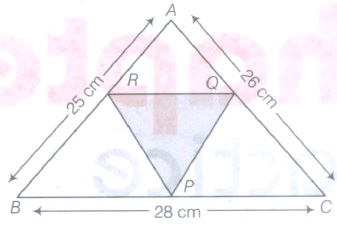
(a) Find the value of PO + OR + PR
(b) What values are depicted here by Girls?
23.
Temperature of a place at 7 : 00 am was 6°C. Temperature increased by 4°C in first hour and decreased by 1°C in the second hour. What was the temperature at 9 : 00 am?
24.
If we denote the height of a place above sea level by a positive integer and depth below the sea level by a negative integer, write the following using integers with the appropriate signs:
(a) 200 m above sea level
(b) 100 m below sea level
(c) 10 m above sea level
(d) sea level
25.
Compare the following pairs of numbers using > or <.
(i) \(0\ \Box -8\)
(ii) \(-1\ \Box\ -15\)
(iii) \(5\ \Box\ -5\)
(iv) \(11\ \Box\ 15\)
(v) \(0\ \Box\ 6\)
(vi) \(-20\ \Box\ 2\)
From the above exercise, Rohini arrived at the following conclusions:
(a) Every positive integer is larger than every negative integer.
(b) Zero is less than every positive integer.
(c) Zero is larger than every negative integer.
(d) Zero is neither a negative integer nor a positive integer.
(e) Farther a number from zero on the right, larger is its value.
(f) Farther a number from zero on the left, smaller is its value. Do you agree with her? Give examples.
26.
Mark -3, 7, -4, -8, -1 and 3 on the number line.
27.
The difference between an integer and its additive inverse is always even.
28.
The sum of all the integers between -4 and -1 is -5.
29.
The sum of any two negative integers is always greater than both the integers.
30.
In number system, there is smallest Integer but there is no largest integer
31.
-100 is to the right of -50 on a number line.
32.
The number of integers lying between -5 and 5 is ________
33.
On the number line, 10 is to the ________ of zero
34.
_______ + (-11) + 100 = 200
35.
________ -15=-10
36.
(-21)- (-10)____(-31)+ (-11)
37.
?-4=-2
1
2
3
4
38.
(-1)+(+1)=?
-1
+1
0
none of these.
39.
Which of the following statements is true?
Greatest negative integer is - 1.
- 10 is to the right of - 8 on a number line.
- 50 is to the left of - 100 on a number line.
- 11 is larger than - 10.
40.
Which of the following statements is true?
Every positive integer is larger than every negative integer.
Zero is greater than every positive integer.
Zero is smaller than every negative integer.
Farther a number from zero to the right, smaller is its value.
41.
The preceding number of the number 1 is
1
-1
2
0
42.
The succeeding number of the number 0 is
-1
0
1
11
43.
Which of the following shows the maximum rise in temperature?
0°C to 10°C
-4°C to 8°C
-15°C to -8°C
-70C to 0°C
44.
Amulya and Amar visited two places A and B, respectively in Kashmir and recorded the minimum temperatures on a particular day as - 4° C at A and -1° Cat B. Which of the following statements is true?
A is cooler than B
B is cooler than A
There is a difference of 2° C in the temperature
The temperature at A is 4°C higher than that at B
45.
Number of integers lying between -2 and 2 is
3
4
2
1
46.
Every integer less than 0 has the sign
+
-
\(\times\)
÷
1.
(-10) + (+ 8)
=(-2)+(-8)+(+8)
=(-2)+0=-2
2.
(+ 6) + (-10)
= (+ 6) + (- 6) + (- 4)
=0+(-4)=-4
3.

4.
-159,-158,-157,-156,-155
5.
(+10) + (+4) = + (10+ 4) = + 14
6.

7.

Here, -8 > -13. So, -13 is on the left of -8. Hence, if we are at -8 on number line, then move to the left from -8 to reach at -13.
8.

Here, -3 and -8 both are on the left of zero, but -3 is near to the zero in comparison of -8. So, -3 is to the right of -8.
9.
After checking the temperature of all places, we can say that the Siachin (-10°) is the coolest place.
10.
A submarine is moving at a depth eight hundreds metre below the sea level can be written as - 800 m, because depth below the sea level is taken as negative.
11.
An aeroplane is flying at a height of two thousands metre above the ground can be written as + 2000 m, because height above the ground is taken as positive.
12.
The opposite of each, is 50 km towards North.
13.
According to the ordering of the integers,
We know that, -1 is to the right of -12 on the number line. So, \(-1 \boxed {>} -12\)
14.
Integers between -15 and -5 are -14, -13:-12, -11, -10, - 9, - 8, - 7, - 6.
15.
| Name of items | Profit | Loss | Representation with proper sign |
| Mustard oil Rice Black pepper Wheat Groundnut oil |
Rs.150 Rs.225 Rs.200 |
|
+Rs.150 -Rs.250 +Rs.225 +Rs.200 -Rs.330 |
16.
-17,-15,-5,-2,0,2,3,5
17.
Given, statements can be represented using integer -Rs 400
18.
-100 < -3 < -1 < 0 < 5 < 100
19.
-15kg
20.
We know that, on the number line, all numbers to the right of a are positive integers and all numbers to the left of a are negative integers.
Thus, representation of numbers on the number line is as follows:

(a) 8 steps to the left of zero is represented by - 8.
(b) 7 steps to the right of zero is represented by + 7.
(c) 11 steps to the right of zero is represented by + 11.
(d) 6 steps to the left of zero is represented by - 6.
21.
1. +4
2. -5
3. (+ 6) + (- 4) = + 2
4. (-5)+(-1)=-6
5. (+8)+(-6)=+2
6. (-4)+(+3)=-1
22.
(a) Given, PO = 12.5 cm, OR = 14 cm and PR = 13 cm
Now, PO + OR + PE = (12.5 + 14 + 13) = 39.5 cm
(b) Beauty, happiness, cooperation.
23.
Temperature at 7 : 00 am = + 6° C
It is given that, temperature increased by 4°C in first hour.
So, temperature at 8 : 00 am = +6°C + 4°C = 10°C
Temperature decreased in second hour by 1°C.
So, the temperature at 9 : 00 am = 10°C - 1°C = 9°C
24.
(a) 200 m above sea level = + 200 m
(b) 100 m below sea level = -100 m
(c) 10 m above sea level = +10 m
(d) Sea level = 0
25.
(i) We have, \(0\ \Box -8\)
Since, 0 is to the right of - 8. ∴ 0 > -8
(ii) We have, \(-1\ \Box\ -15\)
Since, - 1 is to the right of - 15. ∴ -1 > -15
(iii) We have, \(5\ \Box\ -5\)
Since, 5 is to the right of - 5. ∴ 5> -5
(iv)We have, \(11\ \Box\ 15\)
Since, 11 is to the left of 15. ∴ 11 < 15
(v) We have, \(0\ \Box\ 6\)
Since, 0 is to the left of 6. \(\therefore\) 0 < 6
(vi) We have, \(-20\ \Box\ 2\)
Since, - 20 is to the left of 2. \(\therefore\) -20 < 2
Yes, I agree with Rohini. Some examples are as follow:
(a) Every positive integer is larger than every negative integer. e. g. 5 > - 2.
(b) Zero is less than every positive integer. e. g. 0 < 3.
(c) Zero is larger than every negative integer. e. g. 0 > - 4.
(d) Zero is neither a negative integer nor a positive integer, because 0 has neither '+' sign nor '-' sign.
(e) Farther a number from zero, on the right side, larger is its value, because on number line, every integer on the right from zero is greater than zero. e. g. 5 > 0.
(f) Farther a number from zero, on the left side, smaller is its value because on number line, every integer on the left from zero is smaller than zero. e. g. - 8
26.
Draw a line and mark some points at equal distance on it as shown in the figure given below. Mark a point on it as zero. Points to the right of zero are positive integers and marked by +1, + 2, +3 erc., or simply 1, 2, 3 etc and points to the left of zero are negative integers and marked by -1, - 2, - 3 etc. Now, - 3 is a negative integer (since, - 3 has negative sign). So, move 3 points to the left of zero and represent it by point C. 7 is a positive integer (since + 7 has positive sign). So, move 7 points to the right of zero and represent it by point F. To mark - 4 on this line, move 4 points to the left of zero and represent it by point B. To mark - 8, on this line, move 8 points to the left of zero and represent it by point A. To mark - 1 on this line, move 1 point to the left of zero and represent it by point D. To mark 3 on this line, move 3 points to the right of zero and represent it by point E. Thus, we get the following representation of these integers on the number line:

27.
(a)
28.
(a)
29.
(b)
30.
(b)
31.
(b)
32.
The integers lying between -5 and 5 are -4, - 3, - 2, - 1, 0, 1, 2, 3 and 4.
So, total number of integers lying between -5 and 5 is 9.
33.
On the number line, 10 is to the right of the zero.

34.
x + (-11) + 100 = 200
\(\Rightarrow\) x + 89 = 200
\(\Rightarrow\) x = 200 - 89
= 111
35.
We have, ______ 15 = -10
\(\Rightarrow\) ______ - (10 + 5) = -10
\(\Rightarrow\) ______ - 10 - 5 = -10
To het RHS = -10, we need to add additive inverse of -5 i.e. 5 is RHS.
So, +5 - 10 - 5 = -10
Hence, +5 -15 = -10
36.
LHS = (-21) - (-10) = -21 + (Additive inverse of -10)
= -21 + 10 = -11
RHS = (-31) + (-11) = -42
Here, both are negative inegers, but -42 is to the left of -11
\(\therefore\) -11 > -42
37.
(b)
2
38.
(c)
0
39.
(a)
Greatest negative integer is - 1.
40.
(a)
Every positive integer is larger than every negative integer.
41.
(d)
0
42.
(c)
1
43.
0°C to 10°C = +10° C -4° C to 8° C = +12°C (max.)
-15°C to -8°C = +7°C -7°C to 0°C = +7°C
44.
Temperature at A = -4° C
Temperature at B = -1° C
We know that, -4 < -1 So, A is cooler than B.
45.
The integers lying between -2 and 2 are -1, 0 and 1. So, there are 3 integers.
46.
We know that, all the negative integers are less than zero and they have '-' sign.

6th Standard CBSE Syllabus & Materials
6th Standard CBSE
CBSE 6th Social Science Locating Places on the Earth - New Sample Question Papers Study Material - QB365 Set A
NEW6th Standard CBSE
CBSE 6th Science A Journey Through States of Water - New Sample Question Papers Study Material - QB365 Set A
NEW6th Standard CBSE
CBSE 6th Science Temperature and its Measurement - New Sample Question Papers Study Material - QB365 Set A
NEW6th Standard CBSE
CBSE 6th Science Materials Around Us - New Sample Question Papers Study Material - QB365 Set A



CBSE 6th Standard CBSE Subjects
CBSE Standards




