
 100% FREE ACCESS
6th Standard CBSE Syllabus & Materials
6th Standard CBSE
CBSE 6th Social Science The Value of Work - New Sample Question Papers Study Material - QB365 Set A
NEW6th Standard CBSE
CBSE 6th Social Science Family and Community - New Sample Question Papers Study Material - QB365 Set A
NEW6th Standard CBSE
CBSE 6th Social Science India's Cultural Roots - New Sample Question Papers Study Material - QB365 Set A
NEW6th Standard CBSE
CBSE 6th Social Science India,That is Bharat - New Sample Question Papers Study Material - QB365 Set A
NEW6th Standard CBSE
CBSE 6th Social Science Timeline and sources of history - New Sample Question Papers Study Material - QB365 Set A
NEW6th Standard CBSE
CBSE 6th Social Science Oceans and Continents - New Sample Question Papers Study Material - QB365 Set A

Published on: 18/01/2019
Class 6 Mensuration Study Material
Download CBSE Class 6th Standard CBSE Mathematics question papers, sample papers, important questions, and previous year solved papers in PDF format. Get free study materials, NCERT solutions, and exam preparation resources for Class 6th Standard CBSE Mathematics
Questions + Answers key
Take MCQ Mathematics Test
1.
A carpet measures 30.75 cm by 80 cm. Find its cost at the rate of Rs. 15 per square metre.
2.
A rectangular field is 60 m long and 40 m wide Find the cost of fencing at the rate of Rs. 10 per metre.
3.
A room is 9.5 m long and 7.4 m wide. A person wants that the floor of the room to be fitted with tiles of size 20 cm by 10 cm. Find the number of tiles needed.
4.
From the following figure, find its
(i) Perimeter (ii) Area of square
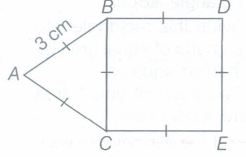
Given, ABC is an equilateral triangle of side 3cm each and BCED is a square
5.
A room is 6 m long and 4 m wide. How many square metres of carpet is needed to cover the floor of the room?
6.
What is the cost of tiling a rectangular plot of land 500 m long and 200 m wide at the rate of Rs.8 per hundred sq m?
7.
What is the perimeter of the following figures? What do you infer from the answers?
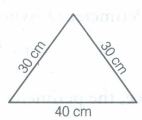
8.
What is the perimeter of the following figures? What do you infer from the answers?
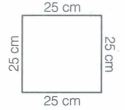
9.
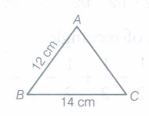
Two sides of a triangle are 12 cm and 14 cm. The perimeter of the triangle is 36 cm. What is its third side?
10.
A piece of string is 30 cm long. What will be the length of each side, if the string is used to form a square?
11.
What is the length of the wooden strip required to frame a photograph of length and breadth 32 cm and 21 cm, respectively?
12.
Find the perimeter of the following figures.
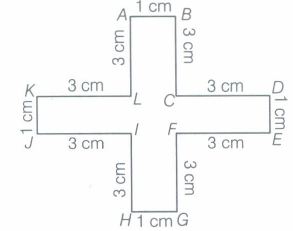
Perimeter = AB+ BC +CD + DE + EF + FG +GH +HI + IJ + JK + KL + LA
=__+__+__+__+__+__+__+__+__+__+__+__=__
13.
Find the perimeter of the following figures.
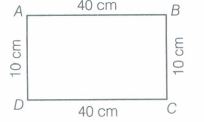
Perimeter = AB + BC + CD + DA
=__+__+__+__=__
14.
Meera went to a park 150 m long and 80 m wide. She took one complete round on its boundary. What is the distance covered by her?
15.
The perimeter of a regular hexagon is 30 cm. How long is its one side?
16.
Find the perimeter of a rectangle whose area is 3400 cm2 and breadth is 17 cm.
17.
Calculate the area of a square whose side is 13 cm long.
18.
Length of a rectangle is three times its breadth. Perimeter of the rectangle is 40 cm. Find its length and width.
19.
Perimeter of an isosceles triangle is 50 cm. If one of the two equal sides is 18 cm, find the third side.
20.
What will happen to the area of a rectangle, if its length and width are doubled
21.
Find the areas of the squares whose sides are 10cm
22.
The area of a rectangular piece of cardboard is 48 cm 2 and its breadth is 6 cm. What is the length of the cardboard?
23.
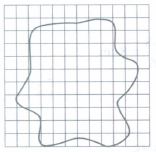
Find the area of the given figure
24.
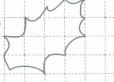
Find the areas of the following figures by counting square.
25.
Find the areas of the following figures by counting square.

26.
A piece of wire is 12 cm long. What will be the length of each side, if the wire is used to form a regular hexagon?
27.
Find the perimeter of a rectangle, whose length is 40 cm and width is 30 cm.
28.
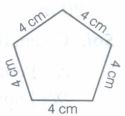
Find the perimeter of the following figures
29.
Find the perimeter of the following figures
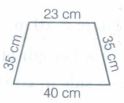
30.
Find the distance travelled by Soniya, if she takes three rounds of a squared park of side 60 m.
31.
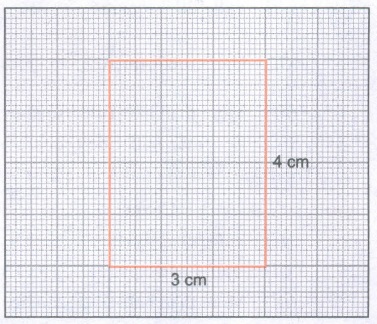
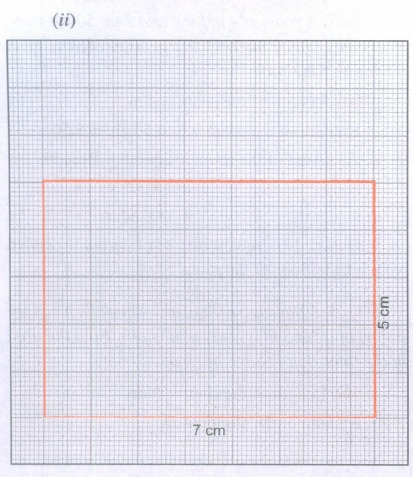
The measures of the sides of some of the rectangles are given. Find their areas by placing them on a graph paper and counting the number of squares.
| Length | Breadth | Area |
| 3 cm | 4 cm | ___ |
| 7 cm | 5 cm | ___ |
| 5 cm | 3 cm | ___ |
32.
A rectangular park is 100 m long and 50 m wide How many rounds are needed to cover the distance of 1.2 km?
33.
The sum of the length of a side and perimeter of a square is 20. Find the area of a square
34.
In figure each square is of unit length
(a) What is the perimeter of the rectangle ABCD?
(b) What is the area of the rectangle ABCD?
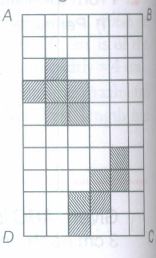
(c) Divide this rectangle into ten parts of equal area by shading squares. (Two parts of equal area are shown here)
(d) Find the perimeter of each part which you have divided. Are they all equal?
35.
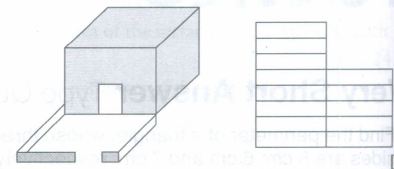
There is a rectangular lawn 10 m long and 4 m wide in front of Meena's house. It is fenced along the two smaller sides and one longer side leaving a gap of 1 m for the entrance. Find the length of fencing.
36.
If length of a rectangle is halved and breadth is doubled, then the area of the rectangle obtained remains same. Is it true?
37.
The lawn in front of Molly's house is 12 m\(\times\) 8m, whereas the lawn in front of Dolly's house is 15 m \(\times\) 5 m. A bamboo fencing is built around both the lawns. How much fencing is required for both?
38.
On a centimetre squared paper, make as many rectangles as you can, such that the area of the rectangle is 16 sq cm (consider only natural number lengths).
(a) Which rectangle has the greatest perimeter?
(b) Which rectangle has the least perimeter?
If you take a rectangle of area 24 sq cm, what will be your answers? Given any area, is it possible to predict the shape of the rectangle with the greatest perimeter? With the least perimeter? Give example and reason.
39.
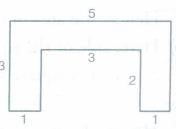
By splitting the following figures into rectangles, find their areas (the measures are given in centimetres).
40.
The length and breadth of three rectangles are as given below.
(a)9 m and 6 m (b) 17 m and 3 m (c)4 m and 14 m
Which one has the largest area and which one has the smallest?
41.
The perimeter of a rectangular piece of cardboard is 6 m. Its breadth is 1m. Find its length.
1 m
2 m
3 m
6 m
42.
Two sides of a triangle are 5 cm and 4 cm. The perimeter of the triangle is 12 cm. The third side has length
1 cm
2 cm
3 cm
6 cm
43.
The perimeter of an equilateral triangle is 9 m. Find the length of the side.
1 m
2 m
3 m
9 m
44.
Find the perimeter of a rectangle whose length and breadth are 9 em and 1 em respectively.
10 cm
20 cm
30 cm
40 cm
45.
A page is 25 em long and 20 em wide. Find the perimeter of this page.
90cm
45 cm
500 cm
5 cm
46.
Apala went to a park 20 m long and 10 m wide. She took one complete round of it. The distance covered by her is
30 m
60 m
20 m
10 m
47.
Perimeter of a square=
4 x Length of a side
2 x Length of a side
3 x Length of a side
6 x Length of a side
48.
Length and breadth of a rectangular sheet of paper are 20 cm and 10 cm, respectively. A rectangular piece is cut from the sheet as shown in figure. Which of the following statements is correct for the remaining sheet?

Perimeter remains same but area changes
Area remains same, but perimeter Changes
Both area and perimeter are changing
Both area and perimeter remain the same
49.
The perimeter of a rectangle, whose sides are 1m 30 cm and 70 cm, is
20 m
4 m
0.2 m
2 m 30 cm
50.
A square shaped park ABCD of side 100 m has two equal rectangular flower beds each of size 10m \(\times\) 5 m (see the figure). Length of the boundary of the remaining park is
360m
400 m
340 m
460 m
1.
Rs.369
2.
Rs.2000
3.
Area of room = 1.4 \(\times\) 9.5 m2 = 1.4\(\times\) 9.5\(\times\) 10000 cm2
Area of one tile = 20\(\times\) 10= 200 cm2
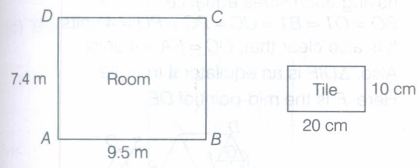
Number of tiles\(=\frac { Area\quad of\quad the\quad room }{ Area\quad of\quad tile } =\frac { 74\times 95\times 100 }{ 200 } \)
\(=\frac { 74\times 95 }{ 2 } =95\times 37=3515\)
4.
(i) Perimeter = AB + AC + BC + BD + DE + CE
= 3+ 3+ 3+ 3+ 3+ 3= 18 cm
(ii) Area of square BCED = Side2 = 32 = 9 sq cm
5.
24 sq m
6.
Given, length of a rectangular plot = 500 m
and breadth of a rectangular plot = 200 m
∴ Area of the rectangular plot = Length \(\times\) Breadth
= 500 m\(\times\) 200 m
= 100000 sq m
∴ Cost of tiling per hundred square metres = Rs. 8
∴ Cost of 1 sq m = Rs.\(\frac { 8 }{ 100 } \)
Now, cost of 100000 sq metre =Rs.100000\(\times\frac { 8 }{ 100 } \)
=Rs. 8000
Hence, the cost of tiling rectangular plot is Rs. 8000
7.
Given, the figure is an isosceles triangle, whose sides are 30 cm, 30 cm and 40 cm, respectively.
∴ Perimeter of triangle = Sum of all sides of a triangle
= (30 + 30 + 40) cm = 100 cm
Here, we observe that the perimeter of each figure is
100 cm i.e. they have equal perimeters.
8.
Given, the figure is a square, whose side is 25 cm.
∴ Perimeter of square = 4 \(\times\) Length of a side
= 4 \(\times\) 25 cm = 100 cm
9.
Let ABC be the given triangle and its sides AB = 12 cm and BC=14cm.
Also, perimeter of triangle = 36 cm
We know that,
Perimeter of a triangle = Sum of all its sides
⇒ AB + BC + CA = 36cm
⇒ 12 cm + 14 cm + CA = 36 cm
⇒ (12+14)cm+CA=36cm
⇒ 26 cm+ CA = 36 cm
∴ CA = (36 - 26) cm = 10 cm
Hence, the third side of the triangle is 10 cm.
10.
Here, length of string will be the perimeter of square.
∴ Perimeter of square = 30 cm
We know that, a square has 4 equal sides.
∴ Perimeter of a square = 4 \(\times\) Length of a side
\(Now,length\quad of\quad one\quad side=\frac { Perimeter\quad of\quad a\quad square }{ 4 } \)
\(=\frac { 30 }{ 4 } cm=7.5cm\)
Hence, length of each side of a square is 7.5 cm.
11.
Given, length of the wooden strip = 32 cm
and breadth of the wooden strip = 21 cm
Now, wooden strip required = Perimeter of the photograph
= 2 \(\times\) (Length + Breadth)
= 2 \(\times\) (32 cm + 21 cm)
=2\(\times\)53cm =106 cm
Hence, the required length of wooden strip is 106 cm.
12.
The perimeter of the given figure is 28 cm
13.
From the given figure, we have
AB = 40 cm, BC = 10cm,CD = 40cm and DA =10cm
Now, the sum of the lengths of the four sides
= AB + BC + CD + DA
= 40 cm + 10 cm + 40 cm + 10 cm
= (40 + 10 + 40 + 10) cm = 100 cm
∴ Perimeter of the given figure
= Sum of the lengths of four sides = 100 cm
Henee, the perimeter of the given figure is 100 cm.
14.
Let ABCD be a park whose lengths are BC, AD and widths are AB, CD respectively.
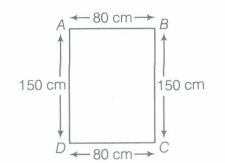
Here, AB = CD = 80 m and BC = DA = 150 m
Now, sum of the lengths of four sides
=AB+ BC + CD +DA
= 80 m + 150 m + 80 m + 150 m
= (80 + 150 + 80 + 150) m = 460 m
∴ Perimeter of the park = Sum of the lengths of four sides of the park =460m
Hence, the distanee eovered by Meera is 460 m.
15.
Given, perimeter of a regular hexagon =30 cm
A regular hexagon has 6 sides.
∴ The perimeter of regular hexagon = 6 \(\times\) Length of a side
⇒30 = 6 \(\times\) Length of a side
∴ The length of a side=\(\frac{30}{6}\)=5cm
Hence, length of each side of a regular hexagon is 5 cm.
16.
434 cm
17.
169 cm2
18.
Let width of rectangle (b)= x cm
Then, length of rectangle (I) = 3x cm
∴ Perimeter = 2 (l + b)
⇒ 40 =2 (3x + x)
⇒ 8x =40
⇒ x=\(\frac{40}{8}\)=5cm
Hence, length is 15 cm and width is 5 cm.
19.
∵ Perimeter = 50 cm [given]
Perimeter of an isosceles triangle = Sum of its all sides
⇒ Perimeter = a + b + c
⇒ 50 = 18 + 18 + Third side
⇒50 - 36 = Third side
⇒ Third side = 14 cm
20.
4 times of the original area
21.
Here, side of the square = 10 cm
∴ Area of square = Side \(\times\) Side = 10 cm \(\times\) 10 cm
= 100 sq cm
Hence, the area of the square is 100 sq cm.
22.
Given, area = 48 cm2 and breadth (b) = 6 cm
We know that, Area = Length \(\times\)Breadth\(\Rightarrow Length=\frac { Area }{ Breadth } =\frac { 48 }{ 6 } =8cm\)
Hence, length of the cardboard is 8 cm.
23.
75 cm2 (approx)
24.
Given, figure is covered by 3 full squares, 4 half squares, 3 more than half squares and 1 less than half square.
∴ Area = \(\left( 3\times 1+4\times \frac { 1 }{ 2 } +3\times 1+1\times 0 \right) sq\quad units\)
= (3 + 2 + 3 + 0) sq unit = 8 sq units
25.
Given, figure is covered by 5 full squares.
∴. Area = 5 \(\times\) 1 sq unit = 5 sq units
26.
2 cm
27.
140 cm
28.
The perimeter of the given figure is 20 cm.
29.
The perimeter of the given figure is 133 cm.
30.
Perimeter of a squared park = 4 \(\times\) Length of a side = 4 \(\times\) 60 = 240 m
Distance covered in one round = 240 m
Distance covered in three rounds = 3 \(\times\) 240 m = 720 m
31.
| Length | Breadth | Area |
| 3 cm | 4 cm | 12 cm2 |
| 7 cm | 5 cm | 35 cm2 |
| 5 cm | 3 cm | 15 cm2 |
(i)
(iii)
32.
4
33.
16 cm2
34.
Given, each side of square is of unit length. Figure contains length of 10 squares and width of 6 squares.
Now, length of rectangle, AD = (BC)
= Sum of length of a side of 10 squares
=1+1+1+1+1+1+1+1+1+1
=10\(\times\)1 =10 units
and breadth of rectangle, AB = (DC)
= Width of 6 squares = 6 \(\times\)1 = 6 units
(a) The perimeter of the rectangle ABCD
= AB+ BC+ CD+DA
= 6+10+ 6+10
= 32 units
(b) The area of the rectangle ABCD = Length \(\times\)Breadth
= AD\(\times\)AB=10\(\times\)6
= 60 units
(c) The total area of rectangle = 60 units
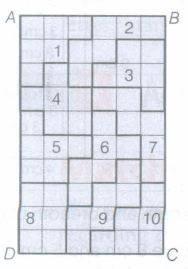
Now, we have to divide the rectangle into 10 equal parts i..e \(\frac{60}{10}=6\) square uni.t.s I.e. we have to take a group of 6-6 square blocks, which is shown in the figure
(d) Now, we find the perimeter of part l.
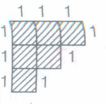
We know that perimeter of a figure is the total length of its boundary.
∴ Perimeter of part I
= 1+ 1+ 1+ 1+ 1+ 1+ 1+ 1+ 1+ 1+ 1+ 1= 12 units
Similarly, we can find the perimeters of remaining 9 parts, all the parts have same perimeter i.e. 12 units.
Yes, all the parts have same perimeter.
35.
Given width of the lawn, AB = EF = 4 m
and length of the lawn, BE = 10m
Also, given length of gap, CD = 1m
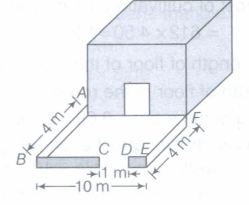
Total length of fencing = AB + (BC + DE) + EF
= AB+ (BE -CD)+ EF
= 4 m +( 10 -1) m +4 m
=(4+ 9+ 4) m =17 m
Hence, the length of fencing of the lawn is 17 m.
36.
True, let the length and breadth of a rectangle be I and b respectively.
We know that,
Area of the initial rectangle = Length \(\times\) Breadth
= I \(\times\) b sq units
If length of a rectangle is havled and breadth is doubled.
i.e. New length = \(\frac{l}{2}\)units
and new breadth = 2b units
Then, area of the new rectangle
= New length \(\times\) New breadth =\(\frac{l}{2}\times2b=lb\quad sq\quad units\)
37.
Given, size of lawn in front of Molly's house
=12m\(\times\)8m
Perimeter = 2 (12 + 8) m= 40 m ... (i)
Now, size of lawn in front of Dolly's house
=15m\(\times\)5m
Perimeter = 2 (15+ 5) m = 40 m ... (ii)
From Eqs. (i) and (ii), we get = 40+ 40= 80 m
Hence, total length of bamboo fencing is 80 m.
38.
We know that,
Area of the rectangle = Length \(\times\) Breadth
Here, the area of the rectangle is 16 sq cm.
So, for getting the area 16 sq em, there are three cases.
Case I When length of the rectangle = 16 cm
and breadth of the rectangle = 1cm
∴ Area of the rectangle = Length \(\times\) Breadth
=16 cm \(\times\) 1 cm = 16sq cm
and perimeter of the rectangle
= 2 \(\times\) (Length + Breadth)
= 2 \(\times\)(16 cm + 1 cm) = ( 2 \(\times\) 17) cm= 34 cm
Case II When length of the rectangle = 4 cm
and breadth of the rectangle = 4 cm
∴ Area of the rectangle = Length\(\times\) Breadth
= 4 cm \(\times\) 4 cm 16 sq cm
and perimeter of the rectangle
= 2 \(\times\) (Length + Breadth)
= 2 \(\times\)(4 cm +4 cm) = (2 \(\times\) 8) cm = 16 cm
Case III When length of the rectangle = 8 cm
and breadth of the rectangle = 2 cm
∴ Area of the rectangle = Length\(\times\) Breadth
=8 cm \(\times\)2 cm =16sq cm
and perimeter of the rectangle
= 2 \(\times\) (Length + Breadth) = 2 \(\times\) (8 cm + 2 cm)
= (2\(\times\)10) cm = 20 cm
(a) The rectangle which made in Case I has the greatest perimeter.
(b) The rectangle which made in Case II has the least perimeter.
Now, given that the area of the rectangle is 24 sq cm.
Again, for getting the area 24 sq cm, there are three cases:
Case I When length of the rectangle = 24 cm
and breadth of the rectangle = 1 cm
∴ Area of the rectangle = Length \(\times\) Breadth
= 24 cm\(\times\) 1 cm = 24 sq cm
and perimeter of the rectangle
= 2 \(\times\) (Length + Breadth)
= 2 \(\times\) (24 cm + 1 cm) = (2 \(\times\) 25)cm = 50 cm
Case II When length of the rectangle = 12 cm
and breadth of the rectangle = 2 cm
∴Area of the rectangle = Length \(\times\)Breadth
= 12 cm \(\times\) 2 cm = 24 sqcm
and perimeter of the rectangle
= 2 \(\times\) (Length + Breadth)
= 2 \(\times\) (12 cm +2 cm)
= (2 \(\times\)14) cm = 28 cm
Case III When length of the rectangle = 6 cm
and breadth of the rectangle = 4 cm
∴ Area of the rectangle = Length \(\times\) Breadth
= 6 cm \(\times\) 4 cm = 24 sqcm
and perimeter of the rectangle
= 2 \(\times\) (Length + Breadth)
= 2 \(\times\) (6 cm +4 cm)
= 2 \(\times\) 10 cm = 20 cm
(a) The rectangle which made in Case I has the greatest perimeter.
(b) The rectangle which made in Case III has the least perimeter.
Yes, it is possible to predict the shape of the rectangle with greatest perimeter and with least perimeter.
e.g. A rectangle having area 16 sq ern and greatest perimeter 34 cm is of the shape 16 cm \(\times\) 1 cm
(i.e. length = 16 cm and breadth = 1 cm), also a rectangle
having area 24 sq cm and least perimeter 20 cm is of the shape 6 cm \(\times\) 4 cm (i.e. length = 6 cm and breadth = 4 cm).
The rectangle with the greatest length has the maximum perimeter and the rectangle with the smallest length has the least perimeter.
39.
Let the given figure is divided into rectangles A, Band C and their length and breadth are written on the figure.
For rectangle A,
Length = 2 cm and breadth = 1 cm
∴ Area of the rectangle A = Length \(\times\) Breadth
=2 \(\times\) 1=2 sq cm
For rectangle B,
Length = 5 ern and breadth = 1 cm
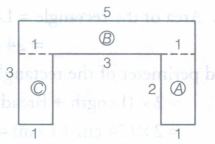
∴ Area of the rectangle B
= Length \(\times\) Breadth = 5 \(\times\)1 = 5 sq cm
For rectangle C,
Length = 2 cm and breadth = 1cm
∴ Area of the rectangle C = Length \(\times\) Breadth
=2 \(\times\) 1=2 sqcm
Now, total area of the given figure = Area of rectangle A + Area of rectangle B + Area of rectangle C
= (2 + 5 + 2) sq cm = 9 sq cm
Hence, the area of the given figure is 9 sq cm
40.
(a) Here, length of the rectangle = 9 m
and breadth of the rectangle = 6 m
∴ Area of the rectangle = Length \(\times\) Breadth = 54 sq m
Hence, the area of the rectangle is 54 sq m.
(b) Here, length of the rectangle = 17 m
and breadth of the rectangle = 3 m
∴ Area of the rectangle = Length \(\times\) Breadth
= 17m \(\times\) 3m = 51 sq m
Hence, the area of the rectangle is 51 sq m.
(c) Here, length of the rectangle = 14 m
and breadth of the rectangle = 4 m
∴ Area of the rectangle = Length \(\times\) Breadth
= 14 m \(\times\) 4 m = 56 sq m
Hence, the area of the rectangle is 56 sq m.
Now, we have 56> 54> 51
Hence, the rectangle having sides 4 m and 14 m has the largest area and the rectangle having sides 17m and 3 m has the smallest area.
41.
Length = \(\frac{6}{2}\) - 1 = 2 m
42.
Third side = 12 - (5 + 4) = 3 cm
43.
Length of side = \(\frac{9}{3}\)=3 m
44.
Perimeter = 2(9 + 1) = 20 cm
45.
Perimeter = 2(25 + 20) = 90 cm
46.
Distance covered = 2(20 + 10) = 60 m
47.
(a)
4 x Length of a side
48.
(a)
Perimeter remains same but area changes
49.
(b)
4 m
50.
(b)
400 m

6th Standard CBSE Syllabus & Materials
6th Standard CBSE
CBSE 6th Social Science Locating Places on the Earth - New Sample Question Papers Study Material - QB365 Set A
NEW6th Standard CBSE
CBSE 6th Science A Journey Through States of Water - New Sample Question Papers Study Material - QB365 Set A
NEW6th Standard CBSE
CBSE 6th Science Temperature and its Measurement - New Sample Question Papers Study Material - QB365 Set A
NEW6th Standard CBSE
CBSE 6th Science Materials Around Us - New Sample Question Papers Study Material - QB365 Set A



CBSE 6th Standard CBSE Subjects
CBSE Standards




