
 100% FREE ACCESS
6th Standard CBSE Syllabus & Materials
6th Standard CBSE
CBSE 6th Social Science The Value of Work - New Sample Question Papers Study Material - QB365 Set A
NEW6th Standard CBSE
CBSE 6th Social Science Family and Community - New Sample Question Papers Study Material - QB365 Set A
NEW6th Standard CBSE
CBSE 6th Social Science India's Cultural Roots - New Sample Question Papers Study Material - QB365 Set A
NEW6th Standard CBSE
CBSE 6th Social Science India,That is Bharat - New Sample Question Papers Study Material - QB365 Set A
NEW6th Standard CBSE
CBSE 6th Social Science Timeline and sources of history - New Sample Question Papers Study Material - QB365 Set A
NEW6th Standard CBSE
CBSE 6th Social Science Oceans and Continents - New Sample Question Papers Study Material - QB365 Set A

Published on: 06/03/2020
6th Standard CBSE Science Annual Exam Model Question 2020
Download CBSE Class 6th Standard CBSE Science question papers, sample papers, important questions, and previous year solved papers in PDF format. Get free study materials, NCERT solutions, and exam preparation resources for Class 6th Standard CBSE Science
Questions + Answers key
Take MCQ Science Test
1.
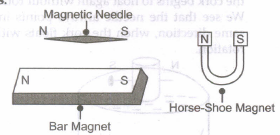
Draw three types of magnets. Label their poles.
2.
Which among the following materials would be identify as soft materials and why?
Ice, rubber band, leaf, eraser, pencil, pearl, a piece of wooden board, cooked rice, pulses and fresh chapati
3.
In ancient times stitching was not known. People used to simply drape the fabrics around different parts of their body. Even today a number of unstitched fabrics are used by both men and women. Can you give four such examples of clothes?
4.
Define vermicomposting.
5.
What is an adaptation?
6.
Which liquid is called universal solvent and why?
7.
Do all the leaves have petioles?
8.
Comparing an earthworm and a snail, explain which of the two moves faster?
9.
The moment you switch on the torch, which part of the bulb glows?
10.
Oxygen and nitrogen form 99% of the air. Other 1% is constitute by which components?
11.
Do the shadows look different in colour when the colours of the objects are different?
12.
During rolling of a ball, which type of motion is performed?
13.
When the ice melts? Is it reversible?
14.
Winnowing is based on which property?
15.
Give the name of two components of food which provide energy.
16.
Cooking of food is necessary. Why?
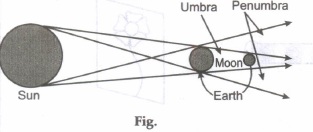
17.
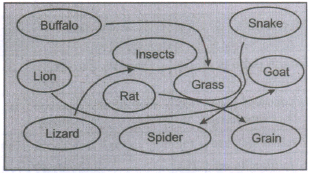
Pick five objects from the word box given in Fig. which are opaque and would sink in water.
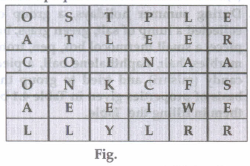
18.
How are synthetic fibres more advantageous and economical than natural fibres?
19.
How many bones does middle finger have?
20.
In places, such as the mountains, where temperatures get very low during winters, the plastic pipes meant for water transportation break. Why do you think it happens?
21.
What is sedimentation? Give an example.
22.
Boojho kept a magnet close to an ordinary iron bar. He observed that the iron bar attracts a pin as shown in figure.

What inference could he draw from this observation? Explain.
23.
Why should we not burn plastic items?
24.
Why do bulbs have two terminals?
25.
A transparent glass window appears hazy when not wiped off regularly. Can you suggest a reason?
26.
List some characters which make birds the flying.
27.
Differentiate between a shadow and an image.
28.
Take out a cooled bottle of water from refrigerator and keep it on a table. After sometime you notice a puddle of water around it, why?
29.
Will the measurement of a room using foot of different persons be equal or not?
30.
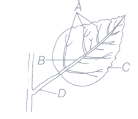
Identify A, B, C and D the figure given below.
31.
Tasty food is not always nutritious and nutritious food may not always be tasty to eat. Comment with examples.
32.
Can you identify the major ingredients of pizza. Which of the ingredients of pizza
(a) come from plants
(b) do not come from plants
33.
Corn is separated from husk by the process of
Sieving
Winnowing
Churning
Handpicking
34.
The part of the stem in between two successive nodes is_________?
Pistil
Root
Node
Internode
35.
_________is the positive terminal of an electric cell.
Metal disc
Metal case
Metal cap
Metal base
36.
A fluid forming an incompressible skeleton is found in____________.
frog
fish
snail
earthworm
37.
Twisting of fibres makes them:
Colourful
Soft
Strong and soft
Longer and stronger
38.
Which among the following are commonly used for making a safety pin?
Wood and glass
Plastic and glass
Leather and plastic
Steel and plastic
39.
Salt can be separated from its solution (salt dissolved in water), because:
Mixing of salt in water is a change that can be reversed by heating and melting of salt
Mixing of salt in water is a change that can not be reversed
Mixing of salt in water is a permanent change
Mixing of salt in water is a change that can be reversed by evaporation
40.
By which device you can see image of sun?
Telescope
Periscope
Pinhole camera
Plane mirror
41.
One decametre is equal to
10cm
10mm
10m
10km
42.
Which one of the following is not a method of disposal of garbage?
Composting
Vermicomposting
Cycling
Landfill
43.
Magnets have a shape of
cylindrical
horse-shoe
ball-ended magnet
All of these
44.
What is not true about air?
It makes the windmill rotate
It helps in the movement of aeroplanes
Birds can fly due to presence of air
It has no role in water cycle
45.
Which of the following is an incorrect statement about excretion?
Excretion takes place in plants.
Excretion takes place both in plants and animals.
Excretion is the process of getting rid of excess water only.
Secretion is one method of excretion.
46.
Which one is the purest form of water?
River water
Groundwater
Rainwater
Ocean water
47.
Read the food items given below.
(i) Wheat
(ii) Ghee
(iii) lodised salt
(iv) Spinach (palak)
Which of the above food items are energy giving foods?
(i) and (iv)
(ii) and (iv)
(i) and (ii)
(iii) and (iv)
48.
Honeybee makes honey from
pollen
petals
nectar
bud
49.
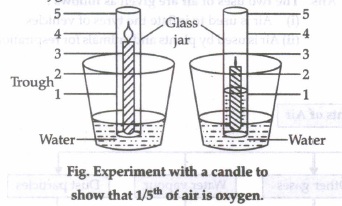
Give an experiment to show that one-fifth of air is oxygen.
50.
Chalk, iron nail, wood, aluminium, candle, cotton usually look different from each other. Give some properties by which we can prove that these materials are different.
51.
Classify the following fibres as natural and synthetic: Acrylic, Wool, Jute, Polyester, Rayon. Give reason also.
52.
Explain about solar eclipse and lunar eclipse. Also, give the ray diagrams.
53.
Connect the animal with the food it eats by an arrow using different colours in Fig. One is done for you.
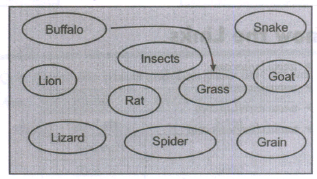
54.
How can we find the length of a curved line? Explain.
55.
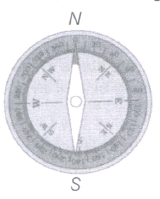
Given below is a figure which shows a magnetic compass. Briefly explain what will happen to the position of its needle if you bring a bar magnet near it. Also, draw a diagram to show the effect on the needle on bringing the bar magnet near it. Also, draw the diagram to show the effect when the other end of the bar magnet is brought near it.
56.
Municipality provides two types of dustbins for garbage collection. One blue coloured and one green coloured. Among the following wastes provided which, waste will you put in which dustbin?
Plastic materials, metal and glass items, waste of plants and animals, peels of fruits and vegetables, dried leaves and twigs, remains of meat like flesh and bones.
57.
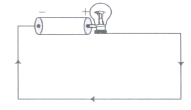
Boojho has a cell and a single piece of connecting wire. Without cutting the wire in two, will he be able to make the bulb glow? Explain with the help of a circuit diagram.
58.
Like many animals although a car also moves it is not considered as a living organism. Give two or three reasons.
59.
Rishi was playing football with his friends. While playing football he fell down and started crying. On seeing him crying, his friends rushed to him and found that he was unable to move his right leg. His friends took him to his house. His father immediately rushed him to a doctor. Doctor diagnosed that his leg was fractured.
(a) Can you suggest, how did doctor diagnose in Rishi's leg?
(b) What do X-rays show us?
(c) What are the values shown by Rishi's friends?
60.
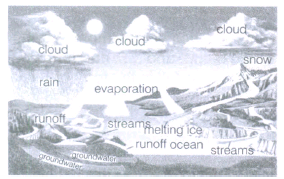
Draw a diagram to show how sea water reaches a lake or pond?
61.
Paheli mixed flour and water and
(a) made a dough,
(b) rolled the dough to make a chapati,
(c) baked the chapati on a pan,
(d) dried the chapati and ground it in a grinder to make powder.
Identify the changes (a) to (d) as the changes that can be reversed or that cannot be reversed.
62.
Observe figure and attempt the questions that follow it.
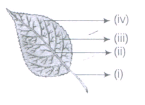
(a) Label the parts (i), (ii), (iii) and (iv) in the figure.
(b) What type of venation does the leaf has?
(c) What type of venation is seen in grass leaves?
63.
Paheli was feeling thirsty but there was only a pot of water at home which was muddy and unfit for drinking. How do you think Paheli would have made this water fit for drinking if the following materials were available to her?
Alum, tub, muslin cloth, gas stove, thread, pan and lid.
64.
Radha came back from school hungry and went to her mother in kitchen. Radha's mother was peeling vegetables. She noted that the peels were very thick and her mother then started washing vegetables. Radha asked her to stop washing the vegetables. Her mother was surprised and asked why? Radha told her all she knew about how nutrients are washed away if we peel and then wash them?
(a) If thick peels are removed from vegetables, what happens?
(b) Washing of vegetables after peeling is not a good practice. Can you tell why?
(c) What are those components that get washed away?
(d) Give two examples of vitamins and minerals containing food.
(e) Do you think Radha has any values? Name them.
1.
2.
Rubber band, leaf, eraser, cooked rice and fresh chapati are soft materials because these materiaIs can be compressed or stretched easily
3.
Saree, lungi, dupatta and towel.
4.
The method of preparing compost with the help of red worms is called vermi-composting.
5.
The presence of specific features or certain habits, which enable a plant or an animal to live in its habitat comfortably, is called adaptation
6.
Water is called the universal solvent because it dissolves most of the salts and substances in it.
7.
No, all the leaves do not have petioles. Leaves without petiole are called sessile.
8.
Earthworm moves faster than snail.
9.
When you switch on the torch, the filament part of the bulb glows
10.
1% of air includes carbon dioxide (C02), water vapours , helium, hydrogen, dust particles and smoke.
11.
No, the shadows are same for different colour of object, it is always black. Some portion of the shadow may be grey.
12.
Rotational and rectilinear motion are performed during the rolling of a ball.
13.
Ice melts when it is heated. Yes, it is reversible
14.
Winnowing is based on the property that the grains are heavier than husk and hay.
15.
Carbohydrates and fats are two components of food which provide energy
16.
We cook food so that it can be used by our body easily.
17.
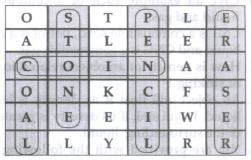
(i) Coal
(ii) Stone
(iii) Coin
(iv) Pencil
(v) Eraser
18.
Synthetic fibres are more advantageous and economical than natural fibres due to following reasons:
(i) synthetic fibres are cheap
(ii) more resistant to water
(iii) high mechanical strength
(iv) easy to wash and handle
(v) dry up quickly.
19.
Middle finger has one bone.
20.
Water pipes break because the water inside them expands as it gets close to freezing. This causes an increase in pressure inside the pipe. When the pressure gets too high for the pipe to contain, it breaks.
21.
When a mixture is allowed to stand for some time, the heavier components in the mixture settle at the bottom and the process is called sedimentation. For example, when mixture of sand and water is allowed to stand for some time, the particles of sand settle down at the bottom of vessel. The settling down of sand particles is called sedimentation.
22.
When we place any iron bar near a bar magnet, it becomes a magnet temporary and small objects like pin, iron filings can be attracted by it. But when we remove this bar from magnet, it again becomes an iron bar and does not attract the small iron objects.
23.
We should not burn plastic items because
(i) they do not bum easily.
(ii) they produce toxic gases when burned and left ire over ashes are also toxic.
(iii) they add to soil pollution.
(iv) burnt pieces may be eaten by cows which may choke them to death.
(v) toxic gases lead to many respiratory diseases.
24.
Bulb has two terminals because it is connected to the terminals of a cell or a battery so that current passes through the filament.
25.
Air is present everywhere and it contains some gases, water vapours and dust particles that stick to the window surface and are visible due to the transparency of windows.
These particles attract outdoor elements Iike pollens, etc which collect on glass window and together form a layer. That is why, transparent glass windows appear hazy if not wiped off regularly.
26.
Some characters are given below
(i) The birds have hollow bones (light weighted), their forelimbs are modified into wings.
(ii) They have sharp eye sight.
(iii) Their joints are completely fused.
27.
The dark patch of light is known as a shadow which is formed when there is an opaque object in the path of light.
When an image is the reflection of light. By seeing image, we can identify the object but shadow can mislead you from actual object.
28.
As the temperature outside the refrigerator is higher than the refrigerator. So, when the cooled bottle of water is kept on a table, water vapours gets condensed and as a result, puddle of water appears around the bottle.
29.
The measurement of a room using foot of different persons will not be equal. This is because foot steps of every person are not constant. Their distance can very time to time.
30.
The parts of a leaf are mentioned as : A - Veins B - Midrib C - Lamina D - Petiole
31.
Tasty food is not always nutritious and nutritious food may not always be tasty to eat. Certain examples in favour of the above statement are
(i) Potato chips are tasty to eat but not nutritious as they contain huge amount of fats.
(ii) Green leafy vegetables either boiled or steamed are very nutritious but not good in taste.
(iii) Certain fast foods like pizza, burger, etc., are very good to taste but are not nutritious as they contain huge amount of fat.
32.
Ingredients of pizza are maida, butter, cheese and vegetables.
(a) Maida and vegetables come from plants.
(b) Butter and cheese do not come from plants. They come from animals.
33.
(b)
Winnowing
34.
(a)
Pistil
35.
(c)
Metal cap
36.
(d)
earthworm
37.
(d)
Longer and stronger
38.
(d)
Steel and plastic
39.
(d)
Mixing of salt in water is a change that can be reversed by evaporation
40.
(c)
Pinhole camera
41.
(c)
10m
42.
(c)
Cycling
43.
(d)
All of these
44.
(d)
It has no role in water cycle
45.
(c)
Excretion is the process of getting rid of excess water only.
46.
(a)
River water
47.
(c)
(i) and (ii)
48.
(c)
nectar
49.
Take a candle and fix it at the centre of a glass vessel. Add some quantity of water in the vessel. Now place an empty dry glass jar over it. Mark five lines at an equal distance above the water surface. Now, carefully light the candle and cover the glass jar. Wait for a few seconds and how the flame will be extinguished due to absence of oxygen to bum.
Now, we can observe that the water level raised in the glass jar is 1/5 of the volume of air present in the glass jar
This experiment shows that one-fifth of air is oxygen
50.
There are following properties by which we can prove that these materials are different:
| Material | Lustre | Hardness/softness | Roughness/smoothness |
|---|---|---|---|
| Chalk | - | Soft | Rough |
| Iron nail | Lustrous | Hard | Rough |
| Wood | - | Hard | Rough |
| Aluminium | Lustrous | Hard | Smooth |
| Candle | Candle | Soft | Smooth |
| Cotton | - | Soft | Smooth |
51.
Natural fibres: Wool and Jute.
i) Wool is an animal fibre which is obtained from sheep.
ii) Jute is a plant fibre which is obtained from plant.
Synthetic fibres: Acrylic, Polyester, Rayon.
iii) These are man-made fibres which are prepared from different chemical substances.
52.
Solar Eclipse: When the sun, the earth and the moon come in a straight line with the moon in between the earth and the sun, then the shadow of the moon falls on the earth. This results in solar eclipse. Solar eclipse occurs on a new moon day.
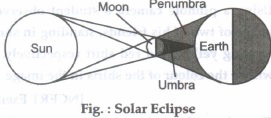
Lunar Eclipse: When the sun, the earth and the moon come in a straight line with the earth in between the moon and the sun, then the shadow of the earth falls on the moon. This results in Lunar eclipse. Lunar eclipse takes place on a full moon day. The shadow consists of two parts. One part is completely dark part of the shadow, where light does not reach from the source of light and this part is known as umbra. Other part is not completely dark, where some light reaches from the source of light and this part is known as penumbra. Penumbra surrounds the umbra.
53.
54.
Draw a curved line CD. Take a thread and make a knot at one of its ends. Keep the knot made in the thread on point C of the line. Place a small portion of the thread along the line, keeping it tight using your fingers and thumb. Keep on stretching the thread on the curved line till you take the thread to the point D of the line. Make a mark on the thread where it touches the other end of the line at point D. Now, stretch the thread along a metre scale and the length between the knot in the beginning and mark on the thread is measured through scale. This measured length on scale will give you the length of the curved line CD.
55.
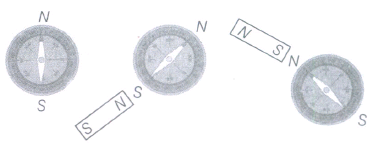
As given in figures, the North pole will be far apart when we bring more near to the compass needle and it will be closer to it when we bring the South pole towards it.
56.
The above mentioned wastes can be categorised into two categories:
(i) Green bins Wastes which can be decomposed is put in green dustbins, e.g. plants and animals waste, peels of vegetables and fruits, dried leaves, twigs, remains of meat like flesh and bones.
(ii) Blue bins Wastes which cannot be decomposed but can be recycled is put in blue dustbins, e.g. plastic materials, glass, metals, etc.
57.
This can be done by arranging the circuit as the given diagram.
One terminal should be connected to the terminal of the cell directly and other terminal can be connected using the given wire.
58.
A moving car though moves is not considered as a living organism because of the following reasons:
(i) Living organisms have the ability to move on their own, whereas a car moves by the burning of fuels like diesel and petrol.
(ii) Like all living organisms, a car does not show any other living characteristics like respiration, digestion, reproduction or growth.
59.
(a) The doctor has diagnosed the fracture by taking photographs of bones, i.e. X-ray images.
(b) X-rays show us the images and shapes of different bones in our body.
(c) Friendly behaviour, sense of responsibility and kind nature are the values shown by Rishi's friends.
60.
Sea water reaches a lake or pond is represented by a diagram:
61.
(a) Made a dough this change cannot be reversed
(b) Rolled the dough to make a chapati. This change can be reversed.
(c) Baked the chapati on a pan, this change cannot be reversed.
(d) Dried the chapati and ground it in a grinder to make powder, this change cannot be reversed.
62.
(a) In the given figure:
(i) Petiole (ii) Midrib (iii) Lamina (iv) Vein
(b) The leaf has reticulate venation, the veins in leaf occur in an irregular way forming a net-like structure.
(c) Grass leaves have parallel type of venation. The vein run parallel to each other on both sides of midrib.
63.
Paheli can make this water fit for drinking by work on following sequence:
Filtration using muslin cloth (cotton fabric).
\(\downarrow\)
Swirl with alum and leave water undisturbed for some time.
\(\downarrow\)
The clear liquid above the impurities is poured in another container(decantation).
\(\downarrow\)
Boil for 10 min in covered pan with lid.
\(\downarrow\)
Cool, filter and now, it is fit for drinking.
64.
(a) Many vegetables contain most of the nutrients just below their skin surface. Thick peeling may lead to their removal.
(b) Washing of vegetables after peeling or cutting removes the water soluble vitamins and minerals from them and lowers their nutritive value.
(c) These components are called nutrients like minerals (iron, calcium, phosporous) and vitamins (B, A, C, D, E).
(d) Vegetables like tomatoes, potatoes, green leafy vegetables, etc.
(e) Yes, Radha is sincere, observant, helpful and knowledgeable. She used her knowledge in right place and stopped her mother for doing incorrect work.

6th Standard CBSE Syllabus & Materials
6th Standard CBSE
CBSE 6th Social Science Locating Places on the Earth - New Sample Question Papers Study Material - QB365 Set A
NEW6th Standard CBSE
CBSE 6th Science A Journey Through States of Water - New Sample Question Papers Study Material - QB365 Set A
NEW6th Standard CBSE
CBSE 6th Science Temperature and its Measurement - New Sample Question Papers Study Material - QB365 Set A
NEW6th Standard CBSE
CBSE 6th Science Materials Around Us - New Sample Question Papers Study Material - QB365 Set A



CBSE 6th Standard CBSE Subjects
CBSE Standards




